Why MSPs Outsource Cybersecurity: Compliance & Value
- Gary Sinnott

- Feb 24
- 7 min read

Protecting sensitive client data is no small task for UK FinTech and Healthcare SMEs under relentless regulatory pressure. Balancing compliance and resilience with limited in-house expertise leaves many leaders searching for smarter solutions. Outsourcing to a qualified Managed Service Provider offers access to specialised cybersecurity expertise and robust protection, helping directors meet strict legal standards while reducing operational risk.
Table of Contents
Key Takeaways
Point | Details |
Importance of MSPs | Managed Service Providers are essential for organisations lacking in-house cybersecurity expertise, providing access to specialised skills and comprehensive security solutions. |
Regulatory Environment | UK regulations are evolving, creating new compliance challenges for MSPs, focusing on enhanced accountability and cybersecurity resilience. |
Strategic Benefits | Outsourcing cybersecurity to MSPs can lead to cost optimisation, immediate access to technical skills, and improved organisational resilience. |
Due Diligence | Careful evaluation of MSP partners is critical, prioritising regulatory compliance, technical capabilities, and alignment with organisational goals to avoid superficial selection. |
MSP Cybersecurity Outsourcing Explained
Managed Service Providers (MSPs) play a critical role in modern cybersecurity infrastructure, offering specialised security services that enable organisations to protect their digital assets efficiently. UK government research highlights that MSPs provide essential IT management services, including comprehensive cybersecurity solutions for businesses unable to maintain in-house expertise.
The landscape of cybersecurity outsourcing is complex and rapidly evolving. MSPs typically deliver a range of critical services designed to protect organisations from digital threats, including:
Network monitoring and threat detection
Vulnerability assessment and management
Incident response and mitigation
Compliance framework implementation
Security infrastructure maintenance
The core value proposition of cybersecurity outsourcing lies in accessing specialised expertise without the substantial overhead of building internal capabilities. Small and medium enterprises particularly benefit from this model, gaining access to enterprise-grade security resources that would otherwise be prohibitively expensive.
UK National Cyber Security Centre guidelines underscore the importance of robust security controls when outsourcing cybersecurity. These guidelines emphasise that MSPs must implement comprehensive security measures to protect not just their infrastructure, but also their clients’ digital environments.
Pro tip: When selecting an MSP, prioritise providers with demonstrable experience in your specific industry and clear, transparent security frameworks.
UK Regulatory Pressures And Risk Landscape
The United Kingdom’s cybersecurity regulatory environment is undergoing significant transformation, with emerging legislative frameworks creating unprecedented compliance challenges for Managed Service Providers (MSPs). These new regulations aim to address the growing complexity of digital security threats and systemic risks inherent in technology service delivery.
Key regulatory developments impacting MSPs include:
Mandatory cybersecurity resilience reporting
Enhanced security control requirements
Increased accountability for digital infrastructure protection
Stricter incident response and disclosure protocols
Comprehensive risk management obligations
The Cyber Security and Resilience Bill represents a critical milestone in UK cybersecurity governance. It introduces more stringent oversight mechanisms, particularly targeting MSPs who manage significant network infrastructure. By imposing mandatory reporting and implementing robust security standards, the legislation aims to mitigate potential vulnerabilities that could compromise entire digital ecosystems.

Government cyber policy research highlights that MSPs are increasingly recognised as potential attack vectors, making regulatory intervention crucial. The evolving threat landscape demands proactive, comprehensive security approaches that go beyond traditional compliance checkbox exercises.
Pro tip: Regularly review your MSP’s compliance documentation and ensure they maintain transparent, up-to-date security certifications aligned with the latest UK regulatory requirements.
Core Benefits: Cost, Skills, And Resilience
UK government research reveals that outsourcing cybersecurity to Managed Service Providers (MSPs) delivers substantial strategic advantages for organisations seeking robust digital protection. By leveraging external expertise, businesses can transform cybersecurity from a cost centre into a strategic investment that drives operational efficiency and competitive advantage.
The core benefits of cybersecurity outsourcing can be categorised into three critical dimensions:
Cost Optimisation
Reduced infrastructure investment
Lower recruitment and training expenses
Predictable monthly security expenditure
Elimination of specialised staffing overheads
Technical Skills Access
Immediate deployment of expert security professionals
Continuous training and certification maintenance
Advanced threat intelligence capabilities
Cutting-edge security technology implementation
Organisational Resilience
24/7 proactive threat monitoring
Rapid incident response mechanisms
Comprehensive risk management frameworks
Business continuity assurance
The economic rationale for outsourcing extends beyond mere cost reduction. By partnering with specialised MSPs, organisations gain access to enterprise-grade security capabilities that would be prohibitively expensive to develop internally. These providers bring comprehensive expertise, advanced technological infrastructure, and continuous learning mechanisms that single organisations struggle to maintain.
Pro tip: Conduct a thorough cost-benefit analysis comparing internal security development against MSP outsourcing, considering not just direct expenses but long-term strategic value and risk mitigation potential.
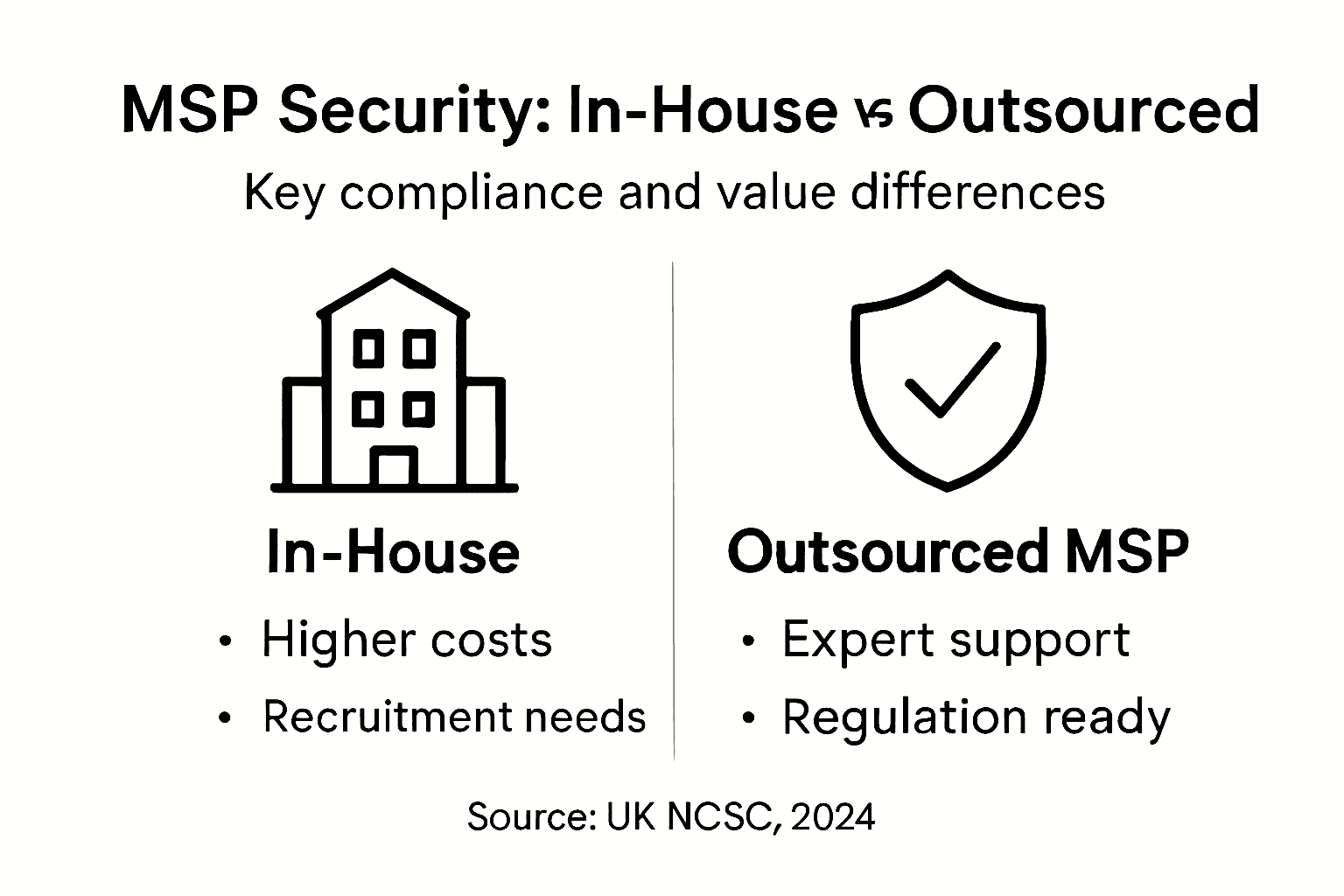
Comparing In-House Versus Outsourced Security
Professional cybersecurity analysis reveals the complex landscape of security strategy, demonstrating that the choice between in-house and outsourced cybersecurity is not a simple binary decision. Organisations must carefully evaluate their unique technological ecosystem, risk profile, and strategic objectives when determining the most appropriate security approach.
Key comparative dimensions include:
In-House Security Advantages:
Direct control over security infrastructure
Deeper understanding of internal systems
Immediate incident response capabilities
Complete data sovereignty
Outsourced Security Advantages:
Access to specialised expertise
Advanced technological capabilities
Scalable security solutions
Continuous threat intelligence
The economic implications are profound. In-house security demands substantial investment in recruitment, training, infrastructure, and ongoing skill development. Conversely, Managed Service Providers (MSPs) offer a more flexible model where organisations can leverage enterprise-grade security capabilities without the prohibitive overhead of maintaining an entire internal security team.
The strategic decision ultimately hinges on an organisation’s specific requirements, budget constraints, and risk tolerance. While some sectors demand absolute internal control, many businesses find that outsourced security provides a more pragmatic, cost-effective approach to maintaining robust digital protection.
The table below contrasts in-house versus outsourced cybersecurity using decision factors not explicitly detailed in the article:
Decision Factor | In-House Security Example | Outsourced MSP Security Example |
Initial Investment | High upfront personnel and tools | Minimal, mostly onboarding costs |
Flexibility | Slow to scale or adjust | Rapid service adaptation to threats |
Technology Refresh | Periodic, requires project funding | Continuous via provider innovation |
Talent Retention | Ongoing challenge and cost | MSP maintains expert teams |
Regulatory Monitoring | Relies on internal compliance team | Automated updates from dedicated specialists |
Pro tip: Conduct a comprehensive capability assessment comparing your internal security resources against potential MSP offerings, focusing on technical competence, response times, and alignment with your specific industry regulations.
Due Diligence, Pitfalls, And Choosing Partners
UK government guidelines emphasise the critical importance of rigorous due diligence when selecting cybersecurity partners. The process of choosing a Managed Service Provider (MSP) requires meticulous evaluation beyond surface-level cost considerations, demanding a comprehensive assessment of technical capabilities, compliance frameworks, and strategic alignment.
Key due diligence considerations include:
Regulatory Compliance Verification:
Active cybersecurity certifications
Documented compliance with NIS regulations
Transparent security policy frameworks
Regular third-party security audits
Technical Capability Assessment:
Incident response track record
Advanced threat detection capabilities
Technology stack compatibility
Scalability of security solutions
Common pitfalls organisations must carefully navigate involve superficial vendor selection processes. Many businesses make critical errors by prioritising cost over substantive security expertise, overlooking the nuanced requirements of comprehensive cyber protection. The most effective partnerships are founded on deep understanding, shared strategic objectives, and a commitment to proactive risk management.
The strategic partner selection process demands thorough evaluation, including comprehensive reference checks, detailed service level agreements, and alignment with organisational risk tolerance. Successful cybersecurity outsourcing transcends transactional relationships, requiring a collaborative approach that integrates external expertise seamlessly with internal strategic goals.
Here’s a summary of due diligence priorities when selecting an MSP partner, extending the points discussed:
Priority Area | What To Evaluate | Example Red Flag |
Industry Experience | Case studies in your sector | No sector-specific references |
Transparency | Full disclosure of security audits | Unwilling to share reports |
Incident Response Speed | Time to detect and mitigate threat | No published response times |
Third-Party Validation | Independent certifications, audits | Lapsed or missing accreditations |
Pro tip: Create a comprehensive vendor assessment matrix that scores potential MSP partners across technical capabilities, regulatory compliance, financial stability, and cultural alignment.
Strengthen Your Cybersecurity Strategy with Freshcyber’s Expert Support
The article highlights the rising challenges MSPs face with ever-tightening UK regulatory compliance and the essential need for resilient, expert-led cybersecurity. For SMEs struggling with evolving frameworks like ISO 27001, GDPR and Cyber Essentials, aligning security with business goals can feel overwhelming while managing risks and demonstrating value. Freshcyber understands these pain points and offers a tailored approach to transform compliance into a strategic asset that drives growth and builds trust.
Our vCISO-led Compliance Currency Engine ensures you do more than just meet regulatory demands. We integrate ongoing risk management, policy leadership and 24/7 active defence through our Vulnerability Management and Compliance solutions to keep your organisation secure and competitive. This means fewer audit stresses and greater confidence to win larger contracts in an increasingly complex market.

Don’t let compliance challenges slow your business down. Visit Freshcyber now to discover how our tailored cybersecurity services can provide the strategic expertise and resilience your SME needs to thrive in today’s digital landscape. Start turning compliance into your most valuable currency today.
Frequently Asked Questions
What are the main benefits of outsourcing cybersecurity to MSPs?
Outsourcing cybersecurity to Managed Service Providers (MSPs) allows organisations to access specialised expertise, reduce costs associated with in-house security teams, and gain advanced technology capabilities. This model also enhances organisational resilience through 24/7 monitoring and rapid incident response.
How do MSPs ensure compliance with cybersecurity regulations?
MSPs adhere to compliance requirements by implementing robust security frameworks, maintaining active cybersecurity certifications, and regularly undergoing third-party audits to validate their security measures. They must also stay updated with emerging regulatory standards to ensure ongoing compliance.
What factors should be considered when choosing an MSP for cybersecurity outsourcing?
When selecting an MSP, organisations should evaluate the provider’s technical capabilities, industry experience, transparency in operations, incident response times, and documented compliance with relevant regulations. Thorough due diligence, including reference checks and service level agreements, is essential.
What role do regulatory pressures play in the decision to outsource cybersecurity?
Regulatory pressures push organisations to seek external cybersecurity expertise, as new legislation often imposes stricter requirements on data protection and incident response. MSPs can help businesses meet these challenges while reducing the risk of non-compliance penalties.
Recommended
Comments