Why Cyber Essentials Matters for UK SMEs
- Gary Sinnott

- Mar 4
- 11 min read

Securing government contracts has become a race with strict rules for legal and financial SMEs. Misunderstanding Cyber Essentials as a simple checkbox exercise means missing out on valuable tenders and risking client trust. The path to Cyber Essentials Plus certification demands ongoing vigilance and third-party verification, ensuring your controls are continuously active and auditable. This article helps Compliance Officers grasp the real obligations, dispelling common myths and outlining how verified certification opens doors to contracts and builds stronger business relationships.
Table of Contents
Key Takeaways
Point | Details |
Cyber Essentials is Essential for Contracts | Certification is a legal requirement for UK government contracts and helps secure access to larger tender opportunities. |
Continuous Compliance is Crucial | Maintaining security controls year-round is necessary; certification is not a one-time effort. |
Plus Certification Enhances Trust | Cyber Essentials Plus provides independent verification, significantly increasing client confidence and market access. |
Documentation Supports Renewal | Systematic record-keeping of security practices is vital for proving compliance during renewal assessments. |
Cyber Essentials: Core Definition and Misconceptions
Cyber Essentials is a UK Government-backed certification scheme designed to protect organisations from common cyber threats. Unlike vague security frameworks, it focuses on five concrete, measurable areas that directly prevent the majority of attacks your firm is likely to face.
Here’s what the scheme actually covers:
Securing internet connections and firewalls
Protecting devices and keeping software patched
Controlling who accesses your data and systems
Deploying malware protection across your infrastructure
Maintaining ongoing security hygiene through updates and monitoring
The scheme offers two distinct pathways. You can pursue basic self-assessment, where you evaluate your own controls against the standard. Alternatively, Cyber Essentials Plus involves independent verification by accredited assessors, giving you the third-party validation that government contractors and enterprise clients now demand.
Why Misconceptions Cost You Contracts
Most SME Compliance Officers treat Cyber Essentials as a single box to tick, then move on. This approach costs you in two ways: you miss genuine security improvements, and you fail to communicate your actual capability to prospective clients.
The truth is different. Cyber Essentials requires consistent, ongoing commitment. Your firm must maintain these controls continuously, not just achieve them once and forget.
Here are common misconceptions that hold firms back:
“It’s a one-time exercise.” Reality: Controls must remain active year-round, with regular reviews and updates.
“It’s only for tech firms.” Reality: Legal and financial organisations face identical threat vectors - data theft, ransomware, credential compromise.
“Plus certification is overkill.” Reality: For government contracts and enterprise clients, Plus is now standard. Basic certification limits your market access.
“It solves all security problems.” Reality: Cyber Essentials addresses common threats but doesn’t eliminate advanced persistent threats or insider risk.
Cyber Essentials Plus demonstrates to clients that your security controls have been verified by qualified third parties, not simply self-assessed. This distinction determines whether you win enterprise contracts.
The difference between self-assessment and Plus matters enormously in your sector. When a law firm or financial services client audits your controls before engagement, they want evidence from independent assessors, not internal documentation.
Pro tip: When pursuing Plus certification, document the business case internally first - show your leadership team which government contracts become accessible and which clients require third-party verification. This framing converts compliance from a cost centre into a revenue enabler.
Mandatory Controls and Certification Types
Cyber Essentials specifies five mandatory controls that form the foundation of your security posture. These aren’t optional extras - they’re the baseline every organisation must implement to qualify for certification.
Here are the five core controls:
Internet connection security through firewalls and boundary protection
Device and software protection with anti-malware and patching
Access control to limit who can view or modify sensitive data
Malware protection across all endpoints and systems
Security updates applied consistently across your infrastructure
Each control addresses a specific attack vector your firm faces daily. Ransomware exploits unpatched systems. Credential theft targets weak access controls. Data breaches follow inadequate network segmentation. These aren’t theoretical risks - they’re the attacks actually targeting UK SMEs right now.
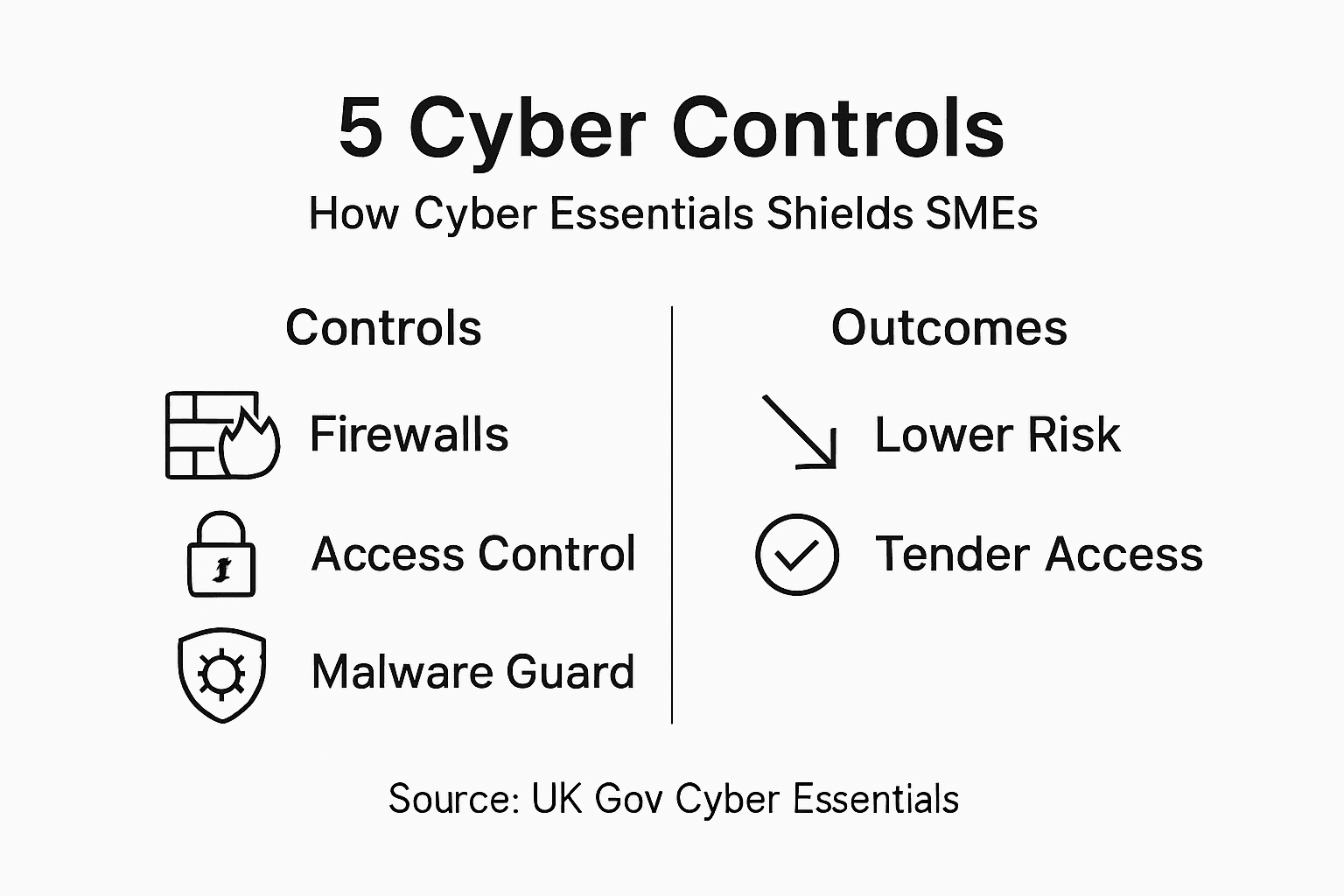
Use the following table as a reference for the five Cyber Essentials controls and the business risks they reduce:
Control Area | Example Threat Reduced | Business Outcome |
Firewall Security | Unauthorised network access | Reduced external attack risk |
Secure Configuration | Exploitation of default settings or bloatware | Minimised attack surface |
User Access Control | Credential theft and privilege escalation | Limited data exposure |
Malware Protection | Ransomware, spyware, and Trojans | Safeguard sensitive data |
Security Update Management | Exploitation of known software vulnerabilities | Stronger, resilient security posture |
Two Certification Routes
Once you understand the controls, you choose your certification pathway. The route you select determines how quickly you can win contracts and what level of client confidence you’ll achieve.
Cyber Essentials (Self-Assessment) means you evaluate your own compliance against the standard by completing a comprehensive questionnaire. While you complete the documentation internally, your submission is still independently reviewed and marked by an accredited external assessor. This path costs less and moves faster, but it relies on the assessor verifying your written answers rather than conducting a technical audit of your systems.
Cyber Essentials Plus is the advanced tier and involves a hands-on technical audit by those accredited assessors. You must pass the self-assessment first, after which the auditors will actively verify that each control works in practice, test your configurations, and perform vulnerability scans before issuing the Plus certificate. This is where IT security checklist for certification becomes critical - your auditors will methodically check every requirement.
The difference between self-assessment and Plus isn’t just paperwork. Government contracts and enterprise clients now mandate Plus certification. Basic certification closes market doors.
For compliance officers at legal and financial firms, this distinction matters enormously. Government contracts require Plus. Enterprise clients request Plus during due diligence. Self-assessment alone limits your competitive reach.
The table below compares self-assessment and Plus certification to clarify their main differences and business implications:
Aspect | Self-Assessment | Cyber Essentials Plus |
Assessment Method | Internal evaluation | Independent external audit |
Client Perception | Basic credibility | High trust signalling |
Contract Access | Limited, SMEs mainly | Essential for government, enterprise |
Audit Burden | Further client audits likely | Usually replaces audits |
Cost & Effort | Lower initial investment | Higher but with contract upside |
Why Certification Type Affects Your Market Position
Self-assessment works for baseline protection and internal governance. Plus certification signals to clients that independent experts have verified your controls actually work. This credibility translates directly into contract wins.

Most SMEs underestimate how much clients value third-party verification. When a prospective government customer reviews your security posture, they’re checking your certification status first. Plus means immediate trust. Self-assessment means additional audits and delays.
Pro tip: If you’re targeting government contracts or enterprise clients, plan for Plus certification from the start. The additional investment pays back quickly through contract access that self-assessment cannot unlock.
Legal Requirements for Government Contracts
If your firm bids on UK central government contracts, Cyber Essentials certification isn’t optional. Under Procurement Policy Note 09/14, basic Cyber Essentials is the mandatory minimum requirement for bidding on central government contracts that involve handling personal information or delivering certain IT products and services.
This requirement has teeth. Public sector organisations evaluate cybersecurity risk before awarding contracts. While basic Cyber Essentials gets you through the door for standard contracts, Cyber Essentials Plus is increasingly demanded for higher-risk contracts (such as Ministry of Defence or highly sensitive data handling) and by enterprise private-sector clients.
Here’s what the requirement actually means for your firm:
Basic Cyber Essentials is a strict pass/fail gateway for central government contracts involving sensitive citizen data.
Procurement teams verify your certification status before reviewing technical bids.
Absence of basic certification automatically disqualifies your firm from bidding on these contracts.
Cyber Essentials Plus becomes a massive competitive advantage—and often a strict requirement - when targeting higher-value public sector tiers or enterprise supply chains.
Why Government Procurement Changed
Public sector cyber incidents created new accountability. When a government supplier’s breach compromises citizen data, the reputational cost falls on the government buyer. That risk triggered a shift toward mandatory supplier certification.
Government procurement now treats cybersecurity as a contractual obligation, not a technical preference. Your firm must prove you can maintain baseline security controls before any contract discussion begins. This protects the government. It also clarifies expectations for your firm.
The Compliance Chain
For legal and financial services firms bidding on government work, this creates a specific compliance chain. Government contracts often flow to larger enterprises, who then subcontract work to smaller firms. Those subcontractors must also hold Cyber Essentials Plus certification.
Your client audits will reference government procurement standards. When a law firm or financial services organisation requests your certification status, they’re checking your government contract eligibility. This affects whether they use you as a preferred vendor.
Without Cyber Essentials Plus certification, your firm cannot bid on UK government contracts. With it, you enter a market worth billions in annual procurement spend.
The certification becomes a gateway to growth. Firms that achieve Plus early position themselves for government work whilst competitors are still planning compliance initiatives.
Statutory Obligations Beyond Procurement
Government procurement requirements also align with broader statutory obligations. Data protection legislation, financial regulation, and sector-specific compliance rules all reference cybersecurity standards. Cyber Essentials Plus demonstrates you meet these obligations without needing separate security audits.
Pro tip: Document your government contract eligibility requirements immediately. Create a timeline showing when Plus certification becomes necessary for your revenue targets. This urgency helps secure internal budget approval and accelerates your certification pathway.
Building Trust and Winning Bigger Tenders
Cyber Essentials certification isn’t just about compliance. It’s a commercial asset that directly influences tender decisions. When procurement teams evaluate your bid, they see certification as evidence that you take security seriously.
Larger clients now treat security certification as a standard evaluation criterion. Your firm’s certification status appears alongside technical capability and financial stability in tender assessments. Without it, you’re competing at a disadvantage against certified competitors.
How Certification Wins Contracts
Tender evaluations use security certification as a trust signal. It tells clients you’ve invested in measurable controls and submitted to independent verification. This reassures procurement teams that you understand their security requirements.
SMEs certified under Cyber Essentials gain credibility that helps them win larger tenders, including public sector contracts. Certification becomes a differentiator when multiple firms bid on the same work.
Here’s what certification delivers in tender evaluations:
Demonstrable commitment to baseline cybersecurity controls
Third-party verification of your security practices (Plus only)
Alignment with government procurement standards
Reduced client audit burden during due diligence
Competitive advantage in tender scoring
The Client Audit Reality
Legal and financial services clients conduct security audits before engaging SME suppliers. They use these audits to assess operational risk. Cyber Essentials Plus certification compresses this process significantly.
Without certification, clients conduct full security assessments. These can take weeks and cost thousands. Plus certification gives clients confidence that qualified third parties have already verified your controls.
Clients recognise Plus as equivalent to their audit requirements. Your certificate becomes proof of compliance, replacing lengthy questionnaires and on-site assessments.
Certification reduces your client’s audit burden and accelerates contract start dates. This speed becomes a genuine competitive advantage when clients face project timelines.
Revenue Impact from Tender Access
Firms that achieve Plus certification access tender opportunities worth significantly more than uncertified competitors. Government procurement alone represents billions in annual spending. Enterprise clients increasingly restrict vendor lists to certified suppliers.
Your certification status determines which tenders you can bid on. Many procurement processes filter out uncertified suppliers before technical evaluation. This means you never compete on capability - you’re simply excluded.
Pro tip: Include your Plus certification prominently in tender responses. Highlight it in executive summaries and bid cover letters, not buried in appendices. Procurement teams scan for certification status in the first review phase, and visible certification influences initial scoring before technical evaluation even begins.
Common Pitfalls and Continuous Compliance
Certification isn’t a finish line. Many firms achieve Cyber Essentials, then assume the work is complete. This approach costs them contracts when renewal time arrives or clients conduct audits.
Continuous compliance means maintaining controls year-round, not just meeting initial assessment requirements. Your certification expires annually, and renewal requires demonstrating that controls remained active throughout the year.
The Renewal Problem
Most SMEs underestimate what renewal demands. While Cyber Essentials is technically a "point-in-time" assessment - meaning the assessor evaluates your compliance on the specific day you submit or are audited - you cannot simply cram for it at the last minute.
If you let patches lapse, allow staff to operate as local administrators all year, and ignore new devices, fixing all of this in the two weeks before your renewal is practically impossible. Firms that take shortcuts initially face a chaotic, expensive scramble when renewals arrive.
Here are the pitfalls that derail compliance officers:
Treating certification as a one-time achievement rather than an ongoing operational standard.
Failing to involve senior management in compliance maintenance.
Neglecting software updates and patches between assessments.
Not updating the asset inventory when new devices or cloud services are purchased.
Assuming last year’s answers will automatically pass this year’s stricter assessment criteria.
Continuous Compliance as Your Safety Net
Because Cyber Essentials Plus involves a hands-on technical audit, any lapsed controls will be instantly exposed by the assessor's vulnerability scans. If a single laptop is missing a critical 14-day patch on the day of the audit, you fail.
Your firm needs a systematic approach to security activities year-round: automated patching, enforced access controls, and regular policy reviews. Legal and financial services firms already maintain strict operational discipline for regulatory purposes. Your IT security should follow the same rhythm.
Renewal failures happen not because the assessment requires 12 months of historical logs, but because abandoned, unmanaged IT systems will inevitably fail a live technical audit. Continuous compliance is your only safety net against a failed renewal.
Renewal failures happen not because controls failed, but because you can’t prove they worked. Documentation is your evidence.
Senior Management Involvement
Compliance officers often manage certification alone, without leadership visibility. This creates risk. When renewal time arrives, executives aren’t aware of the commitment required to maintain certification.
Effective certification renewal relies on understanding pitfalls and involving senior management in ongoing compliance. Budget decisions, policy approvals, and staffing allocations all flow from leadership. Without their engagement, compliance becomes unsustainable.
Involve your executive team in quarterly compliance reviews. Show them renewal timelines. Connect compliance investment to contract wins and client satisfaction.
Pro tip: Schedule your renewal assessment 60 days before expiry, not 30 days. This buffer gives you time to remediate any gaps auditors identify before your certificate expires. Waiting until the last month eliminates your margin for error and risks losing certification between assessments.
Elevate Your SME’s Security with Expert Cyber Essentials Support
Understanding the critical importance of Cyber Essentials for UK SMEs means recognising the challenges of continuous compliance, third-party verification, and obtaining Cyber Essentials Plus certification to unlock government and enterprise contracts. You need more than a one-time tick-box exercise - your firm requires a strategic partner to transform security obligations into a competitive business advantage.
Freshcyber provides exactly this through our Cyber Essentials expertise and comprehensive SME Security approach. We help your legal or financial firm maintain ongoing certification readiness, manage risk dynamically, and present your security posture with confidence that resonates with clients and procurement teams alike.
Don’t let Cyber Essentials become a compliance burden that limits your growth. Partner with Freshcyber at https://freshcyber.co.uk to access the vCISO-led Compliance Currency Engine and 24/7 active defence capabilities. Act now to secure your spot at the top of tender lists and convert digital resilience into winning contracts.
Frequently Asked Questions
What is Cyber Essentials?
Cyber Essentials is a UK Government-backed certification scheme that helps organisations protect against common cyber threats by focusing on five key security controls.
Why do SMEs need Cyber Essentials certification?
SMEs need Cyber Essentials certification to demonstrate a commitment to cybersecurity, improve security posture, and gain access to government contracts and enterprise clients that require certification.
What are the five mandatory controls of Cyber Essentials?
The five mandatory controls include securing internet connections, protecting devices and software, controlling data access, deploying malware protection, and maintaining ongoing security updates and monitoring.
How does Cyber Essentials Plus differ from the basic certification?
Both levels require your submission to be independently reviewed and marked by an accredited third-party assessor. However, basic Cyber Essentials relies on the assessor verifying your written answers and policies. Cyber Essentials Plus goes a step further by involving a hands-on technical audit, where the assessor actively tests your systems (e.g., via vulnerability scans and malware execution tests) to prove those security measures are effectively implemented in practice.
Recommended
Comments