Guide to Vulnerability Management: 60% Incident Reduction for UK SMEs


Your compliance audit is next month, but your vulnerability register is a mess. Patches are overdue, risks are unquantified, and your board is asking why security keeps failing the same checks. Without executive ownership and a strategic approach, vulnerability management becomes an endless cycle of firefighting rather than a competitive advantage. A vCISO-led program transforms this chaos into measurable resilience, aligning security with the compliance frameworks that win you contracts.
Table of Contents
Key Takeaways
Point | Details |
Incident Reduction | Effective vulnerability management aligned with ISO 27001 reduces security incidents by up to 60% within the first year. |
Detection Enhancement | Hybrid scanning plus manual penetration testing improves detection rates by 30% compared to automated tools alone. |
Executive Ownership | vCISO-led programs mitigate 40% of common failure causes through strategic leadership and accountability. |
Audit Efficiency | Integration with Cyber Essentials Plus cuts audit rework by 50%. |
Remediation Success | Median remediation timelines target 45 days with 85% first attempt success rates. |
Introduction to Vulnerability Management for UK SMEs
Vulnerability management is the continuous process of identifying, assessing, prioritising, and remediating security weaknesses across your digital infrastructure. For UK SMEs in regulated sectors, this isn’t just good practice; it’s a compliance requirement embedded in frameworks like ISO 27001:2022 and Cyber Essentials Plus. Without systematic vulnerability management, you risk failed audits, data breaches, and lost contracts.
The business case is clear. ISO 27001 compliance requirements mandate ongoing risk assessment and control effectiveness monitoring. Legal, financial, and healthcare firms face particularly stringent demands from clients and regulators. Yet most SMEs struggle because they treat vulnerability management as a technical tick box exercise rather than a strategic business enabler.
Digital resilience starts with knowing where you’re exposed. A robust vulnerability management program provides the evidence base for board decisions, client assurance, and regulatory confidence. When implemented with vCISO leadership, it becomes the foundation for competitive advantage rather than compliance burden.
Key elements of effective vulnerability management include:
Continuous automated scanning of networks, applications, and cloud environments
Quarterly manual penetration testing to validate real world exploitability
Risk based prioritisation aligned with business impact and compliance obligations
Documented remediation workflows with clear ownership and timelines
Regular reporting to senior leadership and audit committees
For UK SMEs competing for enterprise contracts, vulnerability management proves you take security seriously. Clients increasingly demand evidence of proactive threat mitigation. Your ability to demonstrate systematic vulnerability control directly influences tender success rates and contract values.
Prerequisites: What You Need Before Starting Vulnerability Management
Before launching a vulnerability management program, you need the right organisational foundations. Without executive sponsorship, clear ownership, and baseline capabilities, even the best tools will fail. The importance of executive sponsorship cannot be overstated; approximately 40% of program failures stem from lack of leadership commitment.
Appoint a vCISO or equivalent security leader with direct board access. This role owns the vulnerability management strategy, risk register, and remediation prioritisation. They translate technical findings into business language and ensure security decisions align with commercial objectives. Without this strategic layer, vulnerabilities get logged but never fixed.
Your technical foundation requires both automated and manual capabilities. Vulnerability scanning tools provide continuous monitoring, but manual penetration testing validates whether discovered weaknesses are genuinely exploitable. Invest in tools that integrate with your existing infrastructure rather than creating data silos.
Establish a dynamic risk register that documents identified vulnerabilities, their business impact, assigned owners, and remediation status. This register becomes your single source of truth for audit evidence and board reporting. Update it weekly at minimum; stale data undermines stakeholder confidence.
Baseline cybersecurity hygiene is non negotiable:
Functional patch management processes with documented testing and deployment procedures
Asset inventory covering all network connected devices, applications, and cloud services
Access control policies that limit administrative privileges
Backup and recovery capabilities tested quarterly
Incident response plan with defined escalation paths
Pro Tip: Start small with critical assets first. Attempting organisation wide vulnerability management without proving value on core systems overwhelms resources and creates failure fatigue. Demonstrate quick wins, then expand scope systematically.
Step-by-Step Vulnerability Management Process for UK SMEs
Implementing vulnerability management requires a structured workflow that balances thoroughness with business pragmatism. This process integrates vCISO leadership with technical execution, ensuring compliance alignment throughout. Follow these steps to build a program that satisfies auditors while protecting your business.
First, establish executive ownership and governance. Your vCISO chairs a monthly vulnerability review meeting attended by IT leadership, compliance officers, and relevant business unit heads. This forum prioritises remediation based on business impact rather than technical severity scores alone. Document decisions in meeting minutes for audit evidence.
Second, implement continuous automated scanning across all environments. Configure scans to run weekly against production systems during maintenance windows. Vulnerability management workflow best practices recommend authenticated scans that check patch levels and configuration settings, not just external port exposure. Supplement with quarterly manual penetration tests conducted by qualified ethical hackers.

According to NCSC vulnerability management guidance, implementing continuous vulnerability scanning combined with manual penetration tests provides a 30% higher detection rate of exploitable weaknesses compared to automated scans alone. This hybrid approach catches logic flaws and business context vulnerabilities that automated tools miss.
Third, prioritise vulnerabilities using your risk register. Map each finding to potential business impact, regulatory requirements, and exploit likelihood. Step-by-step vulnerability assessment frameworks help structure this analysis. Critical vulnerabilities affecting compliance controls or client data demand immediate attention; low severity findings on isolated systems can be scheduled for routine maintenance.
Fourth, execute remediation following strict workflows. Assign each vulnerability to a named owner with a documented completion date. For critical items, implement patches within 7 days after testing in a non production environment. Track remediation status in your risk register and escalate overdue items to the vCISO for board visibility.
Research shows that SMEs implementing vulnerability scanning workflow integrated with Cyber Essentials Plus audit efficiency streamline audit processes and reduce rework by 50%. This integration ensures your vulnerability data directly supports compliance evidence requirements.
Fifth, report regularly to stakeholders. Produce monthly vulnerability metrics for senior management covering new findings, remediation rates, overdue items, and trend analysis. Tailor quarterly reports for audit committees to demonstrate compliance with ISO 27001 control requirements.
Process Stage | Timeline | Success Metric |
Automated Scanning | Weekly | 95% asset coverage |
Manual Penetration Testing | Quarterly | Zero critical findings undetected |
Critical Remediation | 7 days | 90% completion rate |
High Risk Remediation | 14 days (CE Maximum) | 100% compliance |
Board Reporting | Monthly | 100% on time delivery |
Pro Tip: Integrate vulnerability remediation with your change management process. Treating patches as informal updates creates configuration drift and breaks audit trails. Formal change tickets with testing evidence and rollback plans protect both security and stability.
Common Mistakes and How to Avoid Them in Vulnerability Management
Even well intentioned vulnerability management programs fail when organisations repeat common mistakes. Understanding these pitfalls and their solutions protects your investment and compliance posture. Research indicates that lack of executive ownership alone causes approximately 40% of program failures.
The single biggest mistake is treating vulnerability management as a purely technical exercise. When IT teams scan and report findings without strategic oversight, vulnerabilities get logged but never fixed. Business priorities override security concerns, and your risk register becomes a liability rather than an asset. Fix this by appointing a vCISO who owns the program and has authority to escalate unresolved risks to board level.
Over reliance on automated scanning without manual validation creates false confidence. Automated tools generate high volumes of findings but cannot assess real world exploitability or business context. You waste resources patching theoretical vulnerabilities while missing genuine threats. Balance automated scanning with quarterly manual penetration testing conducted by skilled practitioners who understand attacker methodologies.
Delayed patch testing and remediation exponentially increases breach risk. Many SMEs discover vulnerabilities but delay fixes for months due to change freeze windows or resource constraints. According to NCSC guidance on common pitfalls, the median time between vulnerability disclosure and active exploitation is 7 days for critical flaws. Implement rigorous testing processes that enable rapid patching without compromising stability.
Ignoring supply chain vulnerabilities threatens both security and compliance. Your vulnerability management scope must extend to third party systems that process your data or connect to your network. Vendors with poor security practices create backdoors into your environment. Require evidence of vulnerability management from all suppliers and include security obligations in contracts.
Misalignment with compliance audit requirements causes excessive rework and failed certifications. If your vulnerability data doesn’t map to ISO 27001 controls or Cyber Essentials Plus requirements, you duplicate effort maintaining separate evidence sets. Design your vulnerability management process from the start to generate audit ready documentation. Best practices to avoid mistakes include maintaining traceability between vulnerabilities, risk register entries, and compliance controls.
Failure to validate remediation effectiveness wastes resources and creates false security. Simply applying a patch doesn’t guarantee the vulnerability is fixed; configuration errors, incomplete updates, or environmental conflicts can leave systems exposed. Implement remediation correctly by rescanning systems after patching and verifying vulnerability closure before marking items complete.
Expected Results and Outcomes of a vCISO-Led Vulnerability Management Program
Setting realistic expectations helps you measure success and maintain stakeholder confidence. A well executed vulnerability management program delivers measurable security improvements and compliance benefits within defined timelines. Understanding typical outcomes guides resource planning and board communications.
Average remediation timelines for UK SMEs following structured processes should aggressively target compliance framework requirements. To maintain Cyber Essentials and Cyber Essentials Plus certification, all High and Critical vulnerabilities (CVSS 7.0 and above) must be remediated within 14 days of a patch release. A mature vCISO-led program will push this further, targeting 7 days for Critical vulnerabilities affecting sensitive data, while ensuring strict adherence to the 14-day maximum for High-risk items. Medium and low-severity findings can extend to 30 or 90 days based on business priorities and risk acceptance. These timelines assume adequate resourcing and executive support.
Success rates for first attempt remediation typically reach 85% when patches are tested in non production environments before deployment. The remaining 15% require additional investigation due to compatibility issues, configuration conflicts, or architectural constraints. Track these metrics monthly to identify patterns suggesting process improvements or training needs.
The most significant outcome is security incident reduction. Research shows that effective vulnerability management programs aligned with ISO 27001 security incident reduction can reduce security incidents by up to 60% within the first year of implementation. This reduction translates directly to lower breach costs, reduced insurance premiums, and improved client confidence.
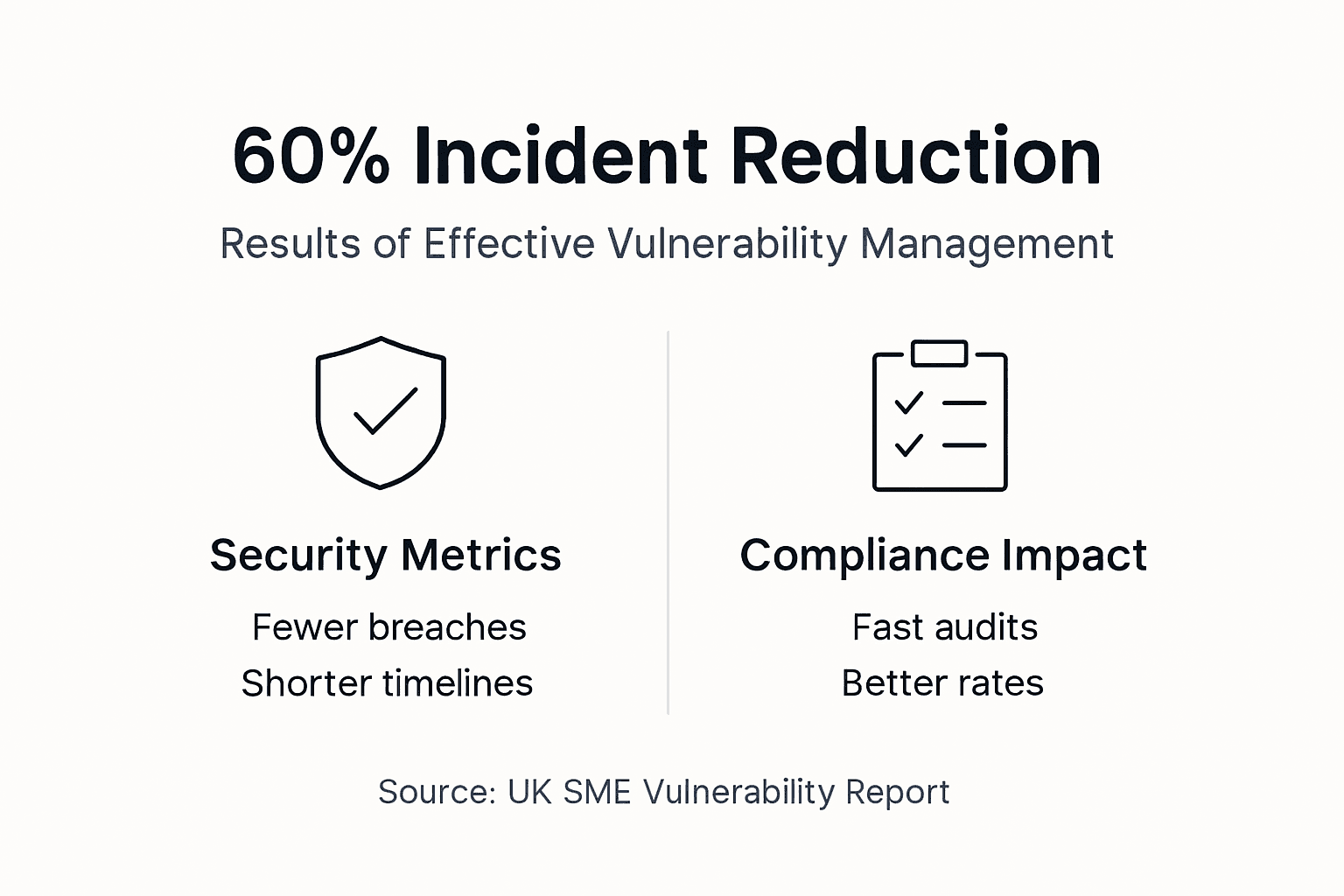
Audit efficiency improves dramatically when vulnerability management integrates with compliance frameworks. SMEs report 50% reductions in audit rework when vulnerability data maps directly to Cyber Essentials Plus and ISO 27001 control requirements. Your auditors spend less time requesting evidence and more time validating control effectiveness.
Incident response times accelerate by approximately 35% with vCISO leadership coordinating between vulnerability management, threat intelligence, and remediation teams. This coordination ensures critical vulnerabilities receive immediate attention when active exploitation is detected in the wild.
Metric | Baseline (No Program) | Year 1 Target | Typical Achievement |
Security Incidents | 12 per year | 5 per year | 60% reduction |
Critical Vulnerability Dwell Time | 180 days | 7 days | 95% compliance |
Audit Rework Hours | 120 hours | 60 hours | 50% reduction |
Remediation Success Rate | 60% | 85% | 85% achievement |
Board Confidence Score | 4/10 | 8/10 | Measurable improvement |
“Implementing vCISO-led vulnerability management transformed our compliance posture. We went from failed Cyber Essentials Plus audits to first time ISO 27001 certification within 18 months. The structured approach gave our board confidence that security was genuinely managed, not just reported.”
These outcomes require sustained commitment and adequate resourcing. Expecting immediate results creates disappointment; vulnerability management is a continuous improvement discipline that compounds benefits over time. ISO 27001 benefits for SMEs extend beyond security to include operational efficiency, risk reduction, and competitive advantage in regulated markets.
Conclusion and Next Steps with vCISO Partnership
Vulnerability management transforms from compliance burden to competitive advantage when led by strategic security leadership. The evidence is clear: vCISO-led programs reduce incidents by 60%, accelerate remediation by 35%, and cut audit rework in half. These outcomes stem from executive ownership, hybrid scanning methodologies, and integration with compliance frameworks like ISO 27001 and Cyber Essentials Plus.
Your next steps depend on current maturity. If you lack vulnerability management entirely, start with executive sponsorship and baseline scanning capabilities. If you have tools but no strategy, appoint a vCISO to own prioritisation and remediation workflows. If your program exists but underperforms, audit it against the common mistakes outlined above.
The strategic approach outlined here requires expertise most SMEs don’t maintain internally. Partnering with a specialist vCISO service provides the leadership, processes, and audit readiness needed to turn vulnerability management into genuine business resilience.
Enhance Your SME’s Security with Freshcyber’s vCISO Services
Ready to transform vulnerability management from tick box exercise to competitive advantage? Freshcyber’s vCISO services for UK SMEs provide the strategic leadership and technical capability outlined in this guide. Our Compliance Currency Engine integrates vulnerability management with ISO 27001, Cyber Essentials Plus, and your broader cybersecurity compliance frameworks, delivering audit ready evidence under a single predictable subscription.

We don’t just advise; we take full ownership of your security roadmap. Our 24/7 MDR service provides continuous monitoring and active threat containment while our vCISO team manages the strategic programme. Learn more about our proven vulnerability management process guide and discover how compliance becomes currency for growth.
Frequently Asked Questions
What is the main role of a vCISO in vulnerability management?
A vCISO provides executive leadership and strategic direction for vulnerability management programs. They own risk prioritisation, coordinate between technical and business teams, ensure compliance alignment, and escalate unresolved vulnerabilities to board level. This strategic oversight addresses the 40% of program failures caused by lack of executive sponsorship.
How often should manual penetration testing be performed?
Perform manual penetration testing quarterly to validate automated scan findings and identify business logic vulnerabilities. Critical infrastructure changes or major application updates warrant additional testing outside the quarterly schedule. Quarterly cadence balances thorough validation with resource constraints typical of UK SMEs.
Can SMEs rely solely on automated vulnerability scanning?
No. Automated scanning provides continuous monitoring and broad coverage but misses context specific vulnerabilities and real world exploitability. Research shows hybrid approaches combining automated scanning with manual penetration testing achieve 30% higher detection rates. Both capabilities are essential for effective vulnerability management.
What are typical remediation timelines SMEs should target?
If you are pursuing Cyber Essentials or Cyber Essentials Plus, the standard is non-negotiable: all High and Critical vulnerabilities must be patched within 14 days. A mature vulnerability program targets 7 days for critical vulnerabilities affecting sensitive data to stay well ahead of this deadline. Medium severity findings typically target 30 days, while low severity items can extend to 90 days. Tracking these metrics ensures a high first-attempt success rate and guarantees you never fail a compliance audit due to an overdue patch.
How does vulnerability management integrate with compliance audits?
Vulnerability management provides evidence for multiple ISO 27001 controls including risk assessment, asset management, and access control. When properly structured, your vulnerability register, remediation workflows, and reporting directly satisfy audit requirements. This integration reduces audit preparation time by 50% and eliminates duplicate documentation efforts.
Recommended
Comments