Remediation in Cybersecurity: Securing SME Compliance


Finding and fixing digital vulnerabilities before attackers have a chance is a daily challenge for SMEs operating in finance and e-commerce across the United Kingdom. Remediation is the process of identifying, assessing, and mitigating weaknesses that could compromise data, customer trust, or compliance. For British organisations, mastering remediation is not just a technical safeguard, but a vital step towards regulatory confidence and protecting your reputation. This guide explains proactive remediation strategies tailored for compliance officers who need to prioritise risks and document every fix to meet legal and audit standards.
Table of Contents
Key Takeaways
Point | Details |
Importance of Timely Remediation | Rapid identification and fixing of vulnerabilities is crucial to prevent breaches and safeguard customer trust. |
Structured Remediation Process | A clear, documented remediation process is essential for compliance and effective risk management. |
Prioritisation of Vulnerabilities | Focus on high-impact vulnerabilities first, assessing based on risk and exploitability to optimise resource allocation. |
Documentation is Key | Maintaining thorough records of remediation actions ensures accountability and supports regulatory compliance efforts. |
Remediation in Cybersecurity Explained
When a vulnerability exists in your systems, time matters. A lot. Remediation is the structured process of identifying, assessing, and mitigating those security weaknesses before attackers can exploit them. For UK-based SMEs in finance and e-commerce, this isn’t just about ticking compliance boxes. It’s about preventing the breach that could damage your reputation, drain your resources, and violate customer trust in a single attack.
At its core, remediation is proactive defense. The term covers everything from discovering that a software patch is missing on a critical server to systematically fixing all the security flaws in your cloud infrastructure. Vulnerability remediation focuses on timely fixing of weaknesses that could be exploited by malicious actors, meaning you’re not just identifying problems, you’re closing them before they become disasters. Think of it like discovering a crack in your shop window. You don’t just note it exists. You fix it immediately because you know someone could use it as entry point. The same logic applies to your digital infrastructure. Every unpatched server, every misconfigured permission, every outdated password policy is a potential entry point.
What separates effective remediation from reactive firefighting is the business-driven approach. When you find a vulnerability, you can’t fix everything at once, so your strategy needs to prioritise based on risk and impact. A flaw in your customer payment system demands urgent attention. A minor issue in an unused test environment can wait. This is where how to implement vulnerability remediation for your business becomes critical—you need a framework that assesses which vulnerabilities pose the greatest threat to your operations and customer data. That framework typically involves containment (isolating affected systems to stop attackers moving further), validation (confirming the threat is actually contained), and restoration (bringing systems back online safely with verified security fixes applied).
For compliance frameworks like ISO 27001, Cyber Essentials, and PCI DSS, remediation is non-negotiable. Regulators and auditors want to see that you’ve identified weaknesses and fixed them within defined timeframes. They want evidence that you have immutable backups to restore from if needed, and that you’re not just rushing to patch systems and accidentally introducing new problems. Financial institutions and e-commerce businesses face particular scrutiny here—your customers’ payment data and personal information depend on your remediation processes working properly. The difference between secure remediation and rushed recovery is the difference between preventing the same breach from happening twice versus accidentally creating new vulnerabilities while trying to fix the first one. That’s why having a strategic partner who understands both the technical fixes and the compliance requirements makes such a difference.
Pro tip: Create a vulnerability remediation register that tracks not just what was found and fixed, but the timescale in which you fixed it and why—this documentation proves to auditors that your remediation process is deliberate and risk-based, not random or reactive.
Types of Cybersecurity Remediation Actions
Not all remediation actions are created equal. Some address immediate threats, others prevent future ones. Understanding the different types of remediation actions available to your organisation helps you respond effectively when vulnerabilities are discovered. For UK-based SMEs handling sensitive financial data and customer transactions, knowing which action to take and when can be the difference between a contained incident and a full-scale breach.
Remediation actions fall into two broad categories: permanent fixes and temporary controls. Direct and permanent fixes such as patching vulnerabilities, updating configurations, removing malicious code, and restoring data integrity are your primary weapons against known threats. When you patch a critical vulnerability in your e-commerce platform, you’re implementing permanent remediation. When you update user access permissions after discovering someone left the system with excessive privileges, that’s remediation too. These actions address the root cause, not just the symptom. On the other hand, temporary risk reduction measures like adding firewall rules or isolating a compromised system are mitigation strategies, not remediation. You might isolate an infected server immediately to stop an attack spreading (mitigation), but then you need to remove the malware and restore the system properly (remediation). Both matter, but they serve different purposes in your response timeline.
The specific remediation actions you’ll typically encounter depend on the threat type. Common remediation responses include software patching (updating code to fix known vulnerabilities), system reconfigurations (changing settings to secure systems properly), access control adjustments (ensuring people only access what they need), and credential rotations (replacing passwords and keys that may be compromised). For malware infections, remediation means detecting and removing the malicious code entirely, not just quarantining it. For ransomware attacks, remediation involves rapid blocking of attacker communication channels and restoring files from clean backups. For machine-to-machine attacks targeting your APIs or integrations, remediation includes enforcing stronger authentication and managing cryptographic keys properly. The key principle remains consistent across all threat types: you’re addressing the vulnerability or compromise at its source, not just treating the symptoms. This is why 7 proven vulnerability management best practices emphasise the importance of prioritising remediation actions based on severity, exploit availability, and business impact rather than treating everything as equally urgent.
Here’s a quick reference to common remediation actions and their downstream business impacts for UK SMEs:
Remediation Action | Primary Objective | Typical Impact on Business |
Patching software | Remove vulnerability | Prevents breach, ensures compliance |
Reconfiguring systems | Secure configurations | Reduces attack surface, improves stability |
Rotating credentials | Replace compromised passwords | Protects sensitive data, limits unauthorised access |
Removing malicious code | Eliminate active threats | Restores integrity, avoids operational disruption |
Adjusting access controls | Enforce least privilege | Minimises insider risk, safeguards critical data |
Restoring from backups | Recover clean versions | Rapid recovery, minimises downtime |
Strengthening authentication | Block machine-to-machine exploits | Secures APIs, preserves transaction reliability |
Prioritisation is essential because most organisations cannot remediate every vulnerability simultaneously. Your payment processing systems and customer data repositories demand immediate attention. Non-critical test environments can wait. A vulnerability that active exploits already target in the wild requires faster action than one that’s theoretical. A flaw affecting 50 users needs different handling than one affecting 500. Your finance and e-commerce teams depend on systems running smoothly, so emergency remediation actions (those completed within hours or days) focus on high-impact, high-severity issues. Standard remediation actions (completed within weeks) address moderate-risk vulnerabilities, whilst lower-priority remediation (completed within months) handles vulnerabilities with minimal business impact. Many SMEs make the mistake of treating every remediation request the same way. That approach burns out your technical team and leaves the actual critical risks unaddressed for longer. A structured prioritisation framework tied to your risk register ensures your remediation efforts hit the highest-impact vulnerabilities first.

Pro tip: Document every remediation action taken, including what was fixed, when it was fixed, and who verified it was successful - this evidence trail is gold during compliance audits and proves you’re managing vulnerabilities proactively rather than reactively.
Key Steps in the Remediation Process
Remediation doesn’t happen by accident. It requires a structured approach where each step builds on the previous one. Without a clear process, your remediation efforts become chaotic - patches get applied without proper testing, systems are restored without verification, and you end up creating new problems whilst trying to fix old ones. For compliance officers at UK SMEs, having a documented remediation process isn’t just best practice, it’s an audit requirement. Regulators want to see that you follow a consistent methodology, not that you react differently to each incident.
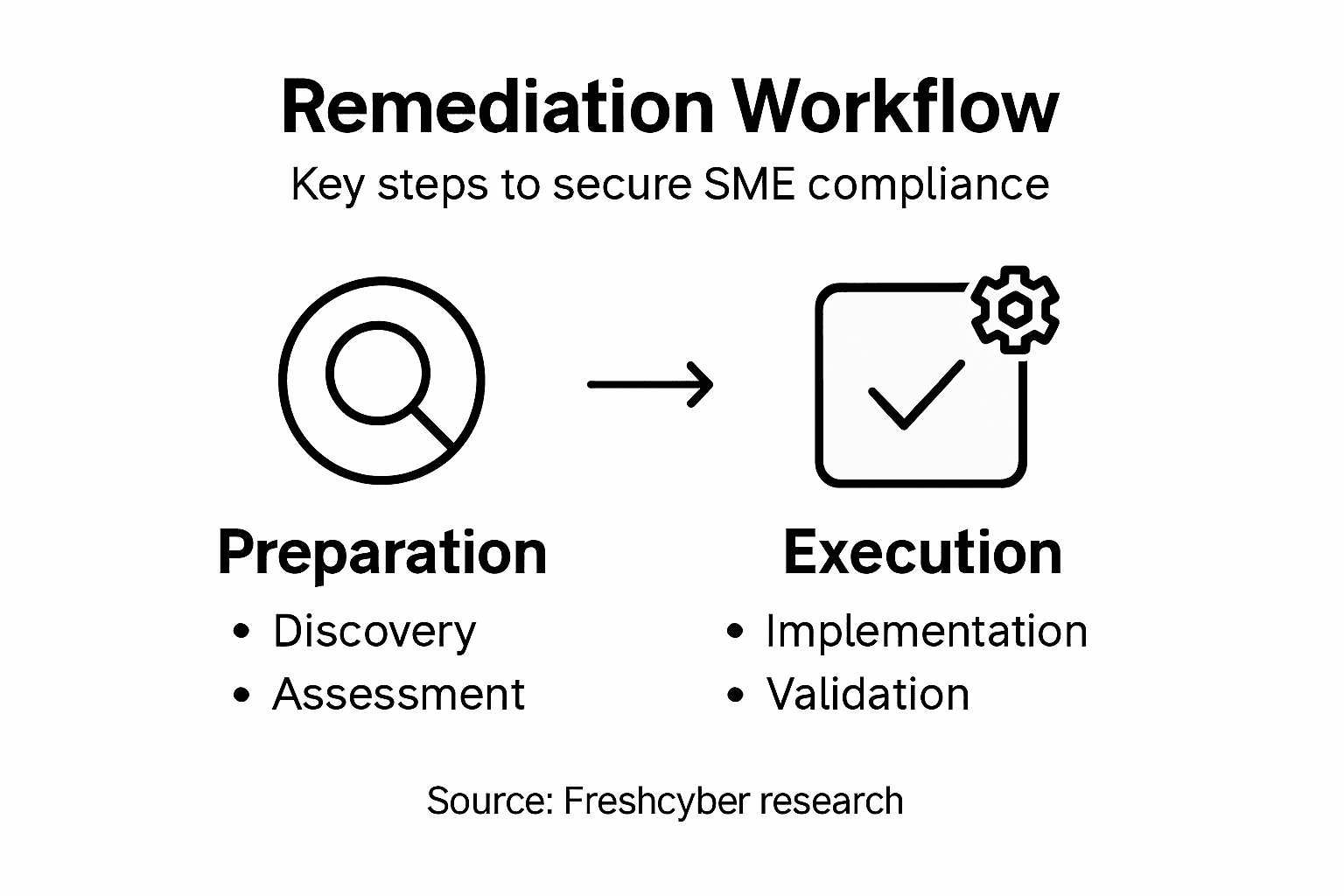
The remediation process typically begins with discovery and assessment. This is where your vulnerability scanning tools, penetration tests, and security monitoring identify weaknesses in your systems. A missing patch on your Microsoft Exchange server. An overly permissive database access rule. An outdated SSL certificate. A user account with administrator privileges they don’t need. Discovery answers the question: what’s broken? Assessment answers the harder question: how broken is it? This step requires honest evaluation. Direct and permanent fixes depend on accurate severity ratings, so you need to assess not just whether a vulnerability exists, but how easily attackers could exploit it and what damage they could cause to your finance operations or customer data. A vulnerability affecting your payment processing system rates higher than one affecting your internal wiki. A flaw that attackers are actively exploiting in the wild today rates higher than one that might be exploited someday.
Once you’ve assessed the vulnerabilities, prioritisation and planning determines your remediation roadmap. Your security team cannot fix everything immediately, so you must sequence the work based on risk, available resources, and business impact. Your finance systems might require emergency remediation within 24 hours. Customer-facing systems might need standard remediation within two weeks. Internal development environments might allow six weeks. This step also involves planning the actual fix. Will you patch the software? Reconfigure the system? Replace the component? For each vulnerability, you determine the appropriate remediation action and validate that the fix won’t break something else. A poorly planned patch that crashes your e-commerce platform during peak trading hours causes more damage than the vulnerability itself.
The implementation phase is where the actual fix happens. This is where you apply patches, update configurations, rotate credentials, or whatever your remediation plan specified. But implementation must happen carefully. For critical systems, you might test the fix in a staging environment first, ensuring it resolves the vulnerability without introducing new problems. You might schedule the remediation during maintenance windows to minimise disruption. You might communicate with users before taking systems offline. Implementation requires coordination between your technical team, business stakeholders, and sometimes third-party vendors if your systems are hosted externally.
Verification and validation confirm that the remediation actually worked. After patching a vulnerability, you rescan the system to confirm the patch applied successfully and the vulnerability no longer exists. After updating access controls, you verify that the correct people have the correct permissions. After restoring systems from backups following a ransomware attack, you ensure the restored systems don’t contain any traces of malware. This verification step prevents remediation failures from going undetected. You cannot assume a patch installed correctly. You cannot assume a configuration change took effect. You must verify.
Finally, documentation and closure completes the remediation cycle. You record what vulnerability was found, when it was remediated, what action was taken, who performed it, and verification that it succeeded. This documentation is not administrative busywork. It proves to auditors that your remediation process is systematic and auditable. It helps your team understand what’s been fixed so you don’t remediate the same issue twice. It feeds your risk register, helping you track your overall security posture over time.
Pro tip: Automate your remediation verification wherever possible - automated rescans confirm that patches applied correctly and vulnerabilities disappeared, eliminating the risk that manual verification steps get skipped when teams are busy.
Regulatory Compliance and Legal Requirements
Remediation isn’t optional for UK SMEs. It’s a legal and regulatory obligation. Your customers, regulators, and the courts expect you to identify vulnerabilities and fix them promptly. For finance and e-commerce businesses, the stakes are even higher. You’re handling sensitive data subject to strict regulations, and failing to remediate known vulnerabilities can expose your organisation to substantial fines, legal action, and reputational damage. Understanding which regulations apply to your business and what they require is the foundation of an effective remediation strategy.
The primary frameworks governing cybersecurity remediation for UK SMEs include GDPR, PCI DSS, Cyber Essentials, and increasingly, the Network and Information Systems Regulations (NIS2). Under GDPR, you’re required to implement appropriate technical and organisational measures to protect personal data. That means identifying vulnerabilities that could lead to data breaches, and fixing them without unreasonable delay. If you suffer a breach and regulators discover that you failed to remediate a known vulnerability, your organisation loses the benefit of the doubt. The Information Commissioner’s Office looks at whether you took reasonable steps to protect data. Failing to patch a critical vulnerability that attackers actively exploit is difficult to defend as reasonable. For finance firms handling payment data, PCI DSS goes further. It explicitly requires you to maintain a vulnerability management programme, conduct regular security assessments, and remediate vulnerabilities according to defined risk ratings. A flaw affecting your payment processing system must be fixed faster than a flaw affecting your office WiFi. PCI DSS doesn’t just ask that you remediate vulnerabilities. It prescribes how quickly you must fix them based on severity. UK cyber security regulations in 2025 continue tightening these requirements, with NIS2 creating new obligations for larger SMEs and critical infrastructure operators.
Beyond regulatory frameworks, common law and contract law create additional obligations. If you process customer data, your contracts likely include warranties that you maintain adequate security. If a breach occurs because you failed to remediate a known vulnerability, customers can sue for breach of contract. If you’re a processor handling data on behalf of a controller (like a payment processor for e-commerce merchants), your data processing agreements specify that you must remediate vulnerabilities promptly. Failure to do so could breach those agreements and expose you to claims for losses suffered. Employment law also intersects with remediation. If a security incident occurs because a vulnerability wasn’t fixed, and staff suffer data breaches affecting their personal data, they may have claims against your organisation. Additionally, if your incident response causes significant system downtime, your business interruption may trigger claims from customers or partners affected by the outage.
The practical implication is straightforward: remediation isn’t a technical nice-to-have, it’s a legal requirement. Your organisation must demonstrate that it identified vulnerabilities and remediated them within appropriate timeframes. That demonstration requires documentation. When was each vulnerability discovered? What severity rating was assigned? When was remediation planned? When was the fix implemented? How was remediation verified? If you cannot produce this documentation, regulators assume you didn’t remediate properly. Your risk register should track every identified vulnerability and its remediation status. Your audit logs should show when patches were applied and systems were updated. Your testing reports should demonstrate that vulnerabilities were eliminated. When auditors or regulators ask questions about your security posture, this evidence proves that you took remediation seriously.
The table below summarises common regulatory frameworks and their remediation requirements for finance and e-commerce SMEs:
Framework | Remediation Requirement | Non-compliance Consequence |
GDPR | Address vulnerabilities without delay | Fines, reputational damage |
PCI DSS | Remediate according to risk ratings | Sanctions, loss of merchant status |
Cyber Essentials | Demonstrate prompt issue resolution | Reduced customer/trust, failed certification |
NIS2 Regulation | Systematic vulnerability management | Regulatory penalties, legal claims |
Contract (B2B/B2C) | Maintain auditable fix records | Breach of contract, litigation |
Common Law | Take reasonable protective measures | Lawsuits, financial damages |
For compliance officers, the key insight is this: remediation is not something your technical team does. It’s something your organisation does, with board awareness and management oversight. Your leadership team must understand that remediation is a legal obligation, not an operational detail. That mindset shift changes how organisations prioritise resources, how they respond to vulnerability reports, and how seriously they take compliance deadlines. Finance and e-commerce businesses cannot afford to treat remediation as a backlog item to be addressed when convenient. The regulatory environment, customer expectations, and legal liability all demand prompt, documented, systematic remediation.
Pro tip: Include remediation metrics in your board-level governance reporting—track vulnerability identification rates, remediation completion times by severity level, and compliance with your defined remediation deadlines to demonstrate to leadership and regulators that remediation is treated as a priority, not an afterthought.
Roles, Risks and Common Mistakes in Remediation
Remediation fails most often not because organisations lack technical capability, but because people, processes, and accountability get tangled. Your security team identifies a critical vulnerability on Friday afternoon. The development team doesn’t see the ticket until Monday. By Wednesday, nobody can remember who’s supposed to fix it. By the following week, the vulnerability remains unfixed whilst three different people have made three different attempts at patching it. This scenario plays out in SMEs repeatedly because remediation involves multiple roles with unclear boundaries and competing priorities. Understanding who owns what, where risks hide, and what mistakes derail remediation efforts helps you build a process that actually works.
Who owns remediation?
Remediation requires clear ownership, and that ownership must extend beyond individual contributors. Organisational silos where security and development teams fail to collaborate effectively remain the most common cause of delayed or incomplete fixes. Your security team discovers vulnerabilities. Your development team fixes them. Your infrastructure team patches systems. Your compliance team verifies everything happened on schedule. But if nobody owns the overall remediation process, vulnerabilities slip through the cracks. A critical flaw gets assigned to a developer who goes on holiday. Nobody follows up. Two months later, the vulnerability still exists.
Effective remediation requires integrated workflows with clear accountability. Assign remediation tasks to teams, not individuals. A developer takes holiday; their team colleague picks up their remediation work. Use automated tracking systems so nothing disappears from view. Schedule regular remediation status meetings where security, development, and infrastructure teams review open issues and discuss blockers. For compliance officers, this means working with your IT and security leadership to establish governance around remediation. Who decides the priority of each fix? Who signs off that remediation is complete? What happens when a team misses a remediation deadline? Without clear answers to these questions, remediation becomes reactive rather than proactive.
Common risks and mistakes
Several predictable mistakes plague remediation efforts. The first is ignoring root causes. You patch a vulnerability on your web server, but you don’t understand how it got there. Three months later, a similar vulnerability appears on a different server because you never addressed the underlying problem. Maybe your patch management process is broken. Maybe developers aren’t following secure coding practices. Maybe your systems don’t have security baseline configurations applied. Without understanding the root cause, you’re playing whack-a-mole, fixing symptoms rather than problems.
The second mistake is poor communication between teams. Your security team discovers a vulnerability and emails a ticket to the development team. Days pass with no response. Nobody knows if the ticket was seen, if it’s blocked by other work, if there are questions about the vulnerability, or if the team simply forgot. Communication gaps and lack of context on business impact cause remediation efforts to stall. Your compliance officer might assume remediation is happening when it’s actually waiting for clarification or stuck behind other priorities.
The third mistake is failing to verify remediation effectiveness. A patch gets applied. Nobody rescans to confirm the vulnerability actually disappeared. Weeks later, a penetration test reveals the vulnerability still exists because the patch didn’t install correctly, or the vulnerability wasn’t actually what was claimed. Worse, you report to auditors that the vulnerability was remediated when it wasn’t. Not verifying remediation effectiveness can lead to compliance failures and leave your organisation exposed to actual attacks.
The fourth mistake is inadequate documentation. You remediate vulnerabilities, but you don’t record what was fixed, when it was fixed, or how it was verified. When auditors ask for evidence of your remediation process, you have nothing to show them. When the same team faces a similar vulnerability six months later, they don’t remember how it was previously resolved. Documentation isn’t bureaucracy. It’s the evidence that proves your remediation process is systematic and auditable.
Managing the risks
Managing remediation risks requires structured prioritisation based on vulnerability severity and exploitability. Not every vulnerability demands immediate action. Use your risk register to score each vulnerability based on the likelihood of exploitation and the potential business impact. Finance systems handling payment data score highest. Internal development systems score lower. Vulnerabilities already being exploited by attackers score higher than theoretical vulnerabilities. This prioritisation ensures your remediation resources hit the highest-impact issues first.
Pro tip: Create a remediation SLA that defines how quickly each severity level must be fixed (critical within 24 hours, high within 5 working days, medium within 2 weeks, low within 30 days) and track compliance against these targets to maintain momentum and demonstrate governance to auditors.
Strengthen Your SME’s Cybersecurity Remediation with Expert Support
Remediation in cybersecurity is crucial for UK SMEs aiming to secure compliance and protect critical finance and e-commerce systems. The article highlights the challenge of managing vulnerabilities quickly and methodically to avoid breaches and regulatory penalties. You need a clear remediation strategy that prioritises risks, verifies fixes, and documents every step for audit purposes. Without dedicated expertise and seamless collaboration between security, development, and compliance teams, remediation can become fragmented and ineffective – putting your business at serious risk.
At Freshcyber, we understand these pain points and help SMEs move beyond checklist certifications to build resilient digital defences. Our Virtual CISO service provides strategic leadership, including risk-based vulnerability prioritisation and compliance oversight aligned with frameworks such as ISO 27001 and PCI DSS. We also offer comprehensive Vulnerability Management services to discover, assess, and verify remediation actions with precision. For broader governance and regulatory demands, our Compliance expertise ensures your remediation efforts satisfy legal and audit requirements without added complexity.

Don’t wait for a breach or audit failure to act. Partner with Freshcyber today to gain expert guidance that guarantees your remediation programme is proactive, risk-focused and fully auditable. Visit freshcyber.co.uk now to schedule a consultation and secure your SME’s compliance future.
Frequently Asked Questions
What is remediation in cybersecurity?
Remediation in cybersecurity is the structured process of identifying, assessing, and mitigating security vulnerabilities in systems to prevent potential breaches and protect sensitive information.
Why is remediation important for SMEs in finance and e-commerce?
Remediation is crucial for SMEs in finance and e-commerce because a security breach can damage reputation, drain resources, and erode customer trust, making timely and effective remediation vital for operational integrity.
What steps are involved in the remediation process?
The remediation process typically involves discovery and assessment of vulnerabilities, prioritisation and planning of remediation actions, implementation of fixes, verification and validation of those fixes, and thorough documentation of the entire process.
How do regulatory frameworks impact cybersecurity remediation?
Regulatory frameworks such as GDPR and PCI DSS mandate timely remediation of vulnerabilities. Non-compliance can lead to significant fines and reputational damage, making it essential for organisations to have an effective remediation strategy in place.
Recommended
Comments