NIST Cybersecurity Framework: Turning Compliance Into Value
- Gary Sinnott

- Feb 8
- 7 min read

Securing a high-value contract in British finance or healthcare can depend on how confidently your cyber risks are managed. With constantly evolving threats and regulatory obligations, UK SMEs need more than basic compliance - they require a comprehensive approach to risk management. The NIST Cybersecurity Framework offers practical strategies that translate technical controls into business resilience. This article unpacks core fundamentals enabling organisations to build robust, adaptable defences and communicate cybersecurity priorities across every leadership level.
Table of Contents
Key Takeaways
Point | Details |
NIST Framework as Strategic Tool | The NIST Cybersecurity Framework provides UK SMEs a roadmap for transforming compliance into strategic resilience by integrating various cybersecurity functions. |
Integrated Cybersecurity Functions | The six core functions - Govern, Identify, Protect, Detect, Respond, and Recover - create a cyclical approach to managing cyber risks effectively. |
Tailoring for Unique Needs | UK SMEs should adapt the framework to their specific organisational contexts, focusing on prioritising relevant risks and ensuring regulatory compliance. |
Avoiding Common Pitfalls | Organisations must avoid superficial compliance and static implementation by fostering a culture of cybersecurity awareness and continuously updating strategies. |
NIST Cybersecurity Framework fundamentals explained
The NIST Cybersecurity Framework offers UK SMEs a powerful roadmap for transforming technical compliance into strategic digital resilience. Voluntary guidelines for risk management represent more than a checkbox exercise - they’re a comprehensive approach to understanding and mitigating cyber threats.
At its core, the framework comprises five fundamental functions that create a holistic cybersecurity strategy:
Identify: Understanding your organisation’s cyber landscape
Protect: Implementing safeguards to limit potential security incidents
Detect: Developing capabilities to recognise potential cybersecurity events
Respond: Creating procedures to address detected cybersecurity incidents
Recover: Maintaining plans for organisational resilience after an incident
These functions aren’t linear checkpoints but an integrated, cyclical process. Each function builds upon the previous, creating a dynamic system of continuous improvement. Small and medium enterprises can leverage this framework to develop mature, adaptable security strategies that go beyond mere regulatory compliance.
The framework’s true power lies in its flexibility. It provides a common language for cybersecurity across different organisational roles, enabling better communication and more strategic risk management. By adopting these guidelines, UK SMEs can transform cybersecurity from a technical burden into a competitive advantage.
Pro tip: Start by conducting a comprehensive gap analysis against the NIST Framework to identify your current cybersecurity maturity level and prioritise improvement initiatives.
Exploring the five core NIST functions
The NIST Cybersecurity Framework provides organisations with a strategic approach to managing cyber risks through its comprehensive set of core functions. Structured cybersecurity risk management approach enables businesses to systematically address potential digital threats.
The framework traditionally includes five critical functions, with the latest version introducing a sixth function:
Govern: Establishing leadership, policy, and risk management strategy
Identify: Discovering and understanding organisational assets and associated risks
Protect: Implementing safeguards to limit potential security incidents
Detect: Developing capabilities to recognise cybersecurity events
Respond: Creating procedures to effectively address detected incidents
Recover: Maintaining plans for restoring operations after a cybersecurity event
Comprehensive risk management lifecycle means these functions are not isolated steps, but an interconnected system. Each function builds upon the previous, creating a dynamic and adaptive cybersecurity approach. The Govern function, newly introduced in version 2.0, emphasises the strategic leadership component of cybersecurity management.
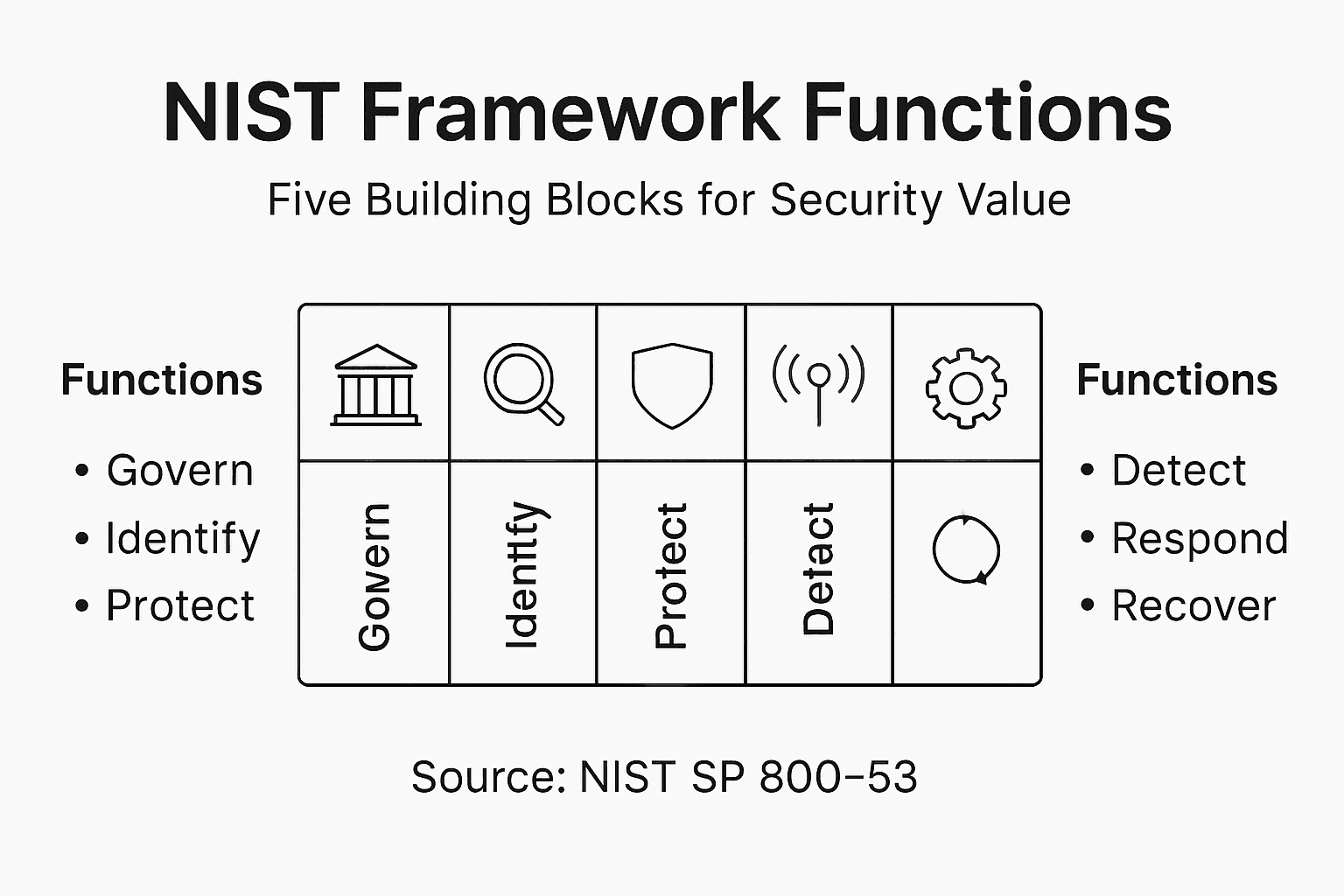
Here is a summary of the six core NIST Cybersecurity Framework functions and their benefits for UK SMEs:
NIST Function | Description | SME Business Benefit |
Govern | Sets leadership and policies | Ensures strategic oversight |
Identify | Maps assets and risks | Clarifies risk landscape |
Protect | Applies essential safeguards | Reduces incident impact |
Detect | Monitors for cyber events | Enables early response |
Respond | Manages cybersecurity crises | Minimises disruption |
Recover | Restores operations swiftly | Enhances organisational resilience |
For UK SMEs, this framework offers more than a compliance checklist. It provides a flexible, scalable methodology for understanding, managing, and mitigating cybersecurity risks. By adopting these functions, organisations can transform cybersecurity from a technical requirement into a strategic business advantage.
Pro tip: Regularly review and update your cybersecurity strategy by conducting a comprehensive assessment against each NIST function, ensuring continuous improvement and alignment with evolving threat landscapes.
Tailoring NIST for UK SME requirements
UK small and medium enterprises face unique cybersecurity challenges that demand a nuanced approach to framework implementation. Small business cybersecurity resources provide critical guidance for adapting the NIST framework to specific organisational contexts.
Key strategies for tailoring the NIST Cybersecurity Framework to UK SMEs include:
Simplify Complexity: Reduce framework controls to essential, most impactful activities
Prioritise Relevant Risks: Focus on threats specific to your industry and business size
Resource-Conscious Implementation: Develop strategies that match your technical and financial capabilities
Regulatory Alignment: Ensure compliance with UK-specific cybersecurity regulations
Scalable Approach: Create a flexible framework that grows with your business
Adaptable cybersecurity governance allows SMEs to transform the framework from a generic template into a strategic business tool. By contextualising the framework, organisations can develop a proportionate, meaningful approach to cyber risk management that reflects their unique operational landscape.

The most successful implementations recognise that cybersecurity is not a one-size-fits-all solution. UK SMEs must design a framework that balances robust protection with practical, cost-effective implementation, turning compliance into a competitive advantage.
Pro tip: Conduct an annual review of your NIST framework implementation, reassessing risk priorities and adjusting your approach to ensure continued relevance and effectiveness.
Compliance obligations and practical SME adoption
UK small and medium enterprises are increasingly confronting complex cybersecurity compliance landscapes that demand strategic, resource-efficient approaches. Structured cybersecurity compliance processes provide essential guidance for navigating regulatory requirements while maintaining operational efficiency.
Key compliance considerations for UK SMEs include:
Data Protection: Ensuring alignment with GDPR and UK data security regulations
Risk Management: Developing comprehensive yet proportionate risk assessment frameworks
Incident Response: Creating clear, actionable protocols for potential cybersecurity events
Documentation: Maintaining transparent records of cybersecurity practices and controls
Continuous Improvement: Regularly updating security strategies to address emerging threats
Scalable compliance roadmaps enable SMEs to transform compliance from a bureaucratic burden into a strategic business advantage. By adopting flexible frameworks that match their specific operational context, organisations can develop robust cybersecurity practices without overwhelming limited resources.
Successful compliance is not about perfection, but about demonstrating a committed, systematic approach to managing cyber risks. UK SMEs must view compliance as an ongoing journey of continuous learning and adaptation, using frameworks like NIST to build organisational resilience and competitive differentiation.
Pro tip: Develop a pragmatic compliance strategy that balances regulatory requirements with your organisation’s specific operational capabilities and risk tolerance.
Common pitfalls and ways to maximise impact
UK organisations often encounter significant challenges when implementing the NIST Cybersecurity Framework, transforming compliance from a theoretical concept to practical risk management. Critical cybersecurity implementation strategies highlight the nuanced approach required for meaningful cyber resilience.
Common pitfalls that can undermine NIST Framework effectiveness include:
Superficial Compliance: Treating the framework as a mere checkbox exercise
Resource Misallocation: Inadequate investment in cybersecurity capabilities
Lack of Leadership Engagement: Minimal executive-level commitment to cyber strategy
Static Implementation: Failing to regularly review and update security approaches
Insufficient Risk Contextualisation: Applying generic controls without understanding specific organisational risks
Cybersecurity governance principles emphasise that maximising framework impact requires a holistic, dynamic approach. Successful organisations integrate cybersecurity deeply into their business strategy, viewing it as a continuous improvement process rather than a one-time implementation.
This table compares common SME pitfalls with strategies to maximise NIST Framework effectiveness:
Pitfall | Consequence | How to Maximise Impact |
Superficial compliance | Missed risks, weak posture | Embed cybersecurity into culture |
Resource misallocation | Gaps in protection | Align investment with risks |
Lack of leadership engagement | Inconsistent efforts | Secure executive sponsorship |
Static implementation | Outdated defences | Regularly review procedures |
Insufficient risk contextualisation | Ineffective controls | Customise to organisational needs |
Effective NIST Framework adoption demands more than technical controls. It requires creating a culture of cybersecurity awareness, establishing clear accountability, and developing adaptive mechanisms that evolve with changing technological and threat landscapes. SMEs must transform the framework from a compliance document into a strategic business enabler.
Pro tip: Conduct quarterly strategic reviews of your cybersecurity framework, involving leadership from across the organisation to ensure ongoing relevance and effectiveness.
Transform NIST Compliance Into Your Business Advantage Today
The article highlights how many UK SMEs struggle to turn the NIST Cybersecurity Framework from a technical compliance burden into a strategic asset that drives resilience and growth. Common challenges include superficial compliance, lack of leadership engagement, and static implementation that fail to reflect evolving cyber risks. At Freshcyber, we understand these pain points deeply and specialise in helping you adopt a practical, risk-focused approach to cybersecurity that aligns with your business goals.
Our Compliance services take the complexity out of frameworks like NIST by providing executive-led strategic leadership through our Compliance Currency Engine. Combined with our Vulnerability Management and proactive threat detection capabilities, we empower UK SMEs to move confidently from ticking boxes to demonstrating genuine security maturity.

Ready to make cybersecurity your strongest business asset instead of a compliance headache? Visit Freshcyber today to explore how our tailored vCISO service can guide your complete cybersecurity journey including strategy, risk management and compliance. Act now to build lasting digital resilience that wins contracts and safeguards your future.
Frequently Asked Questions
What is the NIST Cybersecurity Framework?
The NIST Cybersecurity Framework is a set of voluntary guidelines designed to help organisations manage and mitigate cybersecurity risks through a structured approach comprising five core functions: Identify, Protect, Detect, Respond, and Recover.
How can SMEs benefit from implementing the NIST Cybersecurity Framework?
SMEs can benefit by transforming their cybersecurity practices from mere compliance checks into strategic business advantages, ensuring better risk management, enhanced resilience, and improved communication across organisational roles.
What are the key functions included in the NIST Cybersecurity Framework?
The key functions include: Govern, Identify, Protect, Detect, Respond, and Recover. These functions work together in a cyclical process to address cyber risks effectively and adaptively.
How can UK SMEs tailor the NIST Cybersecurity Framework to their specific needs?
UK SMEs can tailor the framework by simplifying complex controls, focusing on risks relevant to their industry, aligning with regulatory requirements, and ensuring that the framework is scalable and resource-conscious.
Recommended
Comments