Managed Service Providers: Driving SME Security Resilience
- Gary Sinnott

- Jan 29
- 11 min read

Managing security and regulatory compliance is a daily challenge for IT Managers in UK finance and healthcare SMEs. Outsourcing critical IT services to a Managed Service Provider can seem like a straightforward solution, but the choices you make carry legal and operational weight. The UK recognises MSPs as critical infrastructure players under regulations like NIS, which means your partnership directly impacts both compliance and cyber resilience. This guide clarifies how to define, select, and evaluate MSPs to meet sector-specific security needs and legal obligations.
Table of Contents
Key Takeaways
Point | Details |
Managed Service Providers (MSPs) Offer Continuous Support | MSPs provide ongoing monitoring and management of IT security, allowing organisations to focus on core business activities. |
Compliance Is Shared Responsibility | Both the organisation and MSP are accountable for data security and compliance with regulations, making due diligence essential. |
Select MSPs with Proven Expertise | Evaluate potential MSPs based on certifications, client references, and their ability to respond to incidents effectively. |
Regular Performance Monitoring Is Crucial | Establish a structured evaluation process to assess MSP performance and alignment with business security objectives. |
Defining Managed Service Providers in Security
A Managed Service Provider (MSP) is a business that delivers third-party IT services to other organisations on an ongoing basis. Rather than handling security and infrastructure management in-house, you outsource these responsibilities to specialists who monitor, maintain, and protect your systems continuously. The definition sounds straightforward, but the reality is more nuanced. MSPs operate across a spectrum of sizes and service offerings, yet they share a common purpose: providing outsourced IT management support so your internal teams can focus on what matters most to your business.
From a regulatory perspective, the UK recognises MSPs as critical infrastructure players. According to the Information Commissioner’s Office (ICO), digital service providers including MSPs are organisations offering digital services such as online marketplaces, search engines, and cloud services to external customers. More specifically, MSPs are entities that provide IT services covering systems, infrastructure, networks, applications, and related security with regular and ongoing management or monitoring. This definition matters because it determines your compliance obligations. If you work with an MSP that meets certain criteria, both you and your provider fall under the Network and Information Systems (NIS) Regulations as relevant digital service providers (RDSPs). Understanding this relationship is crucial for UK SMEs in regulated sectors like finance and healthcare, where compliance requirements ripple through your entire supply chain.
What distinguishes an MSP from a traditional IT support vendor is the continuous, proactive nature of their work. A break-fix IT support company waits for problems to occur. An MSP actively monitors your systems 24/7, identifying threats and vulnerabilities before they become incidents. This continuous management model aligns perfectly with modern security needs. For SMEs without the budget to employ a full security team in-house, this approach provides executive-level expertise and round-the-clock protection that would otherwise be inaccessible. The MSP becomes an extension of your organisation, acting as a trusted advisor on security strategy and a tactical defence force simultaneously.
Pro tip: When evaluating an MSP for your organisation, verify they operate under formal service-level agreements (SLAs) that include specific response times for security incidents and regular compliance reporting relevant to your sector’s requirements.
Types of Security Services Provided by MSPs
MSPs deliver a comprehensive portfolio of security services designed to protect your organisation across multiple layers. These are not one-off implementations but continuous, evolving defences that adapt as threats change. Understanding what services your MSP should provide is essential when you’re making the investment in outsourced security. The breadth of services available means you can tailor your partnership to match your specific business needs, regulatory requirements, and risk profile.
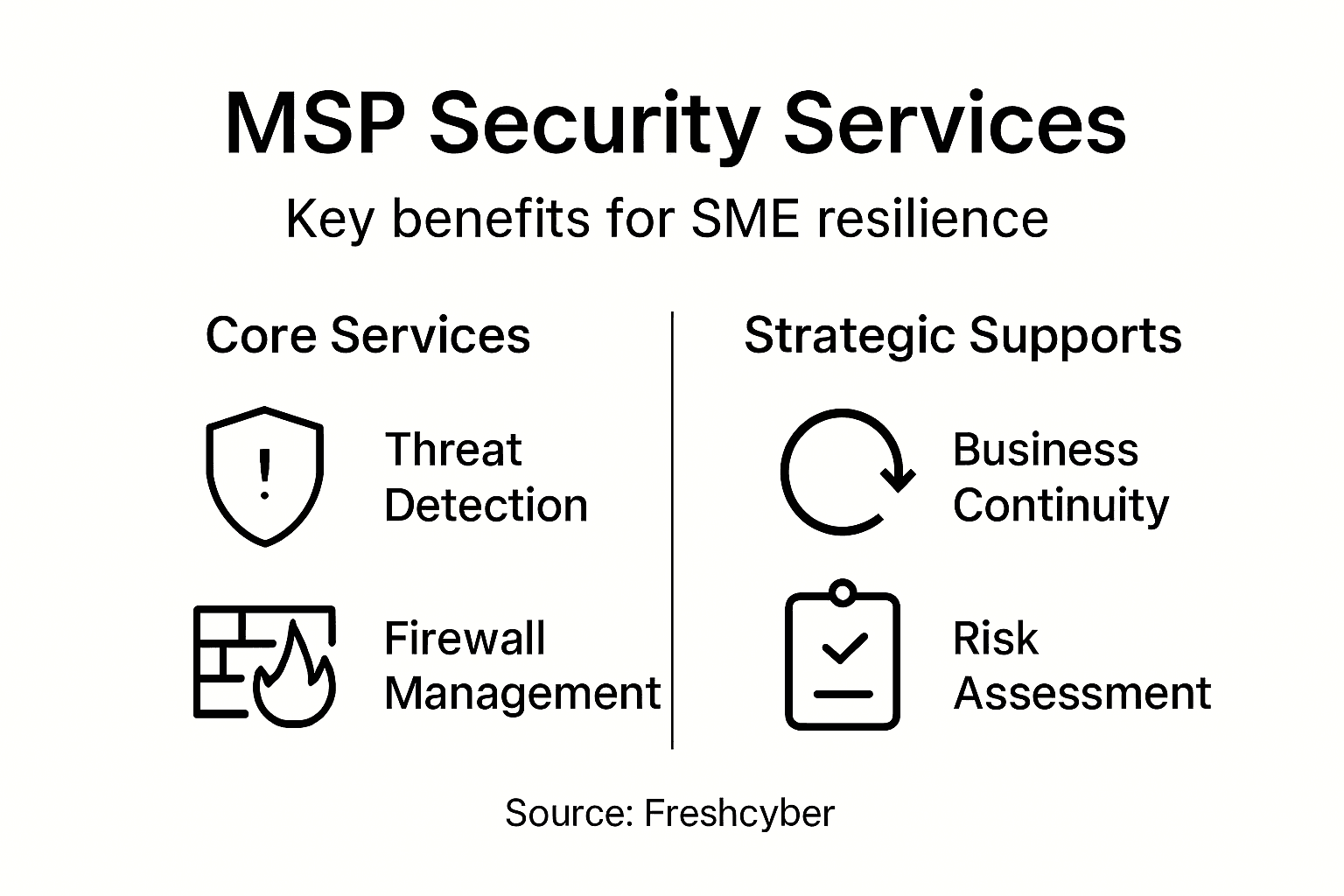
Core security services from MSPs typically include threat detection and incident response, firewall management, and antivirus or anti-malware deployment across your entire infrastructure. Your MSP should actively monitor your networks 24/7, identifying suspicious activity before it becomes a breach. Patch management is another critical service, where your provider automatically deploys security updates to systems before vulnerabilities can be exploited. Identity and access management (IAM) controls ensure only authorised users access sensitive data, whilst secure cloud service provision protects your data wherever it lives. Many MSPs also offer vulnerability management, conducting regular scans of your systems to identify weaknesses before attackers find them. For SMEs in regulated sectors like finance or healthcare, compliance monitoring becomes essential. Your MSP should track your adherence to frameworks like ISO 27001, Cyber Essentials, or GDPR, providing regular reporting that demonstrates your security posture to auditors and clients.

Beyond these technical services, mature MSPs provide strategic capabilities like business continuity planning and risk assessments. These go deeper than compliance box-ticking. A risk assessment identifies which threats pose the greatest danger to your specific business model, allowing you to prioritise your security investment intelligently. Business continuity planning ensures your operations survive a cyberattack or data breach. When selecting an MSP, look for certifications like Cyber Essentials Plus or ISO 27001, which indicate they practise what they preach. Your MSP should work alongside you rather than simply delivering services from a distance. They should understand your business objectives, your supply chain dependencies, and your regulatory obligations, then build a security programme that actually protects what matters most to you.
Pro tip: Request your prospective MSP provide a detailed service inventory mapping which services they deliver and at what escalation level they’ll respond to incidents in your sector, ensuring response times match your business criticality.
Standards, Regulations, and the NIS Bill
If you work with an MSP in the United Kingdom, you need to understand the regulatory framework that governs both your provider and your organisation. The Network and Information Systems (NIS) Regulations 2018 represent a fundamental shift in how cybersecurity is treated by law. Rather than being a nice-to-have or a best practice, security becomes a legal obligation with real consequences for non-compliance. The NIS Regulations impose security and incident reporting obligations on relevant digital service providers, which includes most MSPs operating in the UK. These providers must take proportionate technical and organisational measures to manage risks to network and information systems and comply with incident notification requirements. This matters directly to you as an SME, because your MSP’s compliance status becomes your compliance status. If your provider fails to meet their obligations, you could face regulatory scrutiny, financial penalties, or reputational damage through association.
The upcoming NIS Bill (now the Cyber Security and Resilience Bill) enhances these requirements with more stringent enforcement mechanisms and obligations tailored specifically for critical service providers. The new framework aims to improve UK cyber resilience by raising the bar for organisations that operate essential services. If your organisation operates in regulated sectors like finance or healthcare, these changes affect you directly. Your MSP will need to demonstrate compliance not just to regulators, but to you as well. This is where vetting becomes critical. You cannot simply assume your MSP is compliant. You need documented evidence that they meet the security standards required by law, that they conduct regular assessments, and that they have incident response procedures in place. The regulations also require transparency around how your data is managed and what happens if a breach occurs.
What makes this landscape complex is that different sectors face different regulatory layers. A healthcare provider must comply with the Data Protection Act 2018 and the UK General Data Protection Regulation (GDPR) alongside NIS obligations. A financial services firm faces additional requirements from the Financial Conduct Authority (FCA). An MSP serving multiple sectors must understand all these frameworks and ensure their services align. When you select an MSP, ask them explicitly how they approach compliance across different regulatory domains. Ask for documentation. Ask for audit reports. Ask for their certification status. The cost of selecting an MSP that cuts corners on compliance can far exceed whatever savings you thought you were gaining.
Pro tip: During your MSP selection process, request copies of their latest compliance audit reports, their incident response procedures, and their documented approach to NIS Regulations obligations before signing any contract.
Responsibilities and Risks for UK SMEs
Outsourcing your security to an MSP does not eliminate your responsibility for protecting your data and systems. This is a critical distinction that many SMEs misunderstand. When you engage an MSP, you transfer operational control but not accountability. Your organisation remains responsible for ensuring your data is secure, your systems comply with regulations, and your operations remain resilient. The Information Commissioner’s Office, the Financial Conduct Authority, and other regulators will hold you accountable if something goes wrong, regardless of whether you manage the security internally or outsource it. Your MSP is a service provider, not a scapegoat. Understanding this distinction shapes how you select, contract with, and oversee your provider.
The risks of working with an MSP centre on inadequate vetting, poor oversight, and misaligned incentives. MSPs must have robust security certifications and clear contractual terms covering incident response and data protection, yet many SMEs sign agreements without this due diligence. If your MSP experiences a breach, your organisation faces the notification requirements, the regulatory investigation, the reputational damage, and potentially the financial penalties. Failure to choose the right MSP can expose you to data breaches, service disruption, and compliance failures that escalate financial and reputational damages far beyond the cost of the MSP contract itself. Market consolidation compounds this risk. When large corporations acquire smaller MSP firms, service quality often declines and response times lengthen. Your MSP could be acquired tomorrow, and you might suddenly be dealing with a vastly different organisation with different priorities and standards.
Because most SMEs lack in-house IT teams, your dependency on an MSP for both cyber resilience and compliance is complete. You cannot easily switch providers mid-stream or suddenly take security in-house if your MSP fails you. This asymmetry means you must conduct diligent risk assessments before signing any agreement and continuously monitor MSP performance throughout your relationship. Create a structured oversight process. Meet regularly with your MSP. Review incident logs. Verify that security patches are being deployed on schedule. Request evidence of compliance audits. Treat your MSP partnership like any other critical business relationship: with attention, scrutiny, and a clear understanding of what each party owes the other.
Here is a summary of core responsibilities for SMEs and MSPs in a managed security partnership:
Responsibility Area | SME Obligations | MSP Obligations |
Data Protection | Ensure regulatory compliance and data stewardship | Implement technical controls and monitor environments |
Incident Response | Oversee incident notification duties | Detect, report, and support remediation of incidents |
Compliance Oversight | Request audit reports, review MSP compliance | Maintain certifications and report on compliance status |
Performance Monitoring | Audit SLAs and review service metrics monthly | Deliver reporting, align response times with SLAs |
Pro tip: Include specific, measurable service-level agreements (SLAs) in your MSP contract that define response times for security incidents, patch deployment windows, and availability targets, then audit these metrics monthly to ensure your provider is delivering what they promised.
Choosing and Evaluating Your Security Partner
Selecting an MSP is not a straightforward procurement decision. You are not simply buying a service; you are entering a partnership that will shape your organisation’s security posture for years. The wrong choice can leave you exposed to breaches, compliance failures, and operational disruption. The right choice becomes a genuine competitive advantage, giving you access to expertise and capabilities you could never afford to build in-house. This decision deserves rigour and attention.
Start with certifications and standards compliance. MSPs should hold certifications such as Cyber Essentials Plus and ISO 27001, which indicate they have been independently audited and meet baseline security standards. But certifications alone tell you only that they have met a minimum threshold at a point in time. Dig deeper. Request references from clients in your sector. A healthcare MSP’s capabilities differ from a financial services MSP’s. Ask those references about response times. Ask them about communication during incidents. Ask whether the MSP has actually helped them improve their security posture or simply maintained the status quo. Review their security policies and incident response procedures. These documents reveal how they think about problems and whether their approach aligns with your organisation’s culture and risk tolerance. Transparent pricing matters too. If an MSP will not clearly explain what services are included in their offering and what costs extra, that opacity will frustrate you throughout your relationship.
Once you have selected an MSP, establish a structured evaluation process. Measure their impact on your business resilience. Are they reducing your mean time to detection for security incidents? Are they keeping your systems patched and current? Are they providing regular compliance reporting that gives you confidence with auditors? Evaluate communication effectiveness. An MSP that disappears for months between scheduled calls is not truly a partner. They should be proactive, alerting you to emerging threats relevant to your sector, suggesting improvements, and treating your organisation’s security like their own. Alignment of goals is critical. Your MSP’s incentives should align with yours. If they profit from minimising their work rather than maximising your security, that misalignment will eventually surface. Continuous improvement should be the norm. Your threat landscape changes monthly. Your MSP should adapt their approach accordingly, not simply repeat the same services year after year. Check in quarterly at minimum. Review metrics together. Discuss what is working and what needs adjustment. Treat evaluation as an ongoing conversation, not an annual box-ticking exercise.
This table compares key MSP evaluation criteria to help guide your selection process:
Evaluation Criterion | Why It Matters | Best Practice |
Certification Status | Demonstrates security standard adherence | Request up-to-date certificates |
Incident Response | Ensures readiness for cyber threats | Review documented procedures |
Compliance Alignment | Reduces regulatory risk exposure | Obtain audit and compliance reports |
Client References | Provides real-world service insight | Contact sector-specific references |
Pricing Transparency | Avoids unexpected costs | Clarify all included and extra charges |
Pro tip: Create a formal evaluation scorecard covering certification status, incident response capabilities, compliance alignment, customer references, and pricing transparency, then score each candidate MSP using identical criteria to ensure you are comparing apples to apples.
Strengthen Your SME Security with Expert Managed Services and Strategic Leadership
Managing security risks in partnership with a Managed Service Provider requires more than passive oversight. This article highlights the critical need for continuous, proactive defence and compliance oversight for UK SMEs. Many businesses struggle with maintaining regulatory obligations, ensuring robust incident response, and achieving transparency from their MSPs. The challenge is balancing operational control while relying on trusted providers to be your security extension. The key goal is achieving true digital resilience - not just ticking compliance boxes but building a dynamic defence that adapts and protects what matters most to your organisation.
At Freshcyber, we specialise in helping UK SMEs rise above these challenges through our dedicated Virtual CISO (vCISO) service supported by 24/7 Managed Detection and Response. Our vCISO delivers executive-level security strategy tailored for SMEs, including gap analysis, risk management, and compliance leadership across frameworks like Cyber Essentials and ISO 27001. Meanwhile, our continuous Vulnerability Management ensures your systems stay hardened against emerging threats. This comprehensive approach empowers you to meet your compliance obligations confidently and maintain peace of mind that your MSP partnership is actively protecting your business.

Ready to move beyond basic security and truly safeguard your SME? Explore how Freshcyber can be your strategic security partner by visiting our SME Security resource page. Take the first step to reduce risk, build resilience, and gain expert cybersecurity leadership today at Freshcyber. Secure your future with trusted expertise built for your business.
Frequently Asked Questions
What are Managed Service Providers (MSPs)?
Managed Service Providers (MSPs) are businesses that offer ongoing outsourced IT services, including security management, system monitoring, and infrastructure support, allowing organisations to focus on their core business activities.
How do MSPs improve security for SMEs?
MSPs enhance security by providing continuous monitoring, threat detection, incident response, and compliance management, offering SMEs access to expert-level security capabilities that would be difficult to maintain in-house.
What types of security services can I expect from an MSP?
Typical security services from MSPs include threat detection, incident response, firewall management, antivirus deployment, patch management, identity and access management, and compliance monitoring tailored to the specific needs of the business.
What should SMEs consider when choosing an MSP?
SMEs should evaluate an MSP’s compliance certifications, incident response procedures, service-level agreements (SLAs), client references, and their ability to provide ongoing communication and transparency regarding security measures.
Recommended
Comments