Why Maintain Certification: Securing UK SMEs’ Future
- Gary Sinnott

- Jan 29
- 13 min read

Staying on top of Cyber Essentials certification feels less like ticking a box and more like guarding the future of your business. With new regulatory demands and public sector contract requirements, directors in British SMEs must prove their commitment to cyber security year after year or risk losing out on valuable opportunities and market trust. This guide breaks down the practical steps and ongoing responsibilities that keep your certification valid, protecting your assets and competitive edge in a changing environment.
Table of Contents
Key Takeaways
Point | Details |
Ongoing Commitment | Maintaining Cyber Essentials certification is essential for continuous protection against evolving cyber threats. Regular assessments and updates are necessary for sustained security effectiveness. |
Certification Types | SMEs can choose between Cyber Essentials and Cyber Essentials Plus, depending on their security assurance needs and customer expectations. Plus offers enhanced assurance through independent audits. |
Business Importance | Cyber Essentials certification significantly impacts reputation, contract eligibility, and insurance premiums. It fosters trust with customers and partners while facilitating access to government contracts. |
Risks of Lapsed Certification | Letting certification lapse exposes organisations to increased vulnerabilities, potential loss of contracts, and financial repercussions from higher insurance premiums or denied claims. |
Maintaining Certification: Definition and Core Role
Maintaining certification means keeping your security controls active, updated, and effective year after year. It’s not a one-time achievement you can tick off and forget. Rather, it’s an ongoing commitment to protecting your business against evolving threats. For UK SMEs, Cyber Essentials is a government-backed certification scheme that defines minimum security standards to shield your organisation from common internet-based attacks. But maintaining this certification requires sustained effort, regular assessments, and continuous improvement of your security posture.
The core role of maintaining certification extends far beyond compliance paperwork. When you maintain your Cyber Essentials certification, you’re actively demonstrating to customers, suppliers, and partners that your organisation takes security seriously. This ongoing commitment builds trust in your supply chain, opens doors to government contracts and major corporate tenders, and protects your digital assets from threats that evolve constantly. Each year, your business must complete reassessment to verify that your security controls remain in place and functioning effectively. This means documenting your technical controls, confirming staff are following security policies, and proving that your systems still meet the baseline standards.
What makes maintenance different from initial certification is the focus on sustainability. During your first certification, you establish the foundation by implementing required controls like firewalls, user access management, malware protection, and patch management. During maintenance, you ensure these controls don’t degrade over time. Staff turnover means new employees need training on security policies. Software updates introduce new configuration requirements. Threat actors develop new attack methods. Your certification remains valid only when you actively respond to these changes and demonstrate that your controls are still fit for purpose.
Pro tip: Schedule your annual reassessment at least three months before your current certification expires, giving yourself time to remediate any control gaps before your official assessment date.
Types of Cyber Essentials Certification for SMEs
When you’re considering Cyber Essentials for your SME, you’ll encounter two distinct certification types, each designed to meet different security assurance levels. Understanding the difference between them helps you choose the right fit for your business needs, resource capacity, and customer expectations. The scheme offers flexibility because not every SME faces identical risk profiles or compliance pressures. What works for a healthcare provider might differ from what a software development company requires.
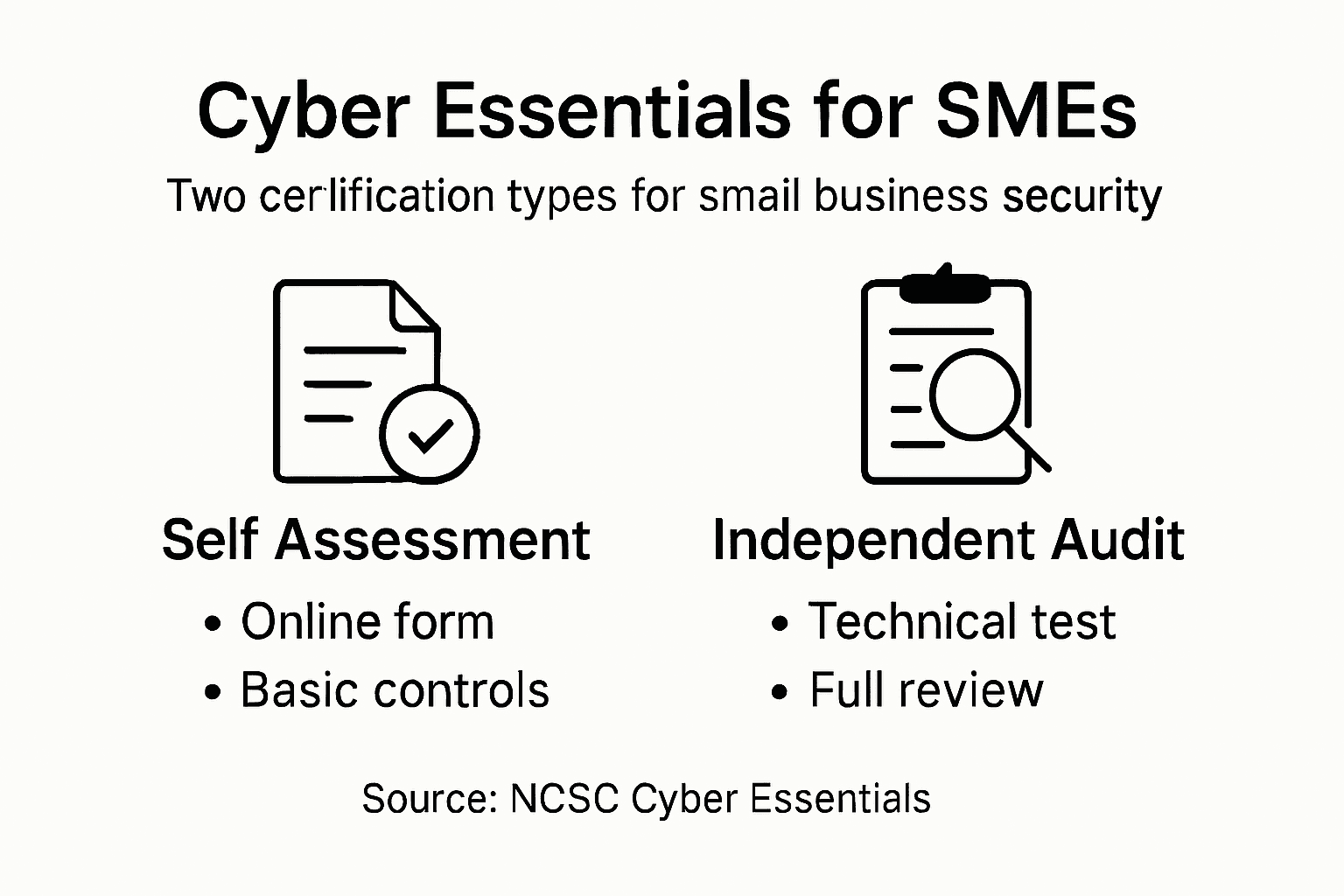
The first option is Cyber Essentials, which involves a verified self-assessment process. You complete a detailed questionnaire demonstrating that your organisation has implemented key security controls. These controls include firewalls, user access management, malware protection, and patch management across your systems. The assessment is essentially a self-declaration, supported by documentary evidence that you supply to prove these controls exist. This approach works well for SMEs seeking baseline protection without extensive third-party involvement. It’s typically more cost-effective and faster to achieve, making it accessible for smaller organisations with limited budgets. However, the assurance is limited because an independent auditor doesn’t physically verify your controls are actually working.
The second option is Cyber Essentials Plus, which takes assurance considerably further. Beyond the self-assessment questionnaire, Cyber Essentials Plus includes an independent technical audit where an external assessor conducts hands-on verification of your security controls. They test your firewalls, examine your access logs, review your patch management records, and confirm that malware protection is genuinely active on your systems. This additional layer of scrutiny provides stronger evidence that your controls are effectively implemented, not just theoretically in place. Organisations facing higher risk profiles, managing sensitive data, or bidding for contracts with stringent security requirements typically choose Plus. The enhanced assurance justifies the higher cost and longer assessment timeline for these businesses.
Your choice between the two depends on several practical factors. If your customers or suppliers explicitly require Cyber Essentials Plus, that decision is made for you. If you’re targeting government contracts, many now expect Plus certification. However, if you’re primarily concerned with protecting your own assets and demonstrating baseline security to general business partners, standard Cyber Essentials often suffices. Consider your industry sector, the sensitivity of data you handle, your current security maturity, and your budget constraints when deciding.
The following table summarises the key differences between Cyber Essentials and Cyber Essentials Plus, helping SMEs select the certification that best matches their needs:
Aspect | Cyber Essentials | Cyber Essentials Plus |
Assessment Method | Self-assessment questionnaire | External technical audit included |
Assurance Level | Baseline, self-declared | Enhanced, independently validated |
Typical Cost | Lower, affordable for most SMEs | Higher, reflects auditor involvement |
Suitable For | SMEs needing basic assurance | SMEs handling sensitive data or higher risks |
Customer Perception | Demonstrates commitment | Provides substantial third-party trust |
Contract Access | Entry to many contracts | Required for public sector, sensitive work |
Pro tip: Start with standard Cyber Essentials to build your security foundation and assess your readiness, then upgrade to Plus within 12 months once you’ve proven your controls are sustainable and your team understands the assessment process.
How Certification Protects Digital Assets
Your digital assets represent the lifeblood of your SME. Customer databases, financial records, intellectual property, operational systems, communications all of these need protection. But protection without structure often fails. Cyber Essentials certification provides that structure by mandating concrete security controls that address the most common attack vectors. Rather than adopting a patchwork of security measures based on guesswork, you implement a framework built on real-world threat intelligence. This focused approach means your investment goes where it matters most.
The certification framework rests on five essential security controls that systematically reduce your exposure to attack. Firewalls and internet gateways form your perimeter defence, filtering malicious traffic before it reaches your systems. Secure configuration hardens your devices and software by removing unnecessary features that attackers might exploit. User access control ensures that only authorised personnel can reach sensitive data, and their access is logged and monitored. Malware protection actively scans for known threats on your endpoints and servers. Regular security updates patch vulnerabilities that attackers continuously exploit across thousands of SMEs. These five pillars work together to create overlapping layers of defence rather than relying on a single point of failure.
Here is a quick reference mapping Cyber Essentials’ five security controls to common business assets, demonstrating how certification safeguards key resources:
Security Control | Protected Business Asset | Example Benefit |
Firewalls & Gateways | Customer databases | Blocks unauthorised access attempts |
Secure Configuration | Financial systems | Minimises exploitable weaknesses |
User Access Control | Intellectual property | Limits data exposure to staff only |
Malware Protection | Endpoint devices | Prevents malware disrupting operations |
Security Updates | Operational servers | Patches vulnerabilities pre-attack |
What makes this protection effective is consistency and completeness. Many SMEs implement some of these controls ad hoc but miss critical gaps. You might have a firewall but poor patch management. You might have antivirus software but weak access controls. Cyber Essentials forces you to address all five areas, ensuring no obvious pathway remains open for attackers. When you maintain this certification, you prove that these controls remain active and functional throughout the year. This ongoing enforcement prevents the slow degradation that happens in businesses without formal frameworks. Your systems don’t gradually weaken because one control was forgotten or deprioritised.
Beyond preventing breach attempts, certification protects your assets from operational disruption. A successful cyberattack doesn’t just steal data; it can lock you out of critical systems, corrupt files, or compromise your ability to serve customers. By maintaining baseline security controls, you significantly reduce the likelihood of incident response becoming your top priority. Your team remains focused on business operations rather than crisis management. Your customers maintain confidence in your ability to protect their information. Your partners continue viewing you as a trustworthy supplier rather than a liability.
Pro tip: Document which digital assets matter most to your business (customer data, financial systems, product designs, operational databases), then map each of the five Cyber Essentials controls to the specific assets they protect, so you understand exactly what you’re defending and why.
Legal Duties and Regulatory Mandates
If your SME supplies goods or services to the UK public sector, you’re operating within a regulatory framework that directly impacts your certification requirements. This isn’t optional guidance or best practice advice. PPN 014 mandates that suppliers bidding for government contracts involving certain data types must hold valid Cyber Essentials or Cyber Essentials Plus certification. For any organisation seeking to win public sector work, this is a hard requirement, not a recommendation. Without certification, you’re ineligible to bid on these contracts, regardless of how excellent your products or services are.
The regulatory landscape extends beyond government procurement. The Procurement Act 2023 and related regulations emphasise ongoing compliance and risk mitigation through certified cybersecurity controls. What this means practically is that maintaining your certification isn’t something you can achieve once and then ignore for three years. You must demonstrate continuous compliance throughout your certification period. Your controls must remain active. Your systems must continue receiving security updates. Your staff must follow security policies consistently. If you allow your controls to degrade or your certification to lapse, you lose eligibility for public sector opportunities immediately. For many UK SMEs, this represents a significant portion of potential revenue, making certification maintenance a genuine business priority rather than a compliance box to tick.
Beyond government contracts, other legal obligations make certification increasingly relevant. If you handle personal data, the UK General Data Protection Regulation and UK Data Protection Act 2018 require you to implement appropriate technical and organisational measures to protect that data. Cyber Essentials controls directly support these legal duties. If you operate in healthcare, financial services, or critical infrastructure sectors, regulators expect baseline cybersecurity standards that align with Cyber Essentials. Your customers and partners may contractually require you to maintain certification as a condition of supplying them. What began as a government requirement has rippled outward, becoming a market expectation across multiple sectors.
The legal reality is straightforward: certification maintenance protects you from multiple directions simultaneously. You meet explicit contractual obligations to customers and government bodies. You demonstrate compliance with data protection and sector-specific regulations. You create documented evidence that you’re managing cyber risk responsibly, which matters if a breach occurs and you face legal action or regulatory investigation. Directors have duties under company law to ensure appropriate management of significant business risks, and cyber security clearly qualifies. Maintaining certification shows you’ve taken reasonable steps to protect your organisation and your stakeholders’ interests.
Pro tip: Calendar your certification expiry date at least six months in advance and set reminders at the four-month and two-month marks, giving yourself sufficient time to remediate any control gaps before your reassessment without rushing or missing contractual deadlines.
Risks of Lapsed or Invalid Certification
A lapsed certification creates a gap in your defences at precisely the moment when you need them most. When your Cyber Essentials certificate expires without renewal, you lose the validated assurance that your security controls are consistently applied and functioning as intended. This isn’t a technical problem alone. The moment your certificate lapses, you’re no longer compliant with the regulatory frameworks that govern your industry and your contracts. For public sector suppliers, the consequences are immediate and unforgiving. You become ineligible to bid on new government contracts. Existing contracts may include clauses requiring continuous certification, meaning you could face termination if you allow yours to lapse. For an SME relying on public sector revenue, this represents a catastrophic business impact.
The operational risks extend beyond lost opportunities. Lapsed certification exposes SMEs to increased vulnerability as organisations lose the validated assurance that key security controls are consistently applied. Without the annual reassessment cycle, your security posture begins to drift almost immediately. Staff who understood security policies leave without being replaced by trained successors. Security updates fall behind schedule because there’s no external deadline driving compliance. Firewall rules become outdated as your network evolves. You’re no longer operating under the discipline of a certification framework, and that discipline matters far more than most organisations realise. Attackers know that lapsed certifications often correlate with degraded security controls. They actively target organisations they know have lost their certification.
The reputational and financial fallout compounds quickly. Your customers and partners lose confidence when they discover your certification has lapsed. Insurance premiums may increase or coverage may be denied if you suffer a breach while uncertified. Regulatory investigations become more severe if an incident occurs during a lapsed certification period, as regulators view this as evidence of negligence. You’ve essentially told the market that cyber security wasn’t important enough to maintain. That message spreads faster than you’d expect, particularly in sectors where security is a purchasing criterion. Potential clients may exclude you from consideration entirely, not because of the breach itself but because you allowed your certification to lapse in the first place. Renewing certification prompts organisations to regularly evaluate and update their cybersecurity measures, ensuring compliance with current standards and protecting against regulatory penalties, contractual losses, and potential financial and reputational harm from cyber incidents.
The path back from lapsed certification is considerably harder than maintaining it continuously. You must remediate any control gaps that have developed during the lapsed period. You must explain to customers and partners why the lapse occurred. You must rebuild trust. That recovery effort consumes time and resources that could have been invested in business growth. The solution is straightforward: treat certification renewal as a non-negotiable business process, like payroll or tax filings. Build it into your annual calendar. Assign clear ownership. Track progress. Don’t let it become an afterthought.
Pro tip: Set up a formal renewal process with your assessor four months before expiry, lock the reassessment date in your calendar, and assign a named individual responsibility for tracking remediation activities, ensuring renewal happens before lapse rather than after it.
Business Impact: Reputation, Contracts, Insurance
Certification does more than tick a compliance box. It directly affects your bottom line through three interconnected channels: how customers and partners perceive you, which contracts you can actually bid for, and how much you pay for insurance. These aren’t theoretical benefits. They’re concrete business outcomes that influence revenue, profitability, and growth potential. When you maintain Cyber Essentials certification, you’re actively managing these three pillars simultaneously.
Your reputation in the market hinges partly on how seriously potential clients believe you take security. Certification signals to customers and partners a commitment to cyber security, enhancing trust and competitive advantage. Think about how you evaluate suppliers yourself. When you’re considering a new vendor, particularly one handling sensitive information, you want assurance that they’re taking security seriously. A certification badge tells you they’ve undergone external scrutiny and met baseline standards. Without it, you’re asking partners to take your word for it. With it, you’re backed by independent assessment. That difference matters enormously in sectors where security is a decision-making factor. Healthcare providers, financial services firms, and government agencies all use certification status as a screening tool. If your certification lapses, you’ve essentially removed yourself from consideration for these opportunities, even if your actual security posture remains sound.
The contract impact is equally stark. Many organisations now include certification requirements in their supplier agreements. Government contracts almost universally require Cyber Essentials as a minimum condition. Private sector enterprises increasingly follow suit, particularly larger organisations managing complex supply chains. If you want access to these opportunities, certification isn’t optional. It’s a prerequisite for participation. The addressable market for your business shrinks dramatically without it. You’re competing only against uncertified suppliers, which limits your pricing power and client quality. Conversely, when you maintain certification, you access a protected market where your competitors may not have the capability or commitment to pursue. That competitive advantage translates directly into contract wins.
Insurance represents a financial advantage that many SMEs overlook. Insurers offer better premiums and reduce risk for certified SMEs, making certification a cost-effective measure that lowers insurance costs and limits claims. Your cyber insurance premiums depend partly on your security posture. Certification provides insurers with independent verification that you’ve implemented baseline controls. They can offer better rates because you’ve reduced your risk profile. For an SME paying for cyber insurance, this premium reduction often pays for the cost of certification itself. Beyond premiums, certification affects claims. If you suffer a breach whilst uncertified, insurers may deny claims or reduce payouts, arguing you failed to maintain reasonable security measures. Maintaining certification protects you both financially and legally when incidents occur.
Pro tip: When negotiating with new clients, mention your active Cyber Essentials certification early in conversations and include it prominently on your website and tender responses, as it often becomes a differentiator that positions you ahead of uncertified competitors.
Protect Your SME’s Future with Expert Cyber Essentials Support
Maintaining Cyber Essentials certification is crucial for UK SMEs to secure ongoing compliance, protect vital digital assets, and stay eligible for key contracts. The challenge lies in keeping your security controls effective amid evolving threats, staff changes, and rigorous reassessment requirements. If you want to transform certification from a one-time effort into a sustainable shield for your business, strategic guidance and continuous vigilance are essential.
Freshcyber specialises in this very challenge. As your dedicated security partner, we provide expert Cyber Essentials consultancy and compliance leadership tailored to UK SMEs. Our Virtual CISO (vCISO) service offers executive-level strategy, gap analysis, and risk management that ensure your certification stays valid and your defences remain robust year after year. Combined with advanced Vulnerability Management services and comprehensive compliance oversight, we help you avoid the costly consequences of lapsed certification while strengthening your digital resilience across the board.

Don’t risk losing contracts or reputational damage because of an expired certificate or weakened controls. Act now to safeguard your SME’s future and make certification maintenance straightforward and effective. Visit Freshcyber today to discover how our tailored solutions keep your certification current and your business secure.
Frequently Asked Questions
What does it mean to maintain certification?
Maintaining certification involves keeping your security controls active, updated, and effective on an ongoing basis, rather than viewing it as a one-time achievement. It requires regular assessments and continuous improvement to protect your organisation from evolving threats.
Why is maintaining Cyber Essentials certification important for SMEs?
Maintaining Cyber Essentials certification demonstrates to customers and partners that your SME takes security seriously. It builds trust, opens doors to government contracts, and protects your digital assets from potential threats.
How often do SMEs need to reassess their Cyber Essentials certification?
SMEs must complete an annual reassessment to verify that their security controls remain effective and compliant. This reassessment involves documenting technical controls and confirming that staff are following security policies.
What are the consequences of allowing Cyber Essentials certification to lapse?
Allowing your certification to lapse can lead to increased vulnerability, loss of eligibility for government contracts, reputational damage, and potential legal implications. It is crucial to maintain certification to ensure ongoing compliance and trust with customers and partners.
Recommended
Comments