Role of Leadership in Cybersecurity Strategy for UK SMEs
- Gary Sinnott

- Jan 16
- 8 min read

Most British SMEs in finance and healthcare face mounting pressure to maintain regulatory compliance while cyber threats grow more sophisticated every year. For compliance officers, aligning with ISO 27001:2022 and Cyber Essentials means juggling complex technical standards and rising operational risks. A single breach can cost UK companies an average of £18,000 in fines and lost business. This article guides you through the modern definition of cybersecurity leadership, highlighting how a vCISO delivers strategic oversight and resilience tailored to British organisational needs.
Table of Contents
Key Takeaways
Point | Details |
Cybersecurity Leadership Evolution | Effective leadership in UK cybersecurity now integrates technical expertise with organisational strategy, viewing security as a business enabler rather than a cost centre. |
Tailored Leadership Models | Small and Medium Enterprises (SMEs) must adopt specific cybersecurity leadership models that align with their unique operational needs and resources. |
Role of vCISOs | Virtual Chief Information Security Officers (vCISOs) provide strategic guidance for SMEs, helping to build comprehensive security frameworks without the cost of full-time executives. |
Compliance and Cultural Integration | Compliance in high-stakes sectors like finance and healthcare requires proactive leadership to create a resilient culture that prioritises cybersecurity as a core organisational strategy. |
Defining Leadership in UK Cybersecurity
In the rapidly evolving digital landscape, cybersecurity leadership goes far beyond traditional technical management. At its core, leadership in UK cybersecurity represents a strategic approach that integrates technological expertise with organisational resilience. Cybersecurity leaders are now expected to be multifaceted professionals who can bridge technical capabilities with broader business objectives, transforming security from a cost centre to a strategic enabler.
The UK government’s perspective emphasises that effective cybersecurity leadership involves collaborative ecosystems connecting government, private sector, and academic institutions. Collaborative cyber defence strategies require senior decision-makers who can drive innovation, manage complex risk landscapes, and develop comprehensive protective frameworks. This approach recognises that cybersecurity is not merely a technical challenge but a holistic organisational strategy that demands sophisticated leadership skills.
Leadership in UK cybersecurity also encompasses cultivating a proactive security culture. This means moving beyond reactive threat responses to developing anticipatory capabilities. Leaders must create environments that prioritise continuous learning, encourage open communication about potential vulnerabilities, and embed security consciousness across all organisational levels. The insights from CYBERUK 2024 highlight that modern cybersecurity leadership is about fostering a united commitment to threat management, where every team member understands their role in maintaining digital resilience.
Pro tip: Develop a strategic cybersecurity roadmap that aligns technical capabilities with your organisation’s broader business objectives, ensuring leadership sees security as an enabler rather than a constraint.
Types of Leadership Models for SMEs
UK Small and Medium Enterprises (SMEs) require nuanced cybersecurity leadership models that recognise their unique operational constraints and resource limitations. Cybersecurity engagement preferences reveal that no single leadership approach fits all organisations, demanding tailored strategies that align with specific business contexts, risk tolerances, and technological capabilities.
Three primary leadership models emerge for SMEs in cybersecurity: the Collaborative Network Model, the Adaptive Resource Model, and the Strategic Resilience Model. The Collaborative Network Model emphasises peer-to-peer knowledge sharing and leveraging sectoral networks to overcome individual resource constraints. This approach, supported by the British Computer Society, enables SMEs to pool expertise, share threat intelligence, and develop collective defence mechanisms that individual organisations might struggle to implement independently.
The Adaptive Resource Model focuses on flexible leadership that can dynamically adjust cybersecurity strategies based on evolving technological landscapes and emerging threats. Leaders adopting this model prioritise continuous learning, scalable security investments, and pragmatic risk management. They understand that cybersecurity is not a static destination but a dynamic journey requiring constant recalibration of defensive capabilities. The Strategic Resilience Model, meanwhile, positions cybersecurity leadership as a holistic business enabler, integrating security considerations into broader organisational strategy and viewing technological protection as a competitive advantage rather than a mere compliance requirement.
Here is a comparison of primary cybersecurity leadership models for UK SMEs:
Leadership Model | Key Characteristics | Typical Advantages |
Collaborative Network | Peer knowledge sharing, networked resources | Shared expertise, reduced isolation |
Adaptive Resource | Flexible, ongoing adjustment to threats | Quick response, resource efficiency |
Strategic Resilience | Security integrated with business strategy | Competitive edge, business alignment |
Pro tip: Conduct a quarterly leadership review that assesses your current cybersecurity leadership model’s effectiveness, mapping it against your organisation’s evolving technological and business needs.
How vCISO Drives Cyber Resilience
Virtual Chief Information Security Officers (vCISOs) have emerged as a transformative solution for UK Small and Medium Enterprises (SMEs) seeking strategic cybersecurity leadership without the substantial overhead of full-time executive roles. Strategic cybersecurity solutions provide SMEs with high-level expertise that bridges critical gaps in technological protection and organisational risk management.

The vCISO model fundamentally transforms cybersecurity from a technical function to a strategic business enabler. By offering scalable, flexible leadership, vCISOs help organisations develop comprehensive security frameworks tailored to their unique operational contexts. They conduct thorough risk assessments, design robust security architectures, and create adaptive strategies that evolve alongside emerging technological threats. This approach enables SMEs to implement enterprise-grade security practices without requiring extensive internal infrastructure or permanent executive commitments.
Moreover, vCISOs play a crucial role in cultivating a robust security culture within organisations. They serve as critical translators between technical teams and business leadership, ensuring that cybersecurity investments are strategically aligned with broader organisational objectives. By providing continuous guidance, developing comprehensive policies, and offering ongoing training, vCISOs help SMEs transform cybersecurity from a compliance requirement into a competitive advantage. The UK government’s analysis underscores that such strategic leadership is increasingly vital in navigating complex digital landscapes and maintaining organisational resilience.
Pro tip: Evaluate potential vCISO partners by assessing their ability to provide customised, adaptable cybersecurity strategies that align with your specific business goals and technological ecosystem.
ISO 27001:2022 Leadership Obligations
The ISO 27001:2022 standard fundamentally reimagines leadership’s role in cybersecurity, demanding a strategic, holistic approach to information security management. Cyber governance mapping emphasises that leadership is no longer about technical compliance, but about embedding security as a core organisational capability.
Under the 2022 standard, leadership obligations extend far beyond traditional risk management. Executives are now required to actively define the organisation’s cybersecurity risk appetite, establish clear accountability structures, and integrate information security into broader enterprise risk frameworks. This means senior leadership must demonstrate a profound understanding of how cybersecurity risks intersect with strategic business objectives, moving from reactive protection to proactive risk anticipation and management.
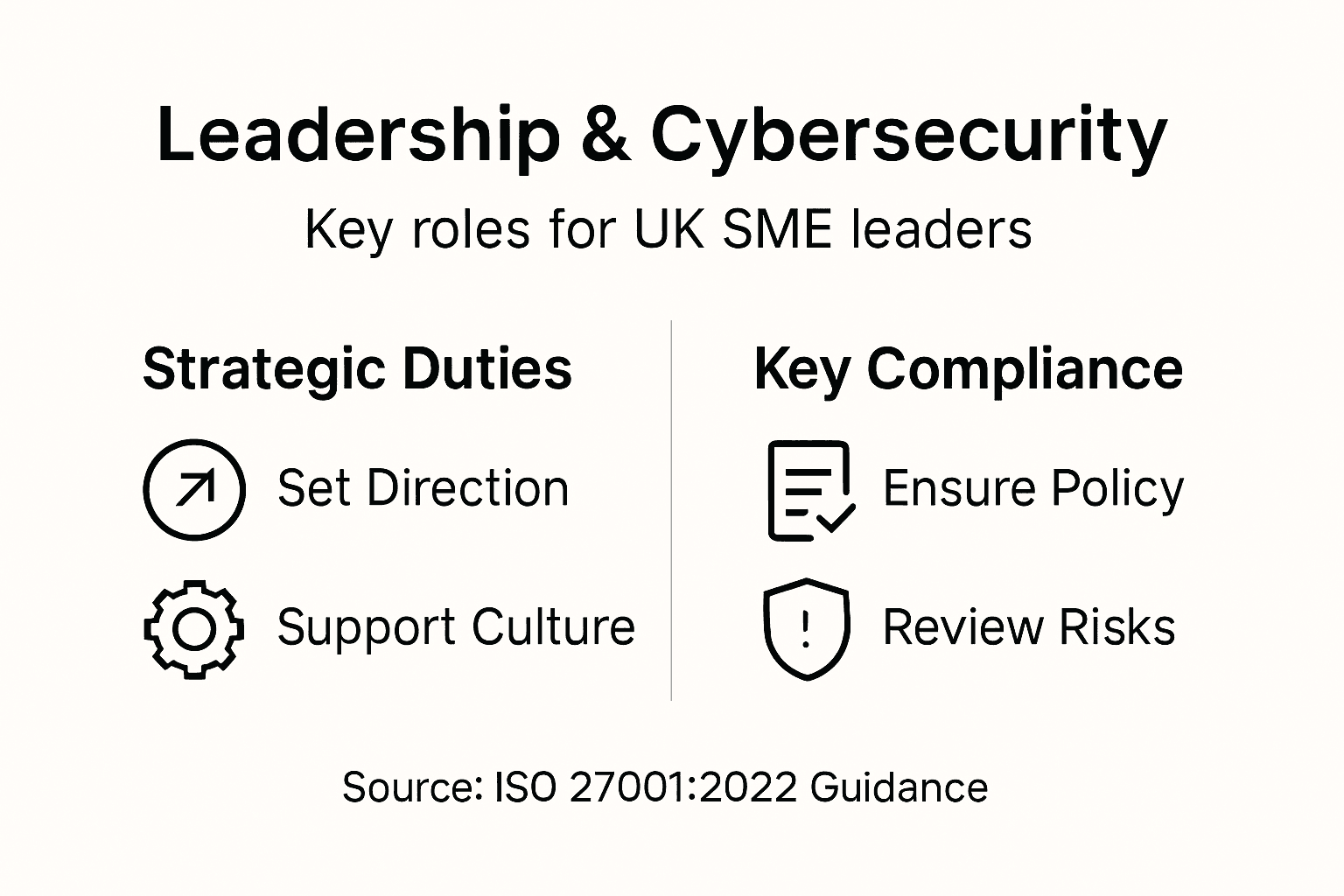
The standard mandates specific leadership responsibilities that transform cybersecurity from a technical function to a strategic business imperative. These include conducting periodic risk assessments, ensuring continuous improvement of the Information Security Management System (ISMS), allocating appropriate resources for security initiatives, and creating a culture of security awareness throughout the organisation. Leaders must now view cybersecurity not as a cost centre, but as a critical enabler of business resilience and competitive advantage. This requires a comprehensive approach that aligns technological capabilities, human factors, and organisational strategy into a unified security vision.
Below is a summary of ISO 27001:2022 leadership obligations for organisational security:
Obligation | Leadership Role | Impact on Organisation |
Define risk appetite | Set acceptable risk levels | Aligns security to business aims |
Establish accountability | Assign clear security ownership | Enhances governance structure |
Integrate security with enterprise | Embed security in all operations | Fosters proactive security ethos |
Continual ISMS improvement | Oversee ongoing updates | Increases resilience and trust |
Pro tip: Conduct a comprehensive leadership workshop to translate ISO 27001:2022 requirements into actionable strategies, ensuring every senior team member understands their specific cybersecurity governance responsibilities.
Risk Management and Strategic Oversight
Cybersecurity risk management for UK SMEs demands a sophisticated, dynamic approach that transcends traditional compliance checkboxes. Cyber security risk management requires leadership to develop a comprehensive framework that anticipates, evaluates, and mitigates potential technological vulnerabilities while aligning with broader organisational objectives.
Strategic oversight involves creating a proactive risk ecosystem that continuously monitors and adapts to emerging cyber threats. This approach necessitates developing a detailed risk register that categorises potential vulnerabilities by likelihood and potential impact, enabling leadership to prioritise resources effectively. UK organisations must move beyond reactive strategies, implementing sophisticated risk assessment methodologies that consider technological, human, and operational dimensions of potential security breaches.
The UK government’s sectoral analysis underscores that effective risk management is fundamentally about creating a resilient organisational culture. This means developing governance structures that integrate cybersecurity considerations into every strategic decision, from technology investments to workforce training. Senior leadership must establish clear accountability mechanisms, ensuring that risk management is not siloed within technical departments but becomes a core organisational capability that involves every team member and aligns with broader business strategy.
Pro tip: Implement a quarterly cross-departmental risk assessment workshop that brings together technical experts, senior leadership, and operational managers to collaboratively identify, evaluate, and prioritise potential cybersecurity risks.
Compliance Challenges for Finance and Healthcare
Finance and healthcare sectors represent the most complex and high-stakes cybersecurity compliance landscapes in the United Kingdom, each characterised by stringent regulatory requirements and extensive data protection mandates. Cyber security strategy for health systems underscores the critical need for leadership to develop comprehensive, adaptive compliance frameworks that protect sensitive information while maintaining operational effectiveness.
In the financial sector, compliance challenges revolve around protecting complex transactional data, preventing financial fraud, and maintaining customer trust. Regulatory frameworks like the Financial Conduct Authority’s guidelines demand rigorous cybersecurity protocols that extend beyond traditional perimeter defence. Healthcare organisations face equally complex challenges, with compliance requirements not only protecting patient data but ensuring uninterrupted medical service delivery. The stakes are extraordinarily high, with potential breaches threatening not just financial loss but direct patient safety and institutional reputation.
Leadership in these sectors must adopt a proactive, holistic approach to compliance that integrates technological solutions, robust governance structures, and continuous staff training. This means developing dynamic risk management strategies that anticipate emerging threats, implement comprehensive monitoring systems, and create adaptive security protocols that can rapidly respond to evolving regulatory landscapes. Successful compliance is no longer about meeting minimum standards but about creating a resilient, security-first organisational culture that views cybersecurity as a fundamental business strategy.
Pro tip: Develop a cross-functional compliance task force that meets monthly to review regulatory changes, assess current security postures, and implement proactive mitigation strategies.
Strengthen Your Cybersecurity Leadership with Freshcyber’s Expert Support
UK SMEs face the critical challenge of evolving their cybersecurity leadership from basic compliance to a strategic business enabler. This article shows how effective leadership involves more than technical knowledge - it demands dynamic risk management, alignment with business goals, and a proactive security culture. If you are struggling to bridge the gap between technical security tasks and comprehensive strategic oversight, or if implementing standards like ISO 27001:2022 feels overwhelming, you are not alone.
Freshcyber specialises in helping SMEs adopt sophisticated cybersecurity leadership through our flagship Virtual CISO (vCISO) service. We provide tailored strategic roadmaps, risk management frameworks, and compliance leadership that transform cybersecurity from a cost centre into your competitive advantage. Whether you need support embedding ISO 27001, managing Cyber Essentials, or strengthening your overall SME Security, our dedicated experts are ready to help you build digital resilience that lasts.

Take control of your cybersecurity leadership today. Explore our detailed resources on Compliance and Cyber Essentials to understand your obligations better, then partner with Freshcyber to develop a strategic security approach that safeguards your business now and in the future. Visit Freshcyber and start your leadership transformation journey.
Frequently Asked Questions
What are the key responsibilities of cybersecurity leaders in SMEs?
Cybersecurity leaders in SMEs are responsible for defining the organisation’s risk appetite, establishing accountability structures, integrating security into overall business strategy, and promoting a culture of security awareness throughout the organisation.
How can a vCISO enhance cybersecurity in an SME?
A vCISO enhances cybersecurity by providing scalable, flexible leadership and developing comprehensive security frameworks tailored to the organisation’s context. They conduct risk assessments, design security architectures, and help integrate cybersecurity into business objectives.
What are the different leadership models for cybersecurity in SMEs?
Three primary leadership models for cybersecurity in SMEs are the Collaborative Network Model, the Adaptive Resource Model, and the Strategic Resilience Model, each offering unique advantages in resource sharing, flexibility, and business integration.
Why is cybersecurity compliance particularly challenging in finance and healthcare?
Cybersecurity compliance in finance and healthcare is complex due to stringent regulatory requirements and the need to protect sensitive data. These sectors face high stakes, with potential breaches threatening financial standing and patient safety.
Recommended
Comments