IT Security Checklist for Certification: Secure Your SME
- Gary Sinnott

- Jan 8
- 8 min read

Over 80 percent of British SMEs in financial services now face client demands for robust cybersecurity certification to stay competitive. For CIOs leading UK-based firms, ISO 27001:2022 is no longer optional if securing high-value B2B contracts is a priority. Tackling the steps from assessment through audit simulation will help your organisation build tangible trust, close security gaps, and sharpen your edge in the demanding British financial market.
Table of Contents
Quick Summary
Main Insight | Explanation |
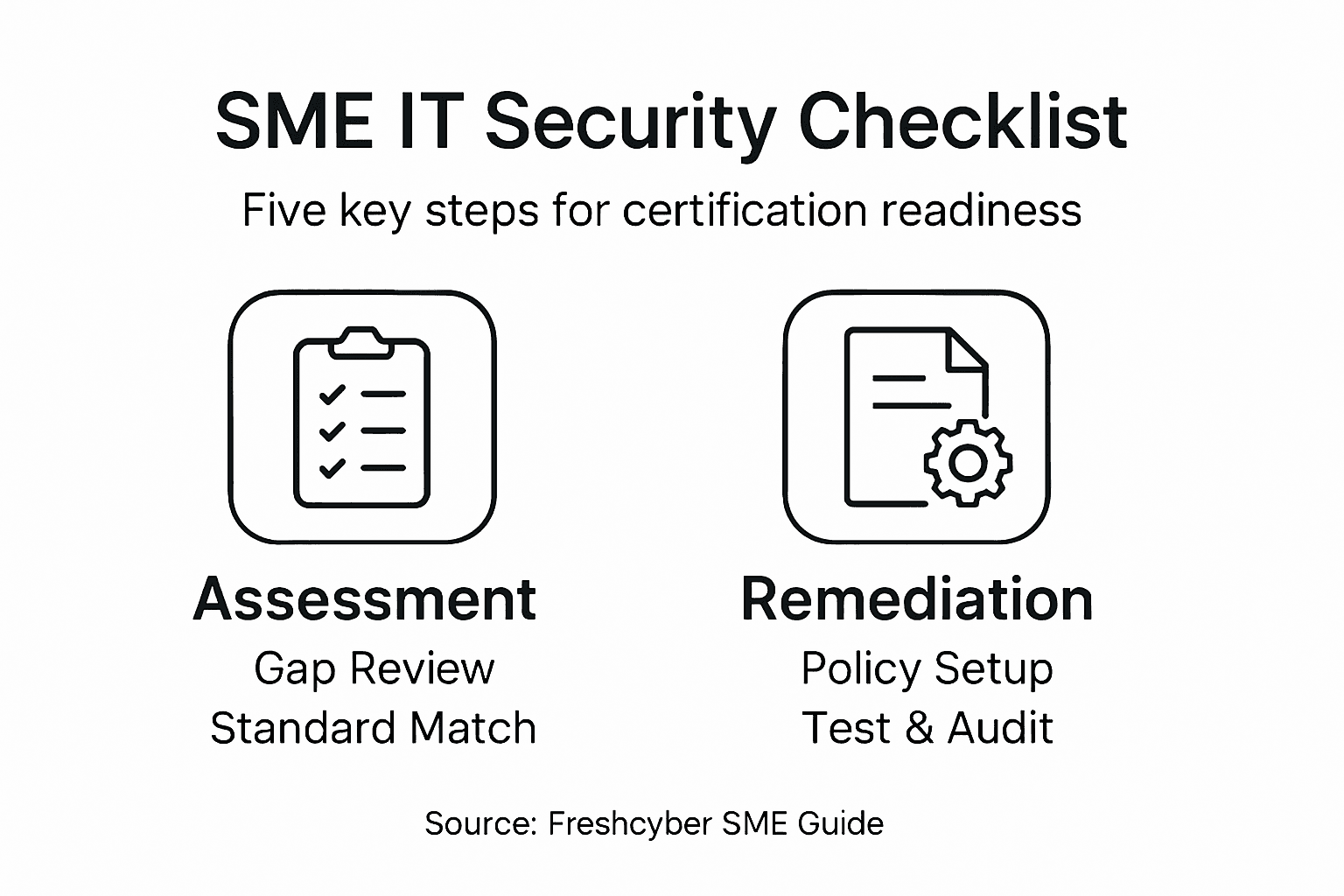
1. Understand Certification Requirements | Assess your organisation’s goals against certification standards like ISO 27001 to identify necessary steps for compliance. |
2. Conduct Vulnerability Assessments | Perform comprehensive evaluations to identify security weaknesses through technical scans and manual inspections for effective risk mitigation. |
3. Develop Robust Cybersecurity Policies | Establish clear policies for access control, incident response, and data protection to ensure a solid cybersecurity foundation for your organisation. |
4. Implement Penetration Testing | Use structured testing methods to simulate attacks, enabling you to address vulnerabilities before they can be exploited by real threats. |
5. Execute Audit Simulations | Regularly assess readiness through tailored attack simulations to validate security controls and improve incident response capabilities. |
Step 1: Assess certification requirements and objectives
Navigating the complex landscape of IT security certification demands a strategic approach tailored to your organisation’s specific needs. Your first critical task involves thoroughly understanding the certification objectives and requirements that align with your business goals, particularly when pursuing standards like ISO 27001 certification.
The assessment phase requires a comprehensive review of your current cybersecurity infrastructure, identifying gaps between existing practices and the certification standards. Begin by mapping your organisation’s information security management system against the specific criteria outlined in frameworks like the UK National Cyber Security Centre’s Cyber Assessment Framework, which provides structured principles for evaluating security maturity. This process involves conducting a detailed gap analysis that examines your technical controls, policy documentation, risk management procedures, and organisational readiness for certification.
During your assessment, focus on understanding the specific requirements of your target certification standard, whether that is Cyber Essentials, ISO 27001, or another industry specific framework. Engage key stakeholders across technical and management teams to gather insights into your current security posture and potential improvement areas. Document each identified gap and prioritise remediation efforts based on their potential impact on achieving certification.
Practical Advice: Create a structured checklist that maps each certification requirement against your current capabilities, allowing you to systematically track and address compliance gaps.
Here is a comparison of major IT security certification standards relevant for UK organisations:
Certification Standard | Scope of Protection | Typical Applicability | Auditing Frequency |
ISO 27001 | Comprehensive information | Large enterprises, SMEs | Annual surveillance audit and re-certification in year 3 |
Cyber Essentials | Basic technical controls | SMEs, public sector | Self-assessment; yearly |
Industry Specific | Varied, often sector-led | Healthcare, finance, defence | Varies by framework |
Step 2: Identify and remediate security gaps
Identifying and addressing security vulnerabilities is a critical process for protecting your organisation’s digital infrastructure. The objective is to systematically uncover potential weaknesses and develop targeted strategies for mitigating risks, ensuring your cybersecurity posture remains robust and resilient.
Begin by conducting a comprehensive vulnerability assessment that examines your entire technological ecosystem. Prioritise cybersecurity risk exposure through a structured approach that involves technical scanning, manual inspection, and stakeholder interviews. This process should include reviewing network configurations, examining access controls, analysing software patch levels, and assessing potential human factor vulnerabilities. Use automated scanning tools to identify technical weaknesses, complemented by manual penetration testing to uncover more nuanced security gaps that automated systems might miss.

Once vulnerabilities are identified, develop a prioritised remediation roadmap based on the potential impact and likelihood of exploitation. Categorise findings according to their severity, focusing first on critical vulnerabilities that could provide immediate entry points for malicious actors. Implement a structured approach to addressing these gaps, which may involve updating software, reconfiguring network settings, enhancing access controls, and providing targeted security awareness training for staff. Government cyber action guidelines recommend a proactive and continuous improvement model that treats cybersecurity as an ongoing process rather than a one time exercise.
Practical Advice: Develop a living document that tracks all identified vulnerabilities, their remediation status, and potential business impact, ensuring continuous visibility and accountability.
Step 3: Establish essential policies and controls
Establishing robust cybersecurity policies and controls forms the foundational framework for protecting your organisation’s digital assets and achieving certification readiness. This critical step involves creating comprehensive guidelines that systematically address potential security risks and define clear organisational expectations.
Begin by developing a set of foundational cybersecurity controls that cover key areas of technological governance. These policies should encompass asset management, access control, software configuration, incident response, and data protection protocols. Ensure each policy is clear, actionable, and aligned with your specific business context. Focus on creating documentation that not only meets certification requirements but also provides practical guidance for your team. Key policies should include acceptable use guidelines, password management standards, remote working protocols, and data handling procedures.
Implement a governance structure that ensures continuous policy review and updates. Government cybersecurity frameworks emphasise the importance of creating living documents that adapt to evolving technological landscapes. Establish clear roles and responsibilities for policy enforcement, including designating specific team members responsible for monitoring compliance, conducting regular policy reviews, and managing updates. Consider creating a centralised repository for all security policies that is easily accessible to relevant staff members, ensuring transparency and consistent understanding across your organisation.
Practical Advice: Schedule quarterly policy review sessions to ensure your cybersecurity controls remain current and effectively address emerging technological risks and regulatory changes.
The table below summarises essential cybersecurity policies and their direct business impacts:
Policy Type | Primary Focus | Business Impact | Review Frequency |
Asset Management | Technology inventory | Prevents unauthorised device access | Quarterly |
Incident Response | Breach procedures | Minimises operational disruption | Annually |
Data Handling | Confidentiality controls | Reduces risk of data leaks | Biannually |
Password Management | Credential guidelines | Limits account compromise opportunities | Quarterly |
Step 4: Conduct comprehensive penetration testing
Comprehensive penetration testing represents a critical validation process for identifying and addressing potential security vulnerabilities within your organisation’s technological infrastructure. This strategic assessment provides an independent and rigorous examination of your cybersecurity defences, simulating real world attack scenarios to uncover potential weaknesses before malicious actors can exploit them.
Begin by developing a structured penetration testing methodology that covers multiple dimensions of your technological ecosystem. This approach should encompass external network testing, internal network assessments, web application security evaluations, and social engineering simulations. Engage certified cybersecurity professionals who can conduct thorough reconnaissance, vulnerability scanning, and controlled exploitation attempts across different technological layers. Ensure the testing strategy includes both automated scanning tools and manual investigation techniques to uncover nuanced vulnerabilities that automated systems might miss.
After completing the penetration testing process, develop a comprehensive remediation roadmap based on the identified findings. CREST approved testing guidelines recommend prioritising vulnerabilities according to their potential business impact and exploitability. Work closely with your technical teams to address each identified weakness systematically, implementing targeted security improvements and verifying the effectiveness of your remediation efforts through follow up testing. Document all findings, remediation steps, and lessons learned to support continuous improvement of your organisation’s security posture.
Practical Advice: Treat penetration testing as a continuous improvement process, scheduling regular assessments to stay ahead of emerging technological risks and evolving threat landscapes.
Step 5: Verify readiness with audit simulation
Audit simulation serves as a critical validation mechanism to thoroughly assess your organisation’s cybersecurity preparedness and compliance readiness. This strategic exercise allows you to proactively identify potential vulnerabilities and validate the effectiveness of your established security controls before an actual certification audit.
Begin by developing a comprehensive attack simulation strategy that mirrors realistic threat scenarios across multiple technological domains. This process should involve creating controlled testing environments that simulate sophisticated cyber attack techniques, allowing you to evaluate your organisation’s detection, response, and recovery capabilities. Engage qualified cybersecurity professionals who can design precise simulation scenarios that challenge your existing security infrastructure, examining everything from technical vulnerabilities to human factor risks such as social engineering susceptibilities.
Utilise ICT readiness frameworks to structure your audit simulation approach, ensuring a holistic assessment of your information security management system. Document each simulation scenario, tracking response times, detection accuracy, and remediation effectiveness. Pay special attention to how your team responds under simulated stress conditions, identifying any gaps in incident response protocols, communication strategies, and technical mitigation capabilities. The goal is not just to uncover weaknesses but to develop a mature, adaptive security posture that can dynamically respond to evolving threat landscapes.
Practical Advice: Treat each audit simulation as a learning opportunity, conducting comprehensive post simulation reviews that transform identified weaknesses into structured improvement initiatives.
Take Control of Your SME’s Cybersecurity Certification Journey
Securing your SME against rising digital threats while meeting certification requirements is a clear challenge highlighted in this IT security checklist. From identifying gaps and managing vulnerabilities to developing essential policies and undergoing rigorous penetration testing, the journey requires strategic insight and hands-on expertise. If you feel overwhelmed by the complexity of frameworks like Cyber Essentials or ISO 27001, or if managing ongoing compliance and cyber risk seems daunting, Freshcyber offers tailored solutions to take that burden off your shoulders.

Step confidently into certification and beyond with Freshcyber’s Virtual CISO (vCISO) service. We provide dedicated leadership focused on your security roadmap, gap analysis, and full ISO 27001 implementation, ensuring your SME not only meets standards but builds true resilience. Explore specialised services designed for smaller businesses in our SME Security category and gain practical compliance support through our Compliance resources. Do not leave your certification success to chance – visit freshcyber.co.uk today and partner with experts who understand the unique challenges your SME faces.
Frequently Asked Questions
What are the key requirements for IT security certification for SMEs?
To achieve IT security certification, SMEs must assess their current cybersecurity measures against specific standards. Map your existing controls to the requirements of the certification you are pursuing and identify any gaps for remediation.
How can I identify security vulnerabilities within my organisation?
Conduct a comprehensive vulnerability assessment that includes technical scans, manual inspections, and stakeholder interviews. Prioritise your identified risks based on potential impact and likelihood of exploitation to create an effective remediation plan.
What essential policies should I implement to secure my SME?
Establish cybersecurity policies covering asset management, incident response, and data handling. Create clear, actionable documentation that fits your organisational context and ensure to review them regularly, for instance, every three months.
Why is penetration testing important for IT security certification?
Penetration testing helps identify and address potential security vulnerabilities by simulating real-world attack scenarios. Schedule regular tests to validate your security measures and make improvements based on the findings within a defined timeline, such as every six months.
How do I prepare for an IT security audit simulation?
Develop an audit simulation strategy that mirrors realistic cyber threats to assess your organisation’s readiness. Engage professionals to conduct the simulation, document the outcomes, and use the results to strengthen your incident response capabilities.
Recommended
Comments