ISO 27001 Compliance: Securing UK Fintech Growth


Competing for enterprise contracts in the British fintech sector often hinges on proving your information security credentials. Without ISO 27001 certification, many UK SMEs find themselves excluded from lucrative opportunities and face increased regulatory pressure as standards tighten for 2025. This guide reveals how achieving the international standard for information security management not only builds client trust but also strengthens operational resilience, helping your organisation stand out in a crowded marketplace.
Table of Contents
Key Takeaways
Point | Details |
ISO 27001 Certification | Essential for UK fintech SMEs to engage with enterprise clients and regulators, improving contract eligibility. |
Core Elements of ISO 27001 | Successful implementation requires a documented ISMS, ongoing risk assessment, and external audit verification. |
Common Pitfalls | Avoid treating compliance as solely an IT task; involve all departments early to ensure comprehensive risk management. |
Business Value | Certification enhances operational efficiency, reduces regulatory scrutiny, and can unlock significant enterprise contracts worth millions. |
ISO 27001 Compliance Explained For SMEs
ISO 27001 is the international standard for information security management. It tells your organisation how to protect sensitive data, manage risks, and build trust with clients who increasingly demand proof of your security posture.
For UK fintech SMEs, this matters. Enterprise clients, investment partners, and regulators now expect ISO 27001 certification before awarding contracts. Without it, you’re competing with one hand tied behind your back.
What ISO 27001 Actually Requires
The standard demands three core elements:
An Information Security Management System (ISMS) – documented processes showing how you identify, manage, and protect information assets
Risk assessment and treatment – identifying threats specific to your business, then implementing controls to mitigate them
External audit verification – a third-party auditor confirming your system works and meets the standard
This isn’t theoretical. You document policies, assign responsibility, train staff, and prove through records that your controls operate continuously.
The ISO/IEC 27001:2022 handbook provides practical implementation guidance tailored to SMEs facing limited budgets and staff constraints, emphasising continuous improvement and risk-driven control selection.
Why SMEs Struggle (And How to Avoid It)
Most fintech SMEs underestimate the workload. You think it’s a checkbox exercise. Then you discover you need documented risk registers, annual policy reviews, access control matrices, incident response procedures, and audit trails.
The gap isn’t technical complexity. It’s the organisational discipline required to maintain these artefacts year-round.
Limited staff makes this harder. Your IT manager wears five hats already. Adding ISMS administration on top feels impossible.
Budget constraints also bite. Traditional consultancies charge £15,000 to £40,000+ for full implementation support, leaving smaller fintech firms squeezed.
What You Actually Gain
Beyond the obvious certification certificate:
Contract eligibility – you unlock enterprise tenders requiring ISO 27001 compliance
Risk reduction – systematic risk management catches vulnerabilities before they become breaches
Competitive advantage – in fintech, security credibility is sales credibility
Regulatory alignment – UK regulators increasingly cross-reference ISO 27001 in oversight expectations
Customer trust – enterprises audit fewer vendors when certification proof exists
These aren’t soft benefits. One fintech SME we worked with won three new contracts worth £750,000 within six months of certification - contracts explicitly blocked without ISO 27001.
The Real Difference Between Implementation Models
You can implement ISO 27001 three ways:
In-house – your team builds the ISMS from scratch (fast failure, high hidden cost)
Traditional consultancy – external firm charges per engagement, leaves after handover (expensive, knowledge walks out the door)
Ongoing partnership – security leadership maintains your ISMS as a living asset, handles audits, evolves controls as threats change (sustainable, cost-predictable)
Fintech SMEs rarely succeed with option one alone. Option two drains budgets. Option three scales without breaking your payroll.
Here’s how the three ISO 27001 implementation models differ for fintech SMEs:
Approach | Cost Impact | Knowledge Retention | Long-Term Sustainability |
In-house | Low initial spend, high hidden costs | Limited, as expertise may be lacking | Difficult, resource drain is likely |
Traditional consultancy | High fees, short-term support | Walks out with consultants | Unstable, risk of losing compliance |
Ongoing partnership | Predictable, scalable investment | Embedded expertise, retained in-house | Sustainable as controls evolve |
Pro tip: Start by mapping what information your fintech processes holds - client data, transaction records, intellectual property - then assess which controls already exist versus which require building. This gap analysis clarifies your actual implementation effort before committing resources.
ISMS Fundamentals And Key ISO 27001 Controls
An Information Security Management System (ISMS) is the backbone of ISO 27001. It’s not a single tool or software platform. It’s a documented framework showing how your organisation identifies risks, applies controls, and maintains security continuously.

Think of it as your security operating system. Policies, procedures, assigned responsibilities, training records, and audit logs all fit together to create a functioning system that protects information assets.
Building Your ISMS Foundation
Every ISMS starts with three foundational elements:
Risk assessment – systematically identify threats to your information (data breaches, unauthorised access, system failures)
Control selection – choose specific security measures that address those threats (encryption, access restrictions, backup procedures)
Documentation – record what controls exist, who owns them, and how they operate
Your risk assessment isn’t a one-time exercise. You revisit it annually, updating threats as your business changes and new attack vectors emerge.
Your ISMS succeeds when controls become routine operations, not compliance theatre. The goal is security that works continuously, not paperwork gathering dust.
The Core ISO 27001 Control Categories
ISO 27001 organises controls across five key domains:
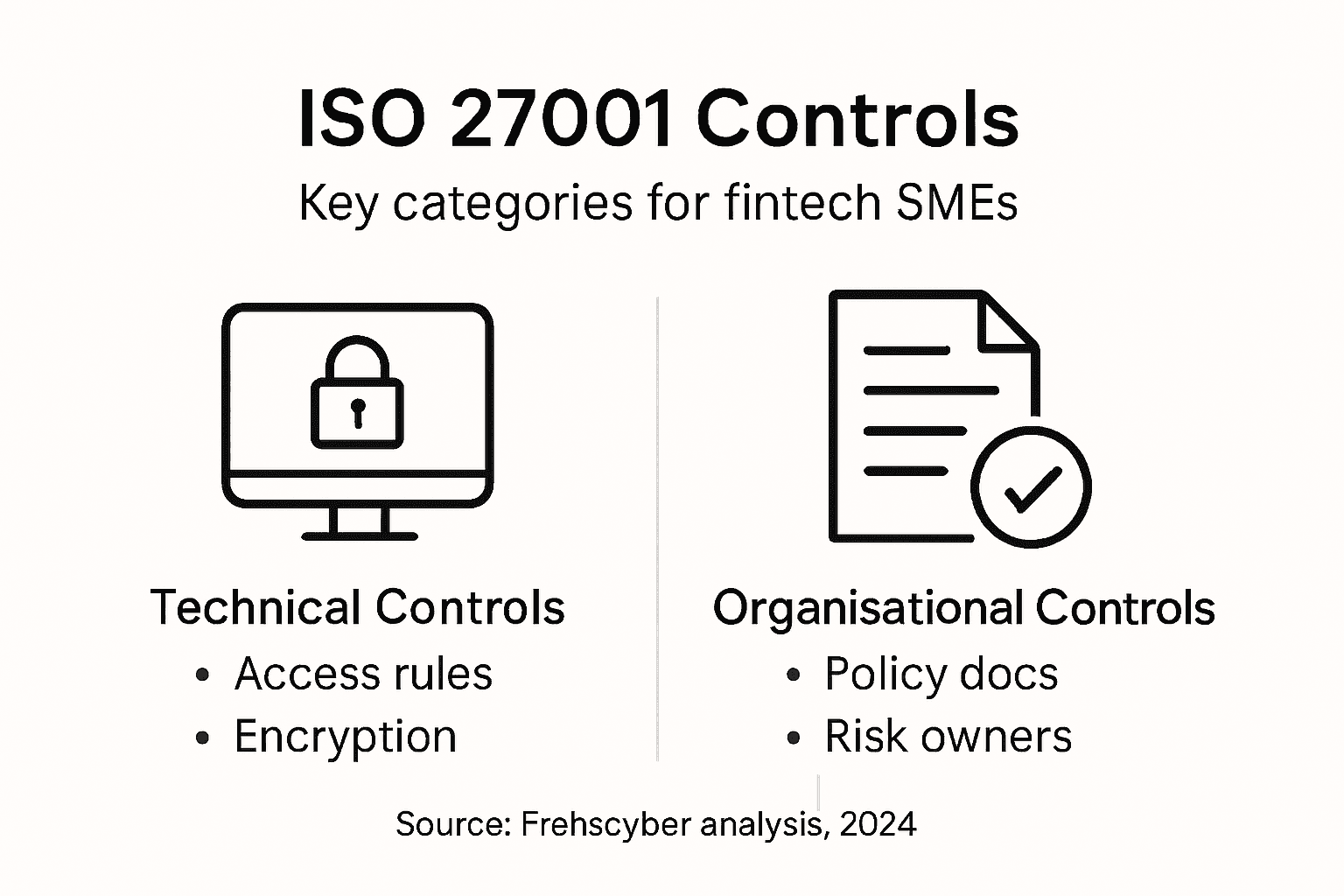
Organisational controls – policies, governance structures, and risk management processes that steer your security strategy
People controls – employee screening, security awareness training, and disciplinary procedures
Physical controls – access restrictions to offices, server rooms, and facilities holding sensitive data
Technical controls – encryption, firewalls, multi-factor authentication, and monitoring systems protecting digital assets
Operational controls – incident response procedures, backup protocols, and change management processes
Most fintech SMEs focus heavily on technical controls because they’re visible and measurable. But organisational controls matter equally - they define why technical controls exist and ensure everyone follows them.
Which Controls Actually Apply To Your Fintech?
ISO 27001 provides 93 controls across different categories. You don’t implement all 93. Instead, your Statement of Applicability (SoA) documents which controls apply to your specific risk profile.
A payment processing firm faces different risks than a data analytics company. Your SoA reflects this reality, explaining which controls you’ve selected and why you’ve excluded others.
This is where compliance workflow planning becomes critical. You map controls to risks, assign owners, define implementation timelines, and track completion. Without workflow discipline, controls fail silently.
Why Fintech SMEs Get This Wrong
Most firms make three mistakes:
Selecting controls based on audit requirements rather than actual risk – controls become box-ticking exercises instead of security measures
Implementing controls but never testing them – you document a backup procedure but never verify it actually restores data
Assigning control ownership to people already overloaded – responsibility without capacity means controls drift
The remedy is straightforward: assign clear ownership, define testing schedules, and track metrics showing controls actually work.
Pro tip: Document control owners in a simple spreadsheet listing each control, the person responsible, testing frequency, and last verification date. Review this monthly in security meetings - this single artefact prevents controls from becoming orphaned or forgotten.
Certification Steps For Fintech IT Managers
ISO 27001 certification isn’t a sprint. It’s a structured journey with defined phases, each building on the previous one. As IT manager, you’ll own much of the technical groundwork, so understanding the roadmap prevents surprises later.
The certification process typically runs 6 to 12 months depending on your starting maturity and organisational size. Fintech firms with existing security foundations complete it faster. Those starting from scratch need patience.
Phase 1: Gap Analysis And Planning
Your first step is understanding the distance between where you are now and where ISO 27001 requires you to be.
A gap analysis documents:
Which controls already exist (access controls, backup procedures, incident logs)
Which controls are missing or incomplete
Resource requirements to close gaps (budget, staff time, tools)
This phase typically takes 4 to 6 weeks. You’ll audit your current security posture, interview department heads, and map existing procedures against ISO 27001 requirements.
The output is a prioritised implementation roadmap showing which controls to build first and realistic timelines for completion.
Phase 2: ISMS Design And Documentation
Now you design your Information Security Management System. This means creating policies, procedures, and governance structures that reflect your fintech operations.
Key deliverables include:
Information Security Policy – high-level statement of your security commitment and principles
Risk Register – documented assessment of threats, likelihood, impact, and mitigating controls
Statement of Applicability – listing all 93 ISO 27001 controls and clearly stating which apply to your firm
Control procedures – step-by-step documentation of how each selected control operates
This phase demands cross-functional collaboration. Your finance team explains data handling; operations describes backup procedures; HR details employee screening practices.
Documentation isn’t bureaucracy—it’s proof that your security operates intentionally, not accidentally. Auditors verify controls through documented evidence, not assumptions.
Phase 3: Implementation And Testing
You now build and test controls identified in your gap analysis. This is where technical work happens: deploying encryption, configuring access restrictions, establishing backup routines.
For each control, you:
Implement the technical or procedural measure
Create evidence showing it operates (logs, audit trails, training records)
Test that it actually works (restore a backup, verify encryption, confirm access denials)
Document findings and remediate any failures
This phase lasts 3 to 6 months depending on control complexity and resource availability.
Phase 4: Internal Audit And Remediation
Before the official audit, conduct your own internal review. This identifies weaknesses before an external auditor finds them, preventing certification delays.
Your internal audit verifies:
Controls operate as documented
Evidence exists proving operation
Policies are followed consistently
Non-conformances are tracked and resolved
Document findings rigorously. If gaps emerge, fix them immediately rather than hoping auditors overlook them.
Phase 5: External Certification Audit
An accredited third-party auditor conducts a formal two-stage audit. Stage 1 reviews your documentation; Stage 2 verifies controls operate in practice.
The auditor interviews staff, reviews logs, tests access restrictions, and observes procedures. They’ll identify non-conformances (control failures) and observations (areas for improvement).
Minor non-conformances can be remediated within 30 days. Major non-conformances require certification to be withheld until resolved.
Once the auditor confirms compliance, you receive your ISO 27001 certificate valid for three years. Annual surveillance audits maintain certification.
Avoiding Common Pitfalls
Fintech IT managers typically struggle with three mistakes:
Underestimating documentation effort – policy writing and procedure documentation takes longer than expected
Treating implementation as IT-only work – controls span people, physical security, and operations; involve all departments early
Delaying evidence collection until audit preparation – gather logs, training records, and audit trails continuously, not retrospectively
The remedy: assign a control owner for each procedure, define monthly verification checks, and maintain a rolling evidence file throughout implementation.
Pro tip: Before engaging an external auditor, verify your IT security checklist for certification is complete and all controls are operating with documented evidence. This pre-audit preparation prevents costly delays and increases first-time certification success.
UK Laws And Regulatory Requirements
ISO 27001 isn’t optional in UK fintech. Regulators, enterprise clients, and data protection authorities increasingly expect it. Understanding the legal landscape clarifying why certification matters helps you prioritise investment and communicate compliance value to leadership.
The regulatory environment has shifted. 2024 brought tighter expectations; 2025 introduces stricter obligations. Your fintech faces converging legal pressures that ISO 27001 directly addresses.
GDPR And The Data Protection Act 2018
Fintech companies process vast amounts of personal data: customer names, transaction histories, payment methods, identity verification documents. The UK General Data Protection Regulation (GDPR) and Data Protection Act 2018 govern how you handle this information.
These laws require:
Data protection by design – security built into systems from inception, not bolted on later
Incident reporting – notifying regulators of breaches within 72 hours
Data subject rights – allowing customers to access, correct, or delete their information
Privacy impact assessments – documenting how you protect sensitive personal data
ISO 27001 provides the systematic risk management framework these laws demand. Your ISMS documents controls protecting personal data, proving compliance to the Information Commissioner’s Office (ICO) if questioned.
The FCA And Financial Conduct Authority Expectations
If your fintech firm holds customer money, provides payments, or offers investment services, the Financial Conduct Authority (FCA) regulates you. The FCA emphasises operational resilience and cyber-risk management in its 2024-2025 guidance.
The FCA expects regulated firms to:
Identify critical systems supporting core business functions
Test resilience to cyber-attacks through scenario planning
Maintain incident response plans with measurable recovery objectives
Report significant cyber incidents to regulators
ISO 27001 demonstrates structured risk management aligning with FCA expectations. Certification proves you’ve assessed threats, implemented controls, and maintain resilience.
2025 UK cybersecurity regulations emphasise supply chain risk management, incident response readiness, and ISO 27001 alignment, making certification critical for financial sector firms competing for enterprise contracts.
The Network And Information Systems Regulations 2018
The Network and Information Systems (NIS) Regulations 2018 apply to “operators of essential services” and “digital service providers” meeting size thresholds. Most fintech SMEs fall under this definition.
NIS requires:
Security obligations – implementing measures protecting network and information systems
Incident reporting – notifying authorities of significant security incidents
Competent authority cooperation – working with regulators during investigations
ISO 27001 demonstrates you’ve met the “security obligations” requirement through documented controls and risk assessment.
Enterprise Client Expectations
Regulatory obligations are one thing. Enterprise clients demand another. Large financial institutions, investment firms, and corporate entities now mandate ISO 27001 certification before awarding contracts to fintech vendors.
This reflects risk transfer. Enterprise firms avoid regulatory penalties by ensuring their suppliers meet security standards. Your certification becomes a contract requirement, not merely a compliance aspiration.
Without it, you’re excluded from tender processes entirely, regardless of your actual security posture.
Below is a concise reference table linking UK fintech regulatory drivers to ISO 27001 certification value:
Regulation | Key Requirement | How ISO 27001 Supports |
GDPR | Data protection by design | Systematic controls and risk framework |
FCA Guidance | Operational resilience | Structured risk assessment, incident response plans |
NIS Regulations | Network/system security obligations | Documented controls and evidence for audits |
Enterprise Client Mandates | Supplier certification | Contract eligibility and business advantage |
Why Compliance Is Competitive Advantage
Compliance isn’t a cost centre. It’s a contract-winning asset. Fintech SMEs achieving ISO 27001 certification unlock enterprise contracts blocked to non-certified competitors.
Regulators increasingly cross-reference ISO 27001 in oversight conversations. The ICO, FCA, and NCSC all recognise it as evidence of mature security governance.
Pro tip: Document your regulatory obligations mapping - list which laws apply to your fintech (GDPR, FCA, NIS, sector-specific rules) and cross-reference the ISO 27001 controls addressing each. Present this mapping to leadership showing how certification satisfies multiple regulatory requirements simultaneously, justifying investment.
Common Pitfalls And Business Benefits
ISO 27001 certification delivers measurable business value. But fintech SMEs often stumble during implementation, squandering that value through preventable mistakes. Understanding both the pitfalls and the benefits helps you navigate the journey strategically.
The difference between success and failure usually isn’t technical. It’s organisational discipline and realistic expectations.
The Five Most Common Pitfalls
Fintech firms typically fail at ISO 27001 for predictable reasons:
Treating compliance as an IT project – security becomes solely the IT manager’s burden, ignoring the cross-functional work required
Implementing controls without business context – technical controls deployed without understanding the risks they address
Underestimating documentation effort – underestimating the time required to write, review, and maintain policies and procedures
Hiring wrong consultants – selecting low-cost advisors who deliver boilerplate policies rather than tailored frameworks
Skipping internal audit – rushing toward external certification without conducting rigorous internal verification first
Each mistake delays certification, increases costs, or results in failed audits requiring remediation cycles.
Certification fails when controls become box-ticking exercises rather than operational realities. Your ISMS must reflect how your fintech actually operates, not how consultants think it should operate.
Why Timeline Estimates Go Wrong
Most fintech SMEs underestimate implementation timelines by 40 to 60 percent. You plan six months; actual delivery takes nine or ten.
This happens because:
Control testing extends longer than expected – verifying that backups restore, encryption functions, and access restrictions work takes multiple test cycles
Cross-functional collaboration slows down – gathering requirements from finance, operations, and HR takes time when teams juggle daily responsibilities
Staff turnover disrupts progress – losing a key resource mid-implementation forces knowledge transfer and timeline reset
Scope creep occurs – discovering missing controls during gap analysis expands your implementation work
The remedy: build a 20 to 30 percent contingency buffer into your timeline, assign dedicated resources, and conduct monthly progress reviews tracking actual versus planned completion.
The Real Business Benefits
When implemented properly, ISO 27001 transforms your fintech’s competitive position:
Enterprise contract eligibility – certifications unlock tender processes worth millions annually
Reduced audit burden – enterprise clients conduct fewer security audits when certification proof exists
Operational efficiency – documented procedures reduce inconsistency and rework, lowering operational costs
Staff confidence – employees understand security expectations and follow procedures consistently
Regulatory favour – regulators view certified firms more favourably during oversight conversations
Reduced breach impact – cyber risk management maturity detected through controls reduces breach likelihood and containment time
Beyond The Certificate
The certificate itself is marketing material. The real asset is the functioning ISMS protecting your information and improving operational resilience.
Certified firms that treat their ISMS as a living system - updating controls annually, testing incident response procedures, evolving controls as threats change - gain durability. They win repeat contracts because they demonstrate continuous security improvement, not just point-in-time compliance.
Firms that let their ISMS gather dust after certification lose the competitive advantage. Controls drift, evidence lapses, and the system becomes liability rather than asset.
Pro tip: Schedule quarterly ISMS reviews with your leadership team reviewing risk trends, control testing results, and emerging threats. This keeps security visible as an operational priority rather than a compliance checkbox, and demonstrates to enterprise clients that you actively maintain your certification value.
Unlock True Compliance Confidence with Freshcyber
ISO 27001 compliance can be overwhelming for UK fintech SMEs facing ever-changing risks, stretched resources, and costly traditional consultancies. The key challenge is transforming static documentation into a dynamic Information Security Management System that actually protects your business and secures those vital enterprise contracts
At Freshcyber, we understand your pain points around risk assessment, control ownership, and continuous evidence collection. Our Compliance solutions are designed to take the burden off your overloaded IT teams with our Compliance Currency Engine. We lead every step of your ISO 27001:2022 journey - from gap analysis and tailored policy suites to audit-ready ISMS maintenance - ensuring you not only meet regulatory demands but also build a clear competitive advantage.

Don’t wait until your next tender opportunity passes you by. Act now to transform ISO 27001 from a daunting obligation into your fintech’s strongest sales asset. Visit Freshcyber to see how our strategic vCISO-led approach combined with Vulnerability Management and Cyber Essentials expertise will protect your growth and scale your security resilience with confidence.
Frequently Asked Questions
What is ISO 27001 compliance?
ISO 27001 compliance refers to adhering to the international standard for Information Security Management Systems (ISMS), which helps organisations protect sensitive data, manage risks, and enhance trust with clients.
Why is ISO 27001 certification important for UK fintech SMEs?
ISO 27001 certification is crucial for UK fintech SMEs as enterprise clients, investment partners, and regulators increasingly expect proof of security standards before awarding contracts, making it a key competitive advantage.
What are the main components required for ISO 27001 implementation?
The main components for ISO 27001 implementation include establishing an Information Security Management System (ISMS), conducting thorough risk assessments and treatments, and undergoing external audit verification to ensure compliance with the standard.
How can fintech SMEs overcome challenges in achieving ISO 27001 certification?
Fintech SMEs can overcome challenges by opting for an ongoing partnership for ISMS management, involving across-the-board participation from all departments, and conducting thorough gap analyses to understand their current security posture and required resources.
Recommended
Comments