The Importance of ISO 27001 for UK SMEs


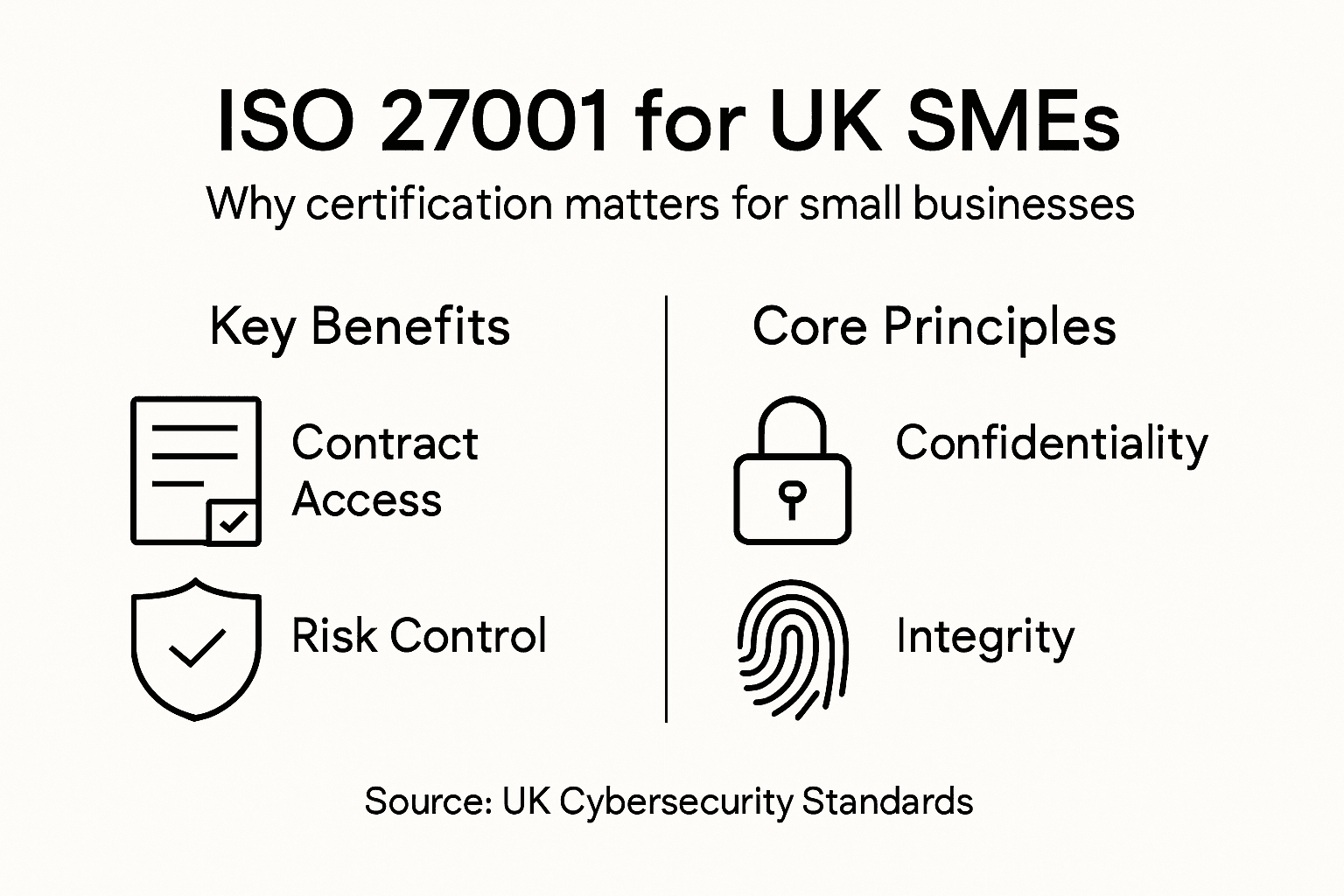
Securing lucrative B2B contracts often hinges on proving your firm’s commitment to robust information security. For directors in the British legal and financial sectors, ISO 27001 certification transforms compliance from a daunting tick-box task into a strategic asset. As regulatory demands tighten with new requirements such as DORA, certification builds trust with enterprise partners, ensures alignment with evolving UK laws, and empowers your SME to compete confidently for larger opportunities. Boldly invest in structured compliance to turn information security into market advantage.
Table of Contents
Key Takeaways
Point | Details |
ISO 27001 Ensures Data Protection | Certification mandates a robust Information Security Management System to safeguard client data and maintain compliance with regulatory demands. |
Certification Drives Business Growth | Achieving ISO 27001 opens doors to larger contracts and enhances your firm’s competitiveness in the marketplace. |
Risk Mitigation Through Standards | Implementing ISO 27001 not only reduces the impact of data breaches but also aligns your firm for better insurance coverage. |
Enhances Supply Chain Trust | Certification demonstrates rigorous security practices, bolstering confidence among clients and partners regarding data handling across your supply chain. |
What ISO 27001 Certification Involves
ISO 27001 certification requires you to build and operate a formal Information Security Management System (ISMS) that protects your firm’s data across all layers. This is not a one-time box-ticking exercise - it’s a structured, ongoing programme that demonstrates to your clients, regulators, and partners that you treat information security with the rigour your legal or financial sector demands.
The process begins with understanding what you’re protecting and where the risks lie. Risk assessment identifies and mitigates threats through a systematic evaluation of your firm’s information assets, from client files to cloud-stored transaction records. You’ll map every place sensitive data lives and flows through your business.
Once you understand your risks, certification involves implementing 93 controls spanning four key areas:
Below is a summary of the core ISO 27001 control areas and how each strengthens your firm’s security posture:
Control Area | Key Focus | Example Benefit |
Organisational | Security governance | Strong leadership accountability |
People | User access management | Prevents unauthorised internal access |
Physical | Facility and equipment safety | Safeguards paper and hardware assets |
Technological | Digital system protections | Reduces risk of cyber-attacks |
Organisational controls: governance, policies, and staff training that embed security into your culture
People controls: vetting, access management, and incident response training
Physical controls: secure offices, server rooms, and document handling
Technological controls: encryption, firewalls, vulnerability scanning, and threat monitoring
You’ll then document your approach in a Statement of Applicability (SoA), which proves to auditors which controls apply to your business and how you’re implementing them. This is where many SMEs stumble - the paperwork feels enormous, but it’s simply your evidence trail.
The certification itself requires an external auditor to verify that your ISMS actually works in practice, not just on paper. They’ll examine your processes, interview staff, and test controls to ensure your firm can genuinely protect confidentiality, integrity, and availability of information.
ISO 27001 certification signals to enterprise clients that you’ve implemented a proven security framework - often a non-negotiable requirement for B2B contracts worth six or seven figures.
The three core principles - confidentiality (only authorised people access data), integrity (data isn’t altered without permission), and availability (systems stay operational when needed) - run through everything you do.
Certification requires planning, scoping your ISMS to your actual business size and complexity, communicating changes across your team, and then continuously monitoring and improving. For UK SMEs, this typically takes 6-12 months from gap analysis to audit, depending on your starting point and resources.
Pro tip: Don’t delay defining your scope or build policies so broad they become unmanageable. Scope your ISMS tightly to your highest-risk areas first - client data handling, staff access, cloud systems - and expand systematically rather than trying to certify everything at once.
Regulatory Drivers and UK Compliance Needs
UK SMEs in legal and financial services face a tightening regulatory environment that makes ISO 27001 compliance less of a competitive advantage and more of a survival requirement. Two major drivers are reshaping the compliance landscape: updated data protection rules and strengthened cyber-security obligations.
The Data Use and Access Act 2025 updates how organisations must handle information under UK law. Data protection laws clarify automated decision-making, cookie use, and scientific research exemptions. For your firm, this means tighter controls around client data processing and clearer documentation of who can access what information.
Meanwhile, the UK Cyber Security and Resilience Bill introduces mandatory security standards for organisations providing essential or digital services. This Bill pushes organisations to implement proportionate security measures, directly aligning with ISO 27001 framework requirements.
These regulations create three immediate pressures for UK SMEs:
Contract requirements: Enterprise clients now demand ISO 27001 as a baseline before signing B2B agreements, especially in financial services and regulated sectors
Regulatory expectations: Sector regulators and the ICO expect firms to demonstrate risk management and incident response capabilities
Data handling obligations: Stricter rules around consent, automated processing, and cross-border data flows require documented controls
For directors in legal and financial firms, this is not abstract compliance. Your clients demand proof you protect their data. Your regulators expect you to report breaches. Your insurers require documented security measures to issue cyber-liability coverage.
Organisations with ISO 27001 compliance align automatically with these regulatory frameworks, turning compliance into a business asset rather than a cost centre.
The convergence is clear: DORA requirements for financial services, GDPR updates, and the Cyber Resilience Bill all point to the same outcome. Firms without formal information security management systems will struggle to win contracts, pass audits, and maintain client trust.
This is why many SME directors are treating ISO 27001 as non-negotiable. It is the single standard that addresses all these regulatory drivers simultaneously.
Pro tip: Map your current regulatory obligations - GDPR, DORA if applicable, sector-specific rules - then align your ISO 27001 roadmap to address all three simultaneously rather than treating them as separate projects.
Enabling Larger Contracts and Market Growth
ISO 27001 certification is your ticket to contracts worth ten or twenty times your current annual revenue. Enterprise clients - banks, insurance firms, and large corporates - will not sign agreements with unaudited security practices. Your certification removes their objection and puts you on their approved vendor list.

When you pursue larger B2B contracts, procurement teams ask three questions: Can you handle our data safely? Can you prove it? Will you remain compliant if something goes wrong? ISO 27001 answers all three at once.
Certification schemes enable businesses to compete for larger contracts by demonstrating adherence to recognised information security standards. This isn’t theoretical - it opens actual market access. Procurement gatekeepers see ISO 27001 and move you forward. Without it, they move you to the reject pile.
The practical impact is straightforward:
Vendor qualification shortlist: Your firm qualifies for tenders that explicitly require ISO 27001 compliance
Faster contract negotiation: Clients skip the security audit questions; they trust your certification instead
Premium pricing: You command higher fees because you carry less risk and require less client due diligence
Relationship expansion: Once you win a contract, you’re positioned to sell additional services to the same client
Financial services firms particularly benefit. Compliance officers at banks and investment firms treat ISO 27001 as non-negotiable. Without it, you cannot become their legal counsel, accountant, or technology vendor.
Beyond immediate contracts, certification supports access to capital and investment. Access to audited financial statements and certifications like ISO 27001 matters for SMEs seeking capital and larger contracts. If you plan to raise funding, exit, or scale significantly, investors want proof your firm manages risk professionally.
ISO 27001 reduces your risk profile in the eyes of clients, investors, and acquirers - directly translating to contract wins and higher valuations.
Many UK SME directors see certification as a growth investment, not a compliance cost. You spend 6-12 months building your ISMS, then spend the next three years winning contracts that would have been impossible without it. The return compounds as you win larger clients and build deeper relationships.
Pro tip: Before starting ISO 27001, audit your sales pipeline and identify three target clients requiring certification as a contract condition, then use that certification timeline as your roadmap deadline.
Risk Reduction and Insurance Advantages
ISO 27001 certification does more than win contracts - it actively reduces the financial and reputational damage when breaches happen. And they do happen. The question is whether your firm survives them intact.
Cyber-attacks hit SMEs constantly. Many UK SMEs dismiss the risk because they think they are too small to target. That is dangerously wrong. Criminals attack SMEs precisely because they have weaker defences and often carry high-value data - client files, financial records, intellectual property.
ISO 27001 adoption supports risk mitigation by establishing strong information security controls, coupled with appropriate cyber insurance to reduce financial impacts of breaches. When you have both certification and insurance aligned, you create a safety net that protects your firm’s survival.
Here is what that protection looks like in practice:
Breach cost reduction: Certified firms typically suffer lower breach costs because they detect incidents faster and contain them more effectively
Insurance premium alignment: Insurers offer better rates and higher limits for certified organisations because they represent lower risk
Claims settlement support: When you submit a breach claim, your ISO 27001 documentation proves you took reasonable precautions, strengthening your claim
Regulatory leniency: Regulators view certified firms more favourably during breach investigations
Insurance requirements present real barriers for SMEs bidding on larger contracts. Procurement teams demand specific policy wording, indemnity limits, and cyber coverage. Without clear security practices, you cannot negotiate those terms confidently.
ISO 27001 certification facilitates clearer understanding of security risks, strengthening your insurance position and enabling confident contract bidding. Your broker can match your coverage to your documented controls, ensuring no gaps between what you promise and what you actually protect.
A single data breach costs SMEs an average of £19,400 in direct costs, but certified firms with proper insurance recover within weeks. Uninsured or under-insured firms often fold.
The economics are stark. Certification costs £5,000 to £15,000 in first-year implementation. Cyber insurance costs £1,500 to £5,000 annually. A single breach without proper defences can cost £50,000 to £250,000 in recovery, legal fees, notification costs, and business interruption.
Directors who have experienced a breach often say certification was their cheapest insurance policy.
The table below highlights how ISO 27001 certification supports risk management and insurance outcomes for UK SMEs:
Area | With Certification | Without Certification |
Breach Impact | Lower financial and reputational loss | Higher risk of severe business damage |
Insurance Premiums | Access to better rates and terms | Higher premiums, limited coverage |
Claim Settlements | Stronger evidence for claims | Weaker position in disputes |
Regulatory Reviews | Favourable treatment, reduced fines | Greater scrutiny, harsher penalties |
Pro tip: When obtaining cyber insurance quotes, provide your ISO 27001 scope and control summary to insurers upfront - this positions them to offer better premiums and terms from day one rather than discovering gaps during claims.
Building Trust Across the Supply Chain
Your firm does not exist in isolation. You rely on suppliers for cloud services, software, payroll systems, and outsourced functions. Your clients rely on you to protect their data even when it passes through third parties. ISO 27001 certification proves to everyone in your supply chain that you take information security seriously.
Supply chain trust is fragile. A single breach at a vendor you work with can damage your reputation and expose your clients’ data. Enterprise procurement teams now demand proof that their vendors - and your vendors - have solid security controls in place.
ISO 27001 certification requires you to manage information security risks across your entire supplier ecosystem. This is not just internal security; it is supply chain security. ISO 27001 supports trust in the supply chain by requiring organisations to manage information security risks related to supplier relationships, including due diligence, contractual obligations, and ongoing monitoring.
Here is what supply chain security involves in practice:
Supplier vetting: Auditing third-party security practices before they access your systems or data
Contractual security clauses: Requiring vendors to meet specific security standards in writing
Incident reporting obligations: Making suppliers notify you immediately if a breach occurs
Ongoing assessments: Monitoring supplier security posture continuously, not just once at onboarding
Access controls: Limiting what each vendor can see and limiting how long they retain data
When you are ISO 27001 certified, you become the trusted vendor that larger clients actually want to work with. Your certification signals that you vet your own suppliers rigorously. You are not a security weak link in their supply chain; you strengthen it.
Building trust across the supply chain is essential for resilience and sustainability. Your customers increasingly demand transparency into how their data moves through your organisation and which third parties can access it.
Certification enables transparency and risk management throughout the supply chain, assuring partners and customers that security is prioritised.
Many SMEs overlook this angle. They think ISO 27001 is about locking down their own office. In reality, it is about becoming a trustworthy link in a larger ecosystem. That trust compounds. When you win a contract because you are certified, you immediately qualify for even larger contracts because you can demonstrate vendor security management.
Directors in legal and financial services particularly benefit. These sectors are paranoid about supply chain risk - and rightfully so. Your certification removes their objection and positions your firm as a partner, not a liability.
Pro tip: Create a simple vendor security assessment form during your ISO 27001 implementation, then use it to audit critical suppliers quarterly - this turns compliance into active supply chain protection that clients notice and value.
Strengthen Your SME’s Security and Win Bigger Contracts with Freshcyber
ISO 27001 certification is a critical challenge for UK SMEs aiming to protect client data, comply with tightened regulations, and access lucrative contracts. The article highlights the complex demands of building an effective Information Security Management System that safeguards confidentiality, integrity, and availability while easing regulatory pressures and insurance hurdles. Whether you struggle with audit readiness, managing supplier risks, or maintaining continuous cyber resilience, these pain points threaten your growth and market trust.
Freshcyber transforms these hurdles into your strongest business assets. Our Cyber Security Compliance for UK SMEs: Guides & Best Practices offer practical pathways to sustained compliance and risk management. Through our virtual Chief Information Security Officer (vCISO) powered Compliance Currency Engine, we guide you from gap analysis to certification, aligning ISO 27001 and other frameworks with your firm’s unique risks and ambitions. Complemented by 24/7 threat hunting and Vulnerability Management, Assessments & Scanning for UK SMEs, we ensure your defences are proactive, not reactive.

Do not let compliance be a barrier but a competitive currency. Act now to elevate your SME’s security posture and unlock high-value contracts with confidence by partnering with Freshcyber. Discover how we can help you build resilient, audit-ready information security at https://freshcyber.co.uk.
Frequently Asked Questions
What is ISO 27001 certification?
ISO 27001 certification is a formal certification that demonstrates an organisation has implemented an effective Information Security Management System (ISMS) to protect sensitive data and manage information security risks.
Why is ISO 27001 important for SMEs?
ISO 27001 is crucial for SMEs as it provides a framework for protecting client data, which is increasingly demanded by enterprise clients and regulatory bodies. It ensures compliance with laws and strengthens your security posture.
How long does it take for a UK SME to achieve ISO 27001 certification?
Typically, it takes UK SMEs between 6 to 12 months to achieve ISO 27001 certification, depending on the company’s resources and existing security measures. This timeframe includes the gap analysis, implementation, and final audit.
How does ISO 27001 certification help with insurance and risk management?
ISO 27001 certification helps reduce financial and reputational damage from data breaches by establishing strong security controls. Certified firms often experience lower breach costs, better insurance rates, and more favourable treatment from regulators.
Recommended
Comments