How to Implement Vulnerability Remediation for UK SMEs
- Gary Sinnott

- Jan 8
- 8 min read

Over half of British SMEs in regulated sectors face regulatory scrutiny for gaps in vulnerability management. Staying ahead of compliance demands is not just a technical challenge but a business-critical issue for CIOs. Effective vulnerability remediation sets the foundation for operational resilience, helping you safeguard sensitive data and reduce risk exposure as your organisation evolves in a complex digital world.
Table of Contents
Quick Summary
Key Message | Explanation |
1. Establish a Risk-Based Prioritisation Framework | Create a systematic approach to identify and rank security risks based on potential impact and likelihood. |
2. Conduct Comprehensive Vulnerability Assessments | Regularly inventory all digital assets to uncover hidden vulnerabilities and assess their potential impacts. |
3. Develop Targeted Remediation Action Plans | Categorise vulnerabilities by severity and create clear prioritised plans for resolving identified issues. |
4. Implement Remediation and Monitor Progress | Assign team responsibilities and use tracking tools to ensure timely implementation and identify process bottlenecks. |
5. Verify Effectiveness and Update Risk Registers | Regularly review security measures and keep risk registers current to adapt to new threats and challenges. |
Step 1: Establish a Risk-Based Prioritisation Framework
Establishing a risk-based prioritisation framework transforms your vulnerability management from a reactive task to a strategic process. By systematically evaluating and ranking potential security risks, you can allocate resources more intelligently and protect your organisation’s most critical assets.
The foundation of an effective risk-based prioritisation framework involves creating a comprehensive risk assessment methodology. Start by mapping your entire digital infrastructure and identifying all potential vulnerabilities. This means conducting thorough asset inventories, understanding system interconnectivity's, and evaluating potential impact zones. Vulnerability management workflows for SMEs can provide structured guidance for this initial mapping process.
Your prioritisation matrix should incorporate multiple risk dimensions including potential financial impact, likelihood of exploitation, system criticality, and regulatory compliance requirements. The UK Energy Research Centre highlights that SMEs must develop frameworks enabling effective risk prioritisation despite limited resources, which means creating a nuanced yet practical scoring system. Assign numerical values to each risk dimension, creating a weighted scoring mechanism that allows you to rank vulnerabilities systematically. Complex vulnerabilities affecting core business systems or holding significant potential for financial or reputational damage should receive immediate attention.
Pro tip: Regularly review and recalibrate your risk prioritisation framework every quarter to ensure it remains aligned with your evolving business landscape and emerging cyber threats.
Here’s a concise summary of key risk prioritisation factors for vulnerability management:
Risk Dimension | Description | Business Impact |
Financial Impact | Potential monetary loss if exploited | Revenue loss, extra costs |
Likelihood of Exploitation | Probability of attacker success | Higher priority for remediation |
System Criticality | Importance to core operations | Service disruption risk |
Regulatory Compliance | Relevance to legal requirements | Fines, sanctions, reputational damage |
Step 2: Conduct Comprehensive Vulnerability Assessments
Conducting comprehensive vulnerability assessments is crucial for identifying potential security weaknesses across your organisation’s digital infrastructure. This systematic process helps you uncover hidden risks before malicious actors can exploit them, providing a proactive approach to cybersecurity management.
Begin by creating a detailed inventory of all hardware, software, and network assets within your organisation. Why vulnerability assessments are important can provide deeper insights into this critical process. The Health and Safety Executive recommends personalising risk assessment approaches to your specific operational context, which means understanding not just the technical components, but how they interconnect and potentially expose your business to security threats. Utilise both automated scanning tools and manual inspection techniques to ensure a thorough examination. Pay special attention to areas like network configurations, user access controls, software patch levels, and potential entry points for external threats.

Your vulnerability assessment should incorporate multiple evaluation dimensions. Categorise risks based on their potential impact, likelihood of exploitation, and the criticality of affected systems. This approach allows you to prioritise remediation efforts effectively. Consider factors such as potential financial damage, regulatory compliance implications, and reputational risks. The Financial Conduct Authority emphasises the importance of understanding vulnerability characteristics that might affect operational decision making, which translates directly into how comprehensively you assess and manage security risks.
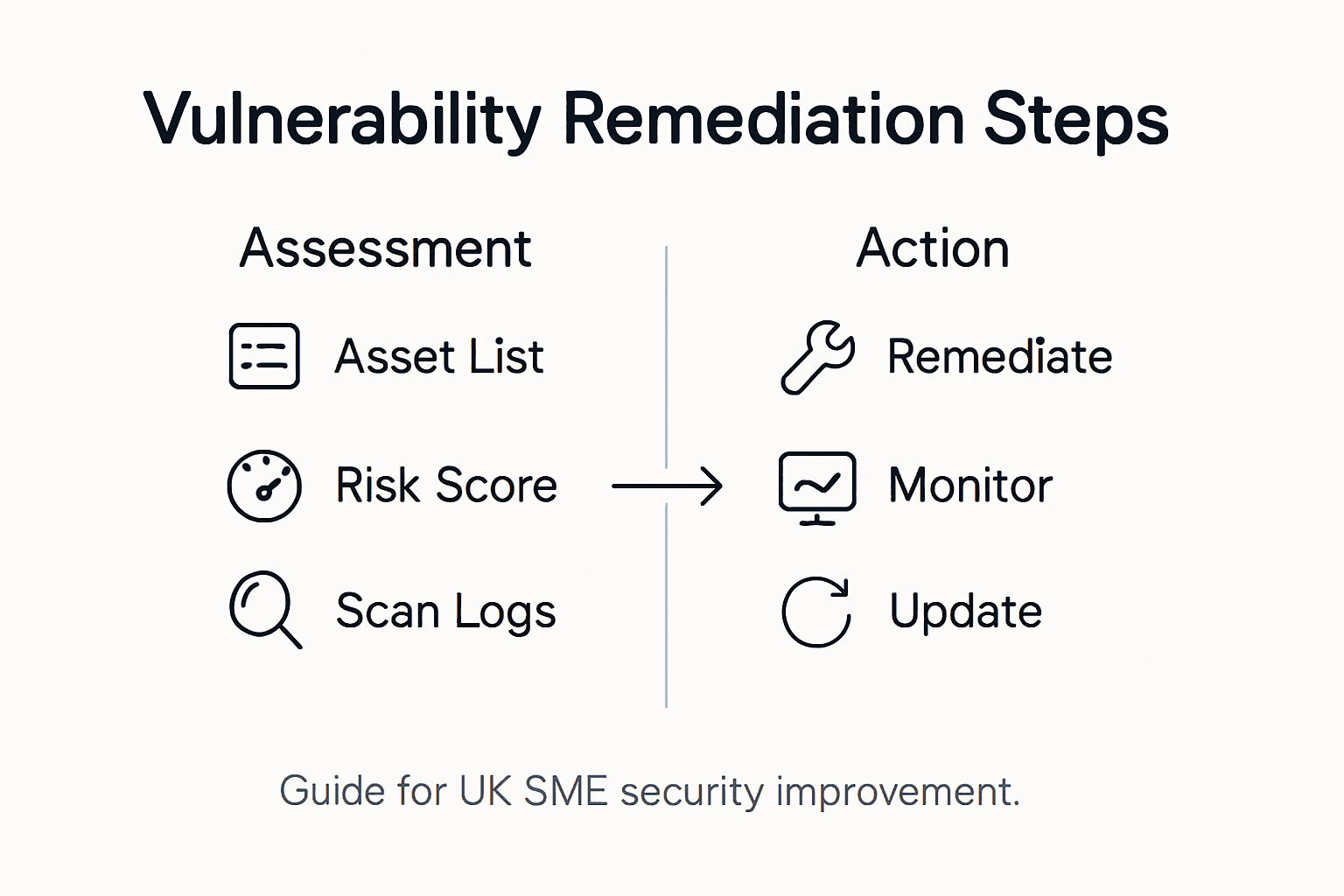
Pro tip: Schedule vulnerability assessments quarterly and after any significant infrastructure changes to maintain an up-to-date understanding of your security landscape.
Step 3: Develop Targeted Remediation Action Plans
Developing targeted remediation action plans transforms your vulnerability insights into strategic, actionable steps that protect your organisation’s digital infrastructure. This crucial phase translates technical findings into practical interventions that address your most critical security weaknesses.
Start by categorising your identified vulnerabilities based on their severity, potential business impact, and ease of resolution. Remediation acceleration strategies provide excellent frameworks for structuring these plans effectively. Each vulnerability should have a clear ownership assignment, specific mitigation steps, precise timelines, and measurable outcomes. For instance, critical vulnerabilities might require immediate intervention within 24 to 48 hours, while lower risk issues can be scheduled for resolution in subsequent maintenance windows.
The UK Finance report emphasises the importance of creating sector-specific and measurable remediation goals. Your action plan should include detailed resource allocation, budget considerations, and potential external support mechanisms. Prioritise vulnerabilities that pose the most significant risks to your operational continuity, regulatory compliance, and financial stability. Develop contingency strategies for each identified vulnerability, ensuring you have backup plans and alternative mitigation approaches. Document each step meticulously, creating a comprehensive roadmap that not only addresses current vulnerabilities but also establishes a repeatable process for future security management.
Pro tip: Create a living document for your remediation plan that can be dynamically updated and shared across your organisation to maintain transparency and accountability.
Step 4: Implement Remediation and Monitor Progress
Implementing remediation actions and establishing robust monitoring processes are critical for transforming your vulnerability management from a one-time exercise to a continuous improvement strategy. This phase ensures that your carefully developed plans translate into tangible security enhancements across your organisation’s digital infrastructure.
Ongoing monitoring strategies for SMEs highlight the importance of creating a systematic approach to tracking your remediation efforts. Begin by assigning specific team members to execute each remediation task with clear accountability and deadlines. Implement automated tracking tools that provide real-time updates on progress, allowing you to quickly identify bottlenecks or areas requiring additional resources. Your monitoring framework should include both quantitative metrics like completion percentage and qualitative assessments of the effectiveness of implemented security measures.
UK Finance recommends developing a comprehensive reporting mechanism that captures detailed insights about your remediation journey. This involves creating dashboards that visualise progress, conducting regular status meetings, and establishing a feedback loop that allows continuous refinement of your security strategies. Pay special attention to documenting lessons learned during each remediation cycle, which will help you develop more sophisticated and efficient approaches in future vulnerability management efforts. Consider implementing quarterly review sessions where you critically evaluate the impact of your remediation actions, assess any new emerging risks, and adjust your strategies accordingly.
The following table highlights stages of remediation and monitoring, plus their expected outcomes:
Stage | Primary Activity | Expected Outcome | Monitoring Approach |
Remediation Actions | Apply security fixes | Reduced vulnerabilities | Automated tracking tools |
Progress Monitoring | Track implementation progress | Timely issue resolution | Regular status meetings |
Effectiveness Review | Assess outcome of changes | Improved security posture | Penetration testing, analysis |
Pro tip: Integrate your remediation monitoring tools with your existing project management systems to create a seamless, transparent tracking environment.
Step 5: Verify Effectiveness and Update Risk Registers
Verifying the effectiveness of your vulnerability remediation efforts and maintaining an up-to-date risk register are crucial final steps in creating a robust cybersecurity management strategy. These processes ensure that your organisation remains proactive and responsive to evolving digital threats.
Risk management templates and approaches emphasise the importance of dynamic risk assessment. Begin by conducting comprehensive effectiveness reviews of your implemented security measures. This involves performing targeted penetration testing, reviewing incident logs, and comparing current security postures against your initial vulnerability assessment. Use quantitative metrics such as reduced system vulnerabilities, decreased security incident frequency, and improved response times to objectively measure the impact of your remediation efforts.
Your risk register should be a living document that reflects the current threat landscape of your organisation. Update the register with detailed findings from your effectiveness reviews, including new identified risks, status changes of existing risks, and the outcomes of your remediation actions. Assign clear ownership for each registered risk, with specific mitigation strategies and timelines. Consider implementing a colour coded system that provides immediate visual understanding of risk severity and status, enabling quick decision making and resource allocation.
Pro tip: Schedule biannual comprehensive risk register reviews and maintain a real-time digital tracking system that allows instant updates and collaborative input from key stakeholders.
Achieve True Cyber Resilience with Expert Vulnerability Remediation Support
Managing vulnerabilities effectively is a challenge faced by many UK SMEs as highlighted in the article “How to Implement Vulnerability Remediation for UK SMEs”. The complexities of establishing risk-based prioritisation, conducting thorough assessments, and delivering targeted remediation can feel overwhelming. You need to transform these technical and strategic tasks into a clear, actionable plan that protects your critical business assets while meeting compliance demands.
Freshcyber is here to guide you through that process with tailored solutions designed specifically for SMEs. Our Virtual CISO (vCISO) service acts as your dedicated security partner, providing hands-on leadership to develop and execute your remediation roadmap based on risk prioritisation and ongoing monitoring frameworks described in this article. From internal and external vulnerability assessments to dynamic risk management and compliance leadership, we empower your business to stay ahead of threats through proven methods.
Partner with Freshcyber to go beyond simple fixes. Ensure your vulnerability management is strategic, measurable, and aligned with recognised standards by leveraging our expertise in Vulnerability Management and SME Security.

Start securing your digital future today. Visit Freshcyber to discover how our consultancy services can transform your vulnerability remediation process into a powerful defence against cyber risk.
Frequently Asked Questions
What steps should I follow to create a risk-based prioritisation framework for vulnerability remediation?
Start by mapping your digital infrastructure and identifying potential vulnerabilities. Create a scoring system that includes factors such as financial impact and system criticality to rank vulnerabilities effectively.
How can I conduct comprehensive vulnerability assessments in my organisation?
Begin by inventorying all hardware, software, and network assets. Use both automated tools and manual inspections to thoroughly identify security weaknesses across your digital environment.
What should be included in a targeted remediation action plan?
Your action plan should categorise vulnerabilities by severity and include specific mitigation steps, ownership assignments, and deadlines. For critical vulnerabilities, aim to implement solutions within 24 to 48 hours while scheduling lower-risk issues for future maintenance.
How do I monitor the progress of my remediation actions?
Assign team members clear responsibilities for each remediation task and implement tracking tools for real-time updates. Conduct regular status meetings to identify any bottlenecks and ensure timely issue resolution.
What metrics should I use to verify the effectiveness of remediation efforts?
Use quantitative metrics such as reduced vulnerabilities and improved response times to measure effectiveness. Regularly conduct penetration testing and review incident logs to assess the impact of your remediation actions.
How often should I update my risk register after remediation?
Keep your risk register as a living document and schedule biannual reviews to ensure it reflects the current threat landscape. Update it in real-time with findings from your assessments and status changes of identified risks.
Recommended
Comments