Role of Cybersecurity in Contract Bids for UK SMEs
- Gary Sinnott

- Jan 26
- 12 min read

Submitting a contract bid can feel like you are under a microscope, especially as a British SME in FinTech or e-commerce. The strength of your cybersecurity is now a key factor that buyers scrutinise to judge whether your business is trustworthy. Cyber resilience is no longer just a technical matter - it is a commercial necessity directly affecting your eligibility and competitiveness. This article explains how meeting cybersecurity standards shapes your chances of winning contracts and staying compliant with evolving legal requirements.
Table of Contents
Key Takeaways
Point | Details |
Cybersecurity is Crucial for Bidding Success | SMEs must demonstrate strong cyber resilience to enhance trust and reliability in contract bids. |
Compliance with Standards is Necessary | Meeting cybersecurity standards, such as Cyber Essentials and ISO 27001, is essential for eligibility in competitive tenders. |
Legal Obligations are Increasing | Understanding and adhering to the Cyber Security and Resilience Bill and other legal frameworks is vital for maintaining eligibility and avoiding penalties. |
Non-compliance Can Have Severe Consequences | Failing to meet cybersecurity requirements can lead to significant financial costs, reputational damage, and loss of future business opportunities. |
Cybersecurity’s Influence on Contract Bidding
When you submit a contract bid as a UK SME, cybersecurity has quietly become one of the most consequential factors determining whether you win or lose. It’s no longer a technical checkbox. Buyers now evaluate your cyber resilience as a direct measure of your reliability and trustworthiness. This shift reflects a fundamental change in how organisations assess vendor risk. They’re not asking whether you have security measures in place - they’re demanding proof that you can protect their data, their systems, and their reputation.
The reason is straightforward: every organisation you work with becomes part of your supply chain, and they become liable if your security fails. Cyber security incidents significantly impact businesses, affecting their ability to operate, serve customers, and maintain trust. When procurement teams evaluate bids, they’re assessing not just your product or service - they’re assessing the risk you represent. A breach in your systems could expose their confidential information, damage their compliance standing, or halt their operations entirely. That’s why larger corporations and increasingly mid-market businesses include cybersecurity requirements in their tender documents. They want vendors who can demonstrate robust defensive measures, incident response capabilities, and continuous monitoring.
For SMEs competing in sectors like FinTech and e-commerce, this creates both a challenge and an opportunity. The challenge is clear: building and maintaining enterprise-grade security when you’re operating with limited resources. The opportunity is equally real - organisations increasingly view security as a differentiator. Those SMEs who invest in proper cyber security frameworks and can articulate their security posture win contracts that go to competitors. Your security position directly influences your commercial position. It affects which bids you can submit, which clients will accept you as a supplier, and ultimately, your ability to scale. Many SMEs discover this too late - after losing a significant contract opportunity because they couldn’t demonstrate compliance with the buyer’s security requirements.
What makes this particularly relevant to your business is that these aren’t optional enhancements. Cyber resilience now underpins trust and growth in business, with strong security directly influencing contract opportunities. When procurement teams send you a security questionnaire, they’re not being overcautious - they’re responding to genuine commercial and regulatory pressure. Your response to that questionnaire often determines whether you progress to the next stage of evaluation.
Pro tip: When preparing bids, treat the security questionnaire as seriously as your pricing proposal—buyers increasingly weight them equally, and a weak security response can disqualify you regardless of how competitive your offer is.
Key Standards Required for UK Contract Success
When you bid for contracts in the UK, particularly those involving government or critical infrastructure clients, you’ll encounter a non-negotiable requirement: compliance with specific cybersecurity standards. These aren’t suggestions or nice-to-haves. They’re gatekeepers. Organisations won’t progress your bid without evidence that you meet them. For SMEs in FinTech and e-commerce, understanding which standards apply to your situation is the difference between accessing major contract opportunities and being automatically eliminated.
The most significant standard you’ll encounter is Cyber Essentials. This scheme, developed by the Government and the National Cyber Security Centre, establishes baseline technical controls that organisations expect from their suppliers. Cyber Essentials compliance is critical for government contract eligibility, and increasingly, private sector clients demand it too. Beyond Cyber Essentials, you may need to pursue Cyber Essentials Plus, which involves independent third-party assessment rather than self-assessment. Then there’s ISO 27001, the international standard for information security management systems. Whilst Cyber Essentials covers technical basics, ISO 27001 addresses the entire governance structure around how you manage, protect, and respond to information security across your organisation. For many larger contracts, particularly those handling sensitive data, buyers expect ISO 27001 certification. The distinction matters: Cyber Essentials proves you have basic controls; ISO 27001 proves you have a comprehensive management system.
Beyond these foundational standards, emerging legal requirements are reshaping the landscape. Mandatory incident reporting and governance frameworks will become mandatory requirements for suppliers to public sector contracts. This means you’ll need to demonstrate not just that you can prevent breaches, but that you have formal incident response procedures, can report breaches within specific timeframes, and maintain governance oversight. For e-commerce and FinTech firms handling payment data, PCI DSS compliance may also be required. Each standard addresses different aspects of your security posture, and most SMEs pursuing serious contract opportunities will need to address multiple standards simultaneously.
The practical reality is that standards compliance has become a commercial necessity, not just a compliance exercise. Organisations use these certifications as proxies for trustworthiness. They reduce their procurement risk by ensuring that suppliers meet baseline expectations. When you hold relevant certifications, you’re no longer defending your security practices against scepticism - you’re leveraging third-party validation. This positioning is particularly powerful for SMEs competing against larger organisations with in-house security teams. Your certifications become proof that you’ve invested in security infrastructure and external validation.
Here’s how the main UK cybersecurity standards differ in scope and business impact:
Standard | Main Focus | Evidence Required | Typical Contract Impact |
Cyber Essentials | Baseline technical controls | Certification document | Entry-level eligibility |
Cyber Essentials Plus | Independent security validation | Third-party assessment | Stronger buyer confidence |
ISO 27001 | Management system governance | Audit and policy documents | Access to higher-value contracts |
PCI DSS | Payment data protection | Compliance report | Acceptance for card processing bids |
Pro tip: Prioritise Cyber Essentials first as your entry point, then plan for ISO 27001 if you’re targeting contracts above a certain value - most procurement teams signal their standard expectations clearly in tender documentation, so review their requirements before investing in multiple certifications.
Meeting Cybersecurity Criteria in Bids
When you receive a security questionnaire alongside a tender document, you’re facing the moment where theory becomes practice. The criteria laid out in those questions directly determine whether your bid advances or gets filed away. Meeting these criteria isn’t about ticking boxes or providing generic reassurances. It’s about demonstrating concrete, verifiable security measures that align with what the buyer expects. For SMEs, this requires a strategic approach that balances honesty about your current state with a clear roadmap showing how you’ll meet requirements.

Start by understanding what the buyer is actually asking. Security questionnaires vary significantly depending on sector and contract value, but they typically fall into several categories: technical controls, governance frameworks, incident response capabilities, and third-party risk management. When they ask about your security controls, they want specifics. Not “we have firewalls” but “we deploy enterprise-grade firewalls with real-time threat monitoring and weekly vulnerability scanning”. When they ask about certifications, they want proof. This is where standards like Cyber Essentials become invaluable assets. Meeting cybersecurity requirements as part of contractual obligations means you need documented evidence that you’ve implemented prescribed controls and maintain ongoing compliance. If you hold Cyber Essentials certification, you can reference specific technical controls directly from the scheme. If you hold ISO 27001, you can discuss your comprehensive information security management system. Without these certifications, you’re essentially defending your practices against sceptical procurement teams without independent validation.
The practical process involves three key steps. First, conduct a thorough audit of your current security posture against the buyer’s stated requirements. Identify genuine gaps. Don’t claim capabilities you don’t have. Procurement teams often verify claims through follow-up questions or security assessments, and exaggerating your current state damages your credibility irreparably. Second, for areas where you fall short, explain your remediation plan with timelines and investment commitments. Buyers sometimes accept phased implementations if your timeline aligns with contract commencement and handover periods. Third, provide evidence wherever possible. Certification documents, audit reports, policy documentation, and third-party assessment results all strengthen your response significantly. For FinTech and e-commerce firms, this evidence gathering should be continuous, not last-minute. Your security posture should be documented, measured, and continuously improved regardless of whether you’re actively bidding.
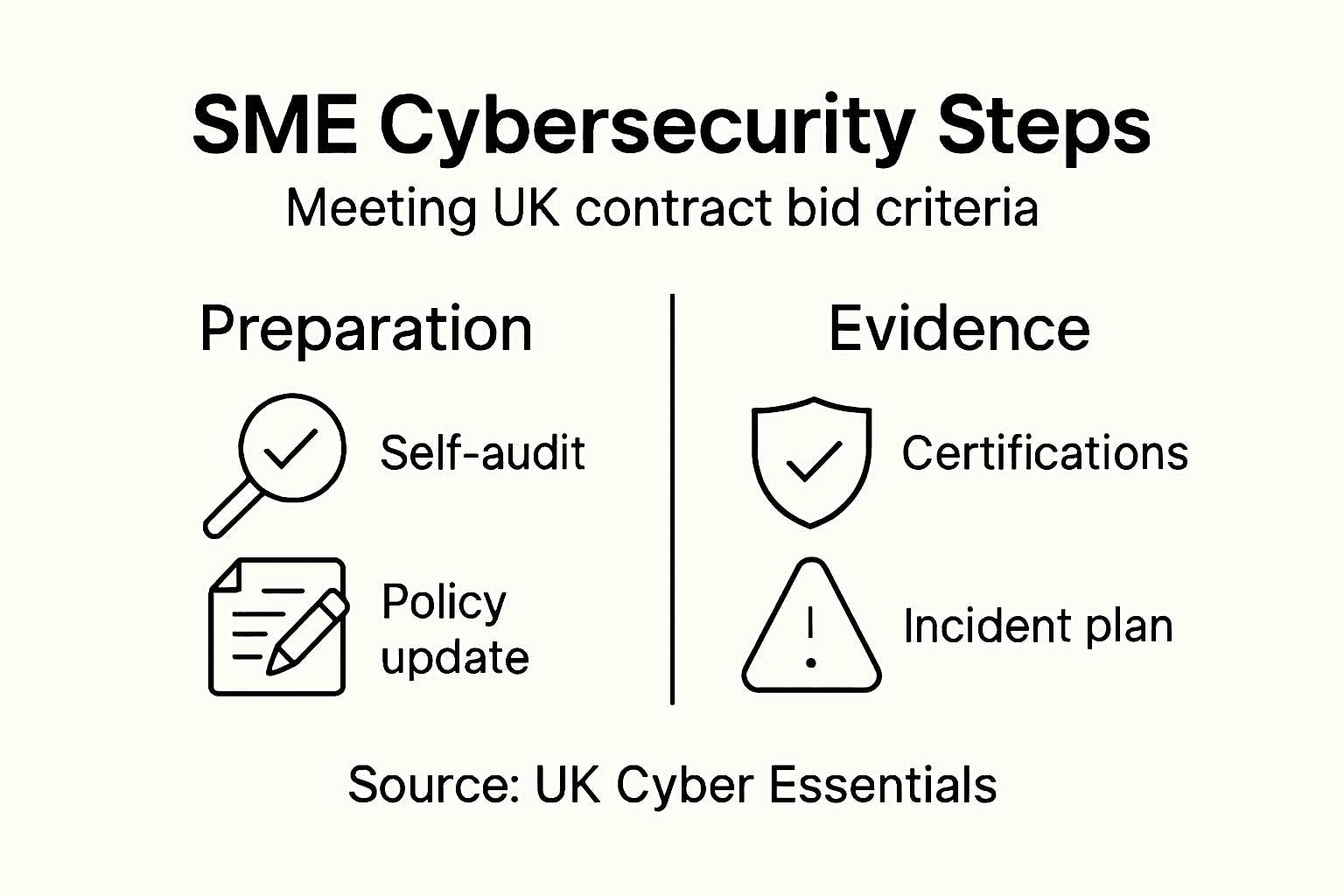
One critical element many SMEs overlook is demonstrating your incident response capability. Buyers want to know what happens when something goes wrong. Can you detect breaches? How quickly? What’s your notification process? What support do you provide to the client during an incident? These answers matter as much as your preventive controls. A well-structured incident response plan, even if it hasn’t been tested by actual incidents, shows sophistication and preparedness that separates credible suppliers from reactive ones.
Pro tip: Build a “bid security package” documenting your certifications, policies, audit results, and incident response procedures before you need it - when an attractive opportunity appears, you’ll respond faster and more comprehensively than competitors still scrambling to gather evidence.
Legal and Regulatory Obligations for Bidders
Cybersecurity is no longer just a commercial consideration when you bid for contracts in the UK. It’s a legal obligation. The regulatory landscape has shifted fundamentally, and understanding what you’re legally required to do isn’t optional anymore. For SMEs bidding for public sector contracts or any work involving critical infrastructure, compliance with new legal frameworks directly affects your eligibility to bid and your liability if things go wrong. Ignorance of these obligations won’t protect you if you fail to meet them.
The most significant development is the Cyber Security and Resilience Bill, which imposes new legal requirements on suppliers involved in public sector contracts. New legal obligations for suppliers include mandatory incident reporting and compliance with NIS Regulations, giving regulators stronger enforcement powers. This means several things practically. First, you can no longer treat cybersecurity breaches as internal matters you manage quietly. You’re legally required to report certain types of incidents to authorities within specific timeframes. Second, you must comply with the Network and Information Systems Regulations, which establish baseline security requirements and incident reporting obligations. Third, regulators now have teeth. Non-compliance can result in significant penalties, enforcement notices, and reputational damage that extends beyond the specific contract.
For FinTech and e-commerce SMEs, the obligations become even more specific when you handle payment data or customer information. The UK Data Protection Act imposes strict requirements around personal data security and breach notification. PCI DSS compliance is mandatory if you process card payments. GDPR still applies to how you handle European customer data. These aren’t theoretical frameworks. They carry financial penalties that scale with your revenue. A data breach affecting thousands of customers can result in fines exceeding your annual profit margin. When you bid for contracts, you’re essentially declaring that you meet these legal requirements. If you don’t and something goes wrong, you’re liable not just to the client but to regulators, customers, and potentially affected individuals.
The practical implication is that your security obligations now extend beyond contract execution. They begin the moment you bid. When you submit a security questionnaire claiming you meet certain standards, you’re making a legal assertion. If that assertion is false and later discovered, you face breach of contract claims, regulatory investigations, and loss of future bidding eligibility. This is why building demonstrable compliance matters. Organisations like the Oxford Cybersecurity Capacity Maturity Model provide frameworks that help you assess and improve your cybersecurity capacity systematically. By benchmarking against recognised frameworks, you create documented evidence that you’ve taken compliance seriously. This documentation becomes crucial if regulators or contract partners ever question your security practices.
Pro tip: Treat your security compliance as a legal matter, not just an operational one—work with a compliance specialist or virtual CISO to ensure you understand your specific legal obligations and can evidence compliance in writing before you bid.
Risks, Costs, and Consequences of Non-Compliance
Non-compliance with cybersecurity requirements isn’t a minor operational issue you can address later. It’s an existential threat to your business. The consequences manifest across multiple dimensions simultaneously: financial penalties, legal liability, contract loss, and reputational destruction. For SMEs already operating with tight margins, a single cybersecurity failure can trigger a cascade of costs that proves fatal. Understanding what you’re risking isn’t meant to frighten you into paralysis. It’s meant to clarify why investing in proper security infrastructure now is the most rational business decision you can make.
The financial consequences are immediate and severe. Cyber security breaches result in significant financial costs and reputational damage, with recovery expenses consuming substantial resources. For a typical SME, a data breach might cost £100,000 to £500,000 in immediate response, forensics, notification, credit monitoring services, and legal fees. That’s before regulatory fines. If you’ve claimed compliance with standards you don’t actually meet and a breach occurs, your liability multiplies. You’re no longer just covering incident costs; you’re facing breach of contract claims from the client, compensation claims from affected individuals, and regulatory investigations into your false compliance claims. A mid-sized e-commerce firm that misrepresented its security posture could face fines exceeding £1 million when you combine regulatory penalties, contract damages, and customer compensation.
Beyond financial costs, non-compliance creates permanent damage to your bidding future. Consequences of non-compliance include enforcement actions such as fines and compliance notices, with SMEs failing to meet cybersecurity duties potentially facing legal penalties and loss of future business. Once you’ve been identified as non-compliant or involved in a significant breach, you become a liability in procurement eyes. Government and large corporate buyers maintain exclusion lists. A security failure gets you added to those lists. Other SMEs lose single contracts and recover. You lose your entire addressable market because buyers across sectors begin asking about your security history. Your reputation becomes radioactive.
The operational consequences are equally damaging. A breach interrupts your ability to serve existing clients. You’ll spend weeks managing incident response, communicating with affected parties, and rebuilding systems. During that time, your regular business halts. Clients might terminate contracts early due to your security failure. Partners and suppliers may distance themselves from your firm. For FinTech and e-commerce businesses where trust is the entire foundation, this damage proves incredibly difficult to reverse. You’re essentially asking clients to trust you with their data again after you’ve proven you couldn’t protect it the first time.
This table summarises the practical consequences SMEs face if cybersecurity obligations are not met:
Consequence | Potential Cost | Operational Impact | Long-term Effect |
Regulatory fines | Up to £1 million+ | Immediate financial stress | Market exclusion |
Contract termination | Lost revenue | Service delivery interruption | Damaged business reputation |
Customer compensation | £100,000 to £500,000 | Increased support workload | Reduced client trust |
Legal investigations | Legal fees, penalties | Time diverted from core work | Loss of future bid opportunities |
Pro tip: Calculate your actual cost of compliance versus your potential cost of a breach - most SMEs discover that investing £50,000 to £100,000 annually in proper security infrastructure costs far less than managing even a moderate breach.
Secure Your Contract Success with Expert Cybersecurity Partnership
Winning UK contract bids means proving your cybersecurity beyond basic assurances. This article highlights the challenges SMEs face navigating complex compliance demands like Cyber Essentials and ISO 27001 while demonstrating robust incident response and continuous risk management. If you want to transform these challenges into competitive advantages, Freshcyber offers a tailored solution designed to elevate your security posture and simplify compliance.
Our flagship Virtual CISO service delivers strategic leadership, guiding SMEs through gap analysis and implementation of critical frameworks that match your contract requirements. With expert support in Compliance, Cyber Essentials, and proactive Vulnerability Management, you will be prepared to provide evidence-backed responses and build trusted partnerships with buyers. Do not risk losing contracts due to weak security claims or lack of certification—take control of your cyber resilience today.

Start your journey to contract-winning cybersecurity now by partnering with Freshcyber at https://freshcyber.co.uk. Secure your competitive edge and meet the stringent demands of UK procurement with confidence.
Frequently Asked Questions
How does cybersecurity influence contract bids for SMEs?
Cybersecurity has become a crucial factor in contract bidding for SMEs. Buyers now assess your cyber resilience as a measure of reliability and trustworthiness, impacting your chances of winning contracts.
What are the key cybersecurity standards SMEs need to comply with when bidding?
Key standards include Cyber Essentials, Cyber Essentials Plus, ISO 27001, and PCI DSS. These standards ensure that you meet baseline security requirements, essential for eligibility in both public and private sector contracts.
How can SMEs effectively demonstrate their cybersecurity measures during the bidding process?
SMEs should provide specific evidence of their cybersecurity measures, such as certifications, audit reports, and detailed descriptions of security controls. It’s important to be transparent about your security posture and any plans for improvement.
What are the consequences of non-compliance with cybersecurity requirements for SMEs?
Non-compliance can lead to significant financial penalties, loss of contracts, and damage to reputation. In addition, failing to meet cybersecurity obligations can result in exclusion from future bidding opportunities.
Recommended
Comments