80% of UK SME Auditors Rank Cybersecurity Top in 2026


In 2026, over 80% of UK internal auditors rank cybersecurity as a top risk, yet many SME directors still treat audits as tick-box exercises rather than strategic assets. With the Cyber Security and Resilience Bill introducing mandatory incident reporting and higher penalties, cybersecurity audits have evolved from optional reviews into business-critical operations. This guide explains the regulatory drivers, audit frameworks, and vCISO advantages that turn compliance into competitive currency for UK SMEs.
Table of Contents
Key Takeaways
Point | Details |
Audits drive compliance and risk reduction | Cybersecurity audits identify vulnerabilities and ensure regulatory alignment across ISO 27001, NIST CSF, and Cyber Essentials Plus frameworks. |
UK regulations mandate comprehensive audits in 2026 | The Cyber Security and Resilience Bill expands scope to MSPs and large entities with stricter incident reporting and penalties. |
vCISO-led audits deliver strategic value | Virtual CISOs transform audits from one-off projects into continuous compliance engines under predictable subscriptions. |
Frameworks vary by SME needs | ISO 27001 suits enterprise clients, Cyber Essentials Plus opens public sector tenders, and NIST CSF provides flexible risk management. |
Audit readiness strengthens market positioning | Proactive audit preparation builds digital resilience and unlocks high-value contracts with enterprise buyers. |
The Rising Imperative of Cybersecurity Audits
Cyber threats targeting UK SMEs have intensified in both frequency and sophistication. Nearly 50% of UK SMEs experienced cyberattacks in the past year, yet many firms underestimate the strategic role of annual security audits for UK SMEs in mitigating these risks. Internal auditors have responded decisively: over 80% rank cybersecurity as the number one risk in 2026, reflecting the profession’s recognition that digital threats now pose existential business risks.
For directors and IT managers, this shift demands action. Cybersecurity audits serve as diagnostic tools that reveal hidden vulnerabilities before attackers exploit them. Unlike reactive incident response, regular security audits for UK SMEs provide structured assessments of governance, technical controls, and risk management processes. Early detection through systematic audits reduces long-term incident costs by identifying weaknesses in access controls, patch management, and business continuity plans.
The financial stakes are clear. Cyber incidents disrupt operations, trigger regulatory fines, and damage client trust. Firms that delay audit programs face compounding risks as threat actors continuously evolve their tactics. Conversely, organisations embracing security audits protecting UK SMEs position themselves as trustworthy partners in supply chains, winning contracts that require demonstrated security maturity.
Pro Tip: Schedule audits during business planning cycles to align security investments with growth objectives, ensuring audit findings inform budget allocations and strategic priorities.
Cyber threats have become more frequent and complex for UK SMEs.
Internal auditors place highest priority on cybersecurity in 2026.
Almost half of UK SMEs suffered recent cyberattacks.
Audits identify vulnerabilities before they escalate into breaches.
Regular audit cycles reduce long-term cyber incident costs.
Regulatory Landscape and Compliance Demands
The UK regulatory environment in 2026 imposes unprecedented audit requirements on SMEs. The Cyber Security and Resilience Bill 2026 broadens regulatory scope and mandates incident reporting with higher fines, transforming cybersecurity from a best practice into a legal obligation. This legislation extends beyond traditional critical infrastructure to cover managed service providers and large entities, directly impacting SMEs operating in these sectors or serving regulated clients.
Mandatory incident reporting creates accountability chains that require documented security controls. Directors must demonstrate due diligence through audit trails proving they implemented reasonable safeguards. Stricter penalties for non-compliance mean that inadequate audit programs now carry material financial and reputational consequences. This regulatory pressure elevates cybersecurity audits from optional reviews to board-level imperatives.
Supply chain audits have emerged as standard practice. Enterprise buyers increasingly require third-party security assessments before awarding contracts. SMEs seeking to supply larger organisations face audit questionnaires covering everything from access controls to incident response capabilities. Firms without robust cybersecurity compliance workflows struggle to compete for these high-value opportunities.
The 2026 regulatory landscape also emphasises continuous compliance over point-in-time certifications. Regulators expect ongoing monitoring, regular policy updates, and dynamic risk assessments. Static audit reports quickly become outdated as threats and business operations evolve. SMEs must adopt audit models that provide continuous visibility rather than annual snapshots.
The Cyber Security and Resilience Bill expands scope to MSPs and large entities.
Mandatory incident reporting and stricter penalties increase audit importance.
Supply chain and third-party audits are becoming standard requirements.
SMEs must align audits with evolving regulatory obligations.
Compliance audits help avoid costly fines and reputational damage.
Structure and Scope of Cybersecurity Audits
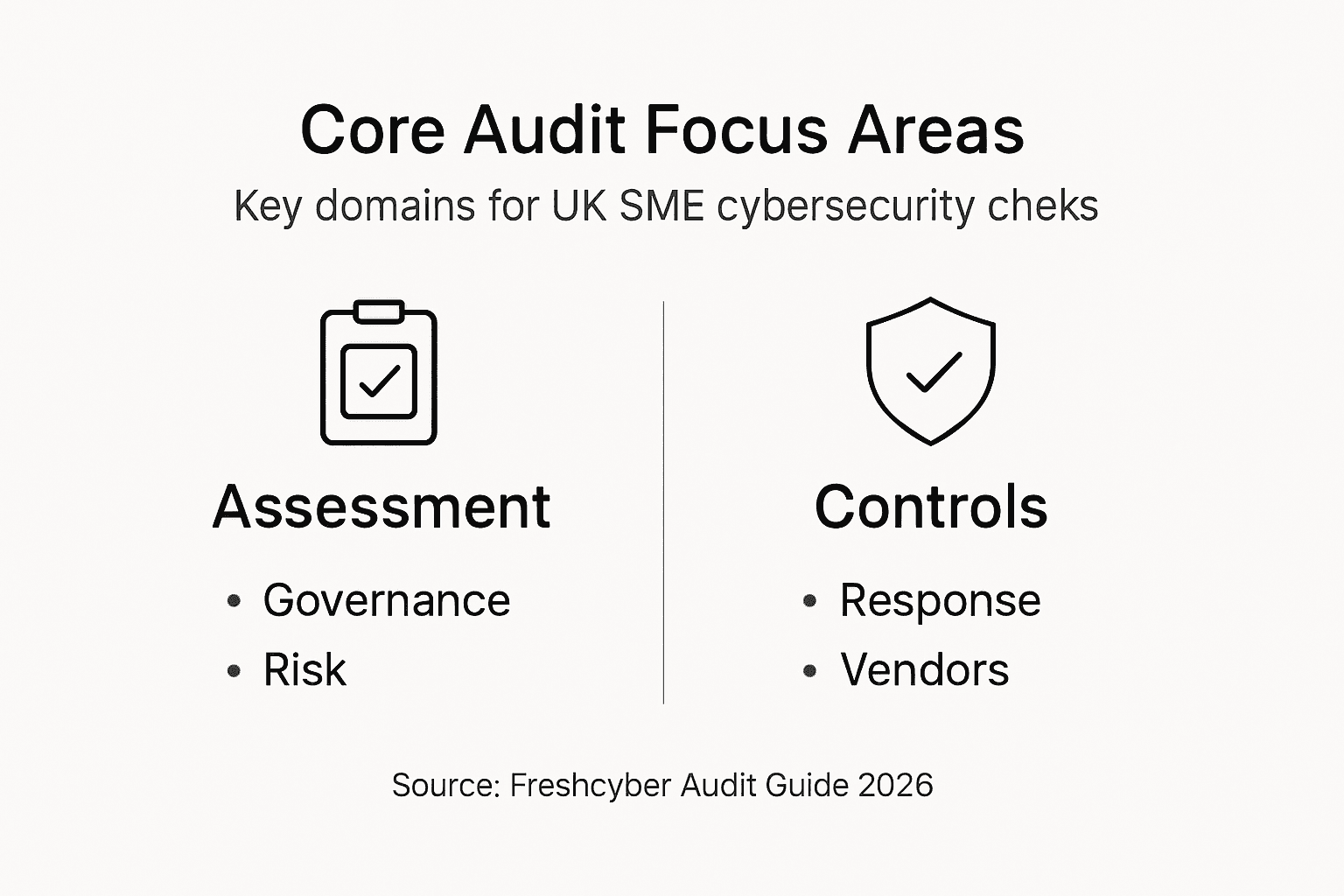
Cybersecurity audits examine three core domains: governance, risk management, and controls. Governance assessments evaluate leadership commitment, security policies, and accountability structures. Risk management reviews analyse threat identification, risk appetite definitions, and mitigation strategies. Core cybersecurity audit areas assess technical and procedural controls protecting information assets.

Frameworks provide structured approaches for conducting audits. Security frameworks for SMEs like ISO 27001, NIST CSF, and CobIT offer methodologies tailored to different organisational needs. ISO 27001 delivers internationally recognised certification attractive to enterprise clients. NIST CSF provides flexible, risk-based guidance suitable for firms building security programs. CobIT integrates IT governance with business objectives, appealing to organisations seeking holistic control frameworks.
Common audit focus areas include incident response preparedness, asset management accuracy, and vendor risk protocols. Auditors examine whether firms maintain current asset inventories, test backup restoration procedures, and validate third-party security controls. These operational assessments reveal gaps between documented policies and actual practices.
Framework Comparison for UK SMEs
Framework | Primary Strength | Best Suited For | Certification Available |
ISO 27001 | International recognition | Enterprise clients, global operations | Yes |
NIST CSF | Flexible risk management | Diverse threat environments | No |
Cyber Essentials Plus | UK public sector access | Government tenders | Yes |
CobIT | IT governance integration | Business process alignment | No |
Pro Tip: Choose frameworks aligned with your target clients’ requirements. If pursuing government contracts, prioritise Cyber Essentials Plus. For enterprise buyers, ISO 27001 certification carries greater weight.
Identify your primary business objectives and client base.
Select frameworks matching client expectations and regulatory mandates.
Conduct gap analyses to understand current versus required maturity.
Develop remediation roadmaps addressing identified control weaknesses.
Schedule regular audits to maintain compliance and certification validity.
The Strategic Role of vCISO in Audit and Compliance
Virtual Chief Information Security Officers transform audits from reactive assessments into proactive strategic tools. Unlike traditional consultants who deliver reports and exit, vCISO services UK providers maintain ongoing relationships that embed security into business operations. This continuity enables managed cyber compliance for UK SMEs through subscription models that eliminate the consultancy tax of repeated project fees.
vCISOs lead multi-framework compliance strategies tailored to SME resource constraints. They develop audit roadmaps spanning ISO 27001, NIST CSF, and Cyber Essentials Plus, ensuring firms meet diverse client requirements without duplicating effort. This integrated approach reduces audit fatigue while maximising compliance coverage across regulatory obligations.
Beyond compliance checklists, vCISOs develop continuous security roadmaps linking audit findings to business objectives. They translate technical vulnerabilities into business risk language executives understand, facilitating informed decision-making. This strategic communication helps secure budget approvals for security investments by demonstrating clear connections between controls and revenue protection.
vCISOs also facilitate stakeholder engagement by bridging technical teams and executive leadership. They present audit results to boards, explain risk implications, and recommend prioritised remediation plans. This governance role ensures security remains visible at decision-making levels rather than buried in IT operations.
Pro Tip: Engage vCISO services early in audit planning to integrate security assessments with broader digital transformation initiatives, ensuring audits inform rather than disrupt business projects.
vCISOs lead multi-framework compliance audit strategies tailored for SMEs.
Subscription models make audits affordable and ongoing rather than one-off.
vCISOs develop continuous security roadmaps beyond compliance checklists.
They facilitate communication with stakeholders, embedding security into business processes.
Common Misconceptions and Audit Realities
Many SME leaders mistakenly view cybersecurity audits as tick-box exercises satisfying regulatory minimums. This perspective misses audits’ strategic value as risk management tools revealing operational vulnerabilities. Effective audits go beyond checking policy documents to assess whether controls actually protect against real-world threats. Treating importance of regular security audits as mere compliance theatre leaves firms exposed to attacks that exploit gaps between documented procedures and actual practices.
Cost concerns often deter SMEs from comprehensive audit programs. Traditional consultancy models charge substantial fees for each assessment, making regular audits financially prohibitive. However, vCISO subscription models distribute costs across ongoing services, delivering value beyond tick-box compliance through continuous monitoring and incremental improvements. This approach replaces expensive, one-off projects with predictable monthly investments.
Another misconception limits audit scope to IT system checks. Modern cybersecurity audits examine business governance, including board oversight, policy enforcement, and security culture. Auditors assess whether leadership demonstrates commitment through resource allocation, training programs, and accountability structures. These governance elements often prove as critical as technical controls in preventing breaches.
Effective audits enhance trust and unlock tender opportunities by demonstrating security maturity to prospective clients. Enterprise buyers increasingly require audit evidence before awarding contracts. Firms with documented security programs and recent audit reports gain competitive advantages in procurement processes. Understanding these realities helps SMEs allocate audit resources strategically.
Audits are not mere tick-box exercises but ongoing risk management tools.
Costs can be managed via vCISO subscriptions instead of expensive, one-off projects.
Audits include business governance, not just IT system checks.
Effective audits enhance trust and unlock tender opportunities.
Expanding Audit Scope: Supply Chain and Third-Party Risk
Supply chain risk assessments have become mandatory components of cybersecurity audits for UK SMEs. The interconnected nature of modern business means vulnerabilities in partner systems can compromise your security posture. Third-party breaches increasingly serve as entry points for attackers targeting primary organisations. Consequently, enterprise buyers demand evidence that suppliers maintain adequate security controls.
Vendor and third-party risk management protocols now form core audit requirements. SMEs must assess managed service providers, cloud vendors, and software suppliers against security standards. These assessments examine whether third parties maintain certifications, conduct their own audits, and implement controls protecting shared data. Failure to manage third-party risks exposes SMEs to compliance violations and contractual liabilities.
The NCSC’s Cyber Essentials Playbook offers practical NCSC supply chain audit guidance for evaluating supplier security. This resource provides questionnaires and assessment frameworks helping SMEs systematically evaluate third-party controls. Following NCSC guidance ensures audit approaches align with UK regulatory expectations.
Audit preparation should incorporate third-party risk protocols from the outset. Document vendor selection criteria, security requirements in contracts, and ongoing monitoring processes. Maintain registries of third-party connections and data sharing agreements. These records demonstrate to auditors that you actively manage supply chain risks rather than treating them as afterthoughts.
Supply chain risk assessments are now mandated in audit scopes for UK SMEs.
Third-party vulnerabilities increase breach likelihood and affect overall security posture.
SMEs must assess managed service providers and suppliers rigorously.
NCSC’s Cyber Essentials Playbook offers practical guidance for supply chain audits.
Audit preparation should incorporate third-party risk protocols to ensure compliance.
Bridging Understanding to Practice: Audit Readiness and Beyond
Transforming audit knowledge into operational readiness requires systematic preparation. Start by conducting gap analyses against chosen frameworks like ISO 27001 and NIST CSF. These assessments compare current controls against standard requirements, identifying specific weaknesses requiring remediation. Gap analyses provide roadmaps for cyber audit preparation guide efforts.
Develop tailored vCISO-led audit roadmaps ensuring strategic alignment between security investments and business objectives. Prioritise remediation efforts based on risk severity and regulatory deadlines. Roadmaps should sequence control implementations logically, addressing foundational issues like access management before advanced capabilities like threat hunting.
Implement continuous monitoring to maintain preparedness and compliance between formal audits. Automated tools track control effectiveness, alert teams to configuration drifts, and provide evidence for auditors. Continuous monitoring transforms audits from disruptive events into routine validations of ongoing security operations, significantly improving security posture.
Engage senior leadership and audit committees regularly for governance oversight. Schedule quarterly security briefings covering threat trends, audit findings, and control effectiveness metrics. Executive engagement ensures security remains visible at board level and secures necessary resources for remediation efforts.
Use audit insights to drive proactive improvements and market trust. Share certification achievements with clients and prospects as SME digital strategy essentials demonstrate maturity. Audit results validate marketing claims about security commitments, converting compliance investments into competitive differentiators.
Conduct gap analysis against ISO 27001 and NIST CSF frameworks.
Develop tailored vCISO-led audit roadmaps ensuring strategic alignment.
Implement continuous monitoring to maintain preparedness and compliance.
Engage senior leadership and audit committees regularly for governance.
Use audit insights to drive proactive improvements and market trust.
Enhance Your Cybersecurity Compliance with Freshcyber vCISO Support
Navigating the complex audit landscape requires expertise that most SMEs lack internally. Freshcyber’s vCISO services provide the strategic leadership necessary to transform audits from compliance burdens into business enablers. Our Compliance Currency Engine manages multi-framework requirements under predictable subscriptions, eliminating the consultancy tax that makes traditional audit programs unaffordable.

We specialise in helping UK SMEs navigate ISO 27001, NIST CSF, and Cyber Essentials Plus audits with tailored programs matching your business objectives. Our vCISOs take full ownership of your security roadmap, conducting gap analyses, developing remediation plans, and maintaining continuous compliance. This integrated approach ensures you remain audit-ready while focusing on core business operations.
Explore our ISO 27001 compliance tips and cybersecurity compliance workflow for UK SMEs resources to understand how strategic audit management builds competitive advantages. Start your journey to smarter cybersecurity audit success with Freshcyber today.
Frequently Asked Questions
How often should UK SMEs conduct cybersecurity audits?
Annual audits represent the minimum frequency for maintaining certifications like ISO 27001 and Cyber Essentials Plus. However, SMEs operating in regulated sectors or experiencing rapid growth should conduct quarterly reviews of critical controls. Continuous monitoring tools provide ongoing visibility between formal audits, ensuring real-time compliance.
What advantages do vCISOs offer over traditional audit consultants?
vCISOs provide continuous strategic leadership through subscription models, eliminating repeated project fees that traditional consultants charge. They maintain ongoing relationships that embed security into business operations rather than delivering one-off reports. This continuity enables proactive risk management and seamless audit preparation aligned with business objectives.
Which UK regulations are driving audit changes in 2026?
The Cyber Security and Resilience Bill 2026 introduces mandatory incident reporting, expanded regulatory scope covering MSPs, and increased penalties for non-compliance. GDPR remains in force with stricter enforcement. Supply chain security requirements have intensified across public and private sectors, mandating third-party risk audits.
What cost-effective audit strategies work for SMEs?
vCISO subscription models distribute audit costs across ongoing services, replacing expensive one-off projects with predictable monthly investments. Prioritise frameworks matching client requirements to avoid unnecessary certifications. Automate evidence collection through continuous monitoring tools, reducing manual audit preparation effort and consultant fees.
How do ISO 27001 and Cyber Essentials Plus differ for SMEs?
ISO 27001 provides comprehensive information security management suitable for enterprise clients requiring international standards. Cyber Essentials Plus offers UK-specific baseline security controls mandatory for government contracts. ISO 27001 demands greater documentation and control depth, while Cyber Essentials Plus provides faster, more affordable certification for SMEs targeting public sector opportunities. Many firms prepare for cybersecurity audit programs pursuing both certifications to maximise market access.
Recommended
I was running a small aesthetics clinic in Brighton, and clinical waste was something I never thought I'd have to deal with on a daily basis. But after every client, there were needles, cannulas, wipes, and used vials that needed to be disposed of safely and legally – it's not just about being tidy, it's about public health and staying on the right side of the law. Our old contractor started missing collections, leaving bags of offensive waste piling up in our storage room, and I was getting that sinking feeling every time I walked past the pile because I knew we weren't compliant. I started looking around and found a provider that actually understands healthcare waste, covers everything from…