Cyber Security Terms Explained: Clarity for SMEs
- Gary Sinnott

- Mar 13
- 12 min read

Security jargon often makes risk management feel more complex than it needs to be. For IT Managers and Directors in British finance and healthcare SMEs, true understanding starts with the basics. Clear definitions of terms like information security, encryption, incident response, and regulatory roles are the bedrock of confident compliance and secure contracts. Precise language is your best defence against gaps that could cost both business and reputation.
Table of Contents
Key Takeaways
Point | Details |
Understanding Core Principles | Information security is based on confidentiality, integrity, and availability. These principles are essential for compliance and protecting sensitive data across all formats. |
Importance of Incident Response | Timely incident response is crucial to mitigate damage and comply with regulatory requirements. Delays in notification can lead to significant fines and reputational harm. |
Necessity of Multi-factor Authentication | Implementing multi-factor authentication is vital, especially in finance and healthcare, to prevent unauthorised access. It significantly reduces the risk of account breaches. |
Clarifying Security Terminology | Clear and precise security terminology in contracts fosters better communication and understanding, preventing costly misunderstandings and enhancing compliance efforts. |
Core Cyber Security Terms Defined
Security terminology can feel overwhelming, but understanding the fundamentals is essential for protecting your firm. Here’s what you need to know without the jargon.
Information Security and Data Protection
Information security means protecting data from unauthorised access, damage, or theft. For finance and healthcare firms, this extends beyond IT systems to include paper records, emails, and client communications.
According to the UK National Cyber Security Centre, information security involves three core principles:
Confidentiality: Only authorised people can access sensitive data.
Integrity: Data cannot be altered without permission or detection.
Availability: Systems and data remain accessible when needed.
Your compliance auditors will assess whether your firm meets these three standards. They’re not optional - they’re the foundation of every major framework, from ISO 27001 to Cyber Essentials Plus.
Without these three pillars in place, your firm fails compliance. Full stop.
Encryption and Ransomware
Encryption scrambles data using mathematical algorithms so only authorised users can read it. Think of it as converting a document into a language only you and your recipients understand.
Two encryption types matter:
Data in transit: Encrypting emails, file transfers, and cloud uploads whilst they travel across networks.
Data at rest: Encrypting stored files on servers, laptops, and external drives.
Ransomware is malicious software that locks your data and demands payment for access. In healthcare and finance, ransomware attacks can halt operations entirely, destroy client trust, and trigger regulatory investigations.

A single infected email attachment can encrypt your entire network within hours. Your backup systems must be isolated and tested regularly—attackers increasingly target backups first.
Personal Data Breaches and Incident Response
A personal data breach occurs when unauthorised parties access, steal, or damage personal information. Under UK GDPR, you must report breaches to the Information Commissioner’s Office within 72 hours of discovery.
Your response speed matters. Delays in notification can result in substantial fines and reputational damage that contracts won’t recover from.
Key elements of incident response include:
Detection: Identifying the breach occurred.
Containment: Stopping the attacker’s access immediately.
Investigation: Understanding what data was compromised and how.
Notification: Informing affected parties and regulators.
Recovery: Restoring systems and preventing recurrence.
Without a documented incident response plan, your team will waste time during the crisis, missing critical notification deadlines.
Access Control and Authentication
Access control determines who can access what data and systems. Multi-factor authentication (MFA) requires users to prove their identity in multiple ways - usually a password plus a code from a phone or authenticator app.
MFA is non-negotiable for finance and healthcare. It blocks most attacks because stolen passwords alone cannot grant access.
Pro tip: Enable MFA on all cloud accounts (Microsoft 365, Google Workspace, AWS) immediately - this single step blocks 99% of automated attacks targeting your firm.
Key Categories and Their Differences
Cyber security isn’t one monolithic discipline - it breaks down into distinct categories, each with different roles, objectives, and technical demands. Understanding these differences helps you identify gaps in your firm’s defences and prioritise investment wisely.
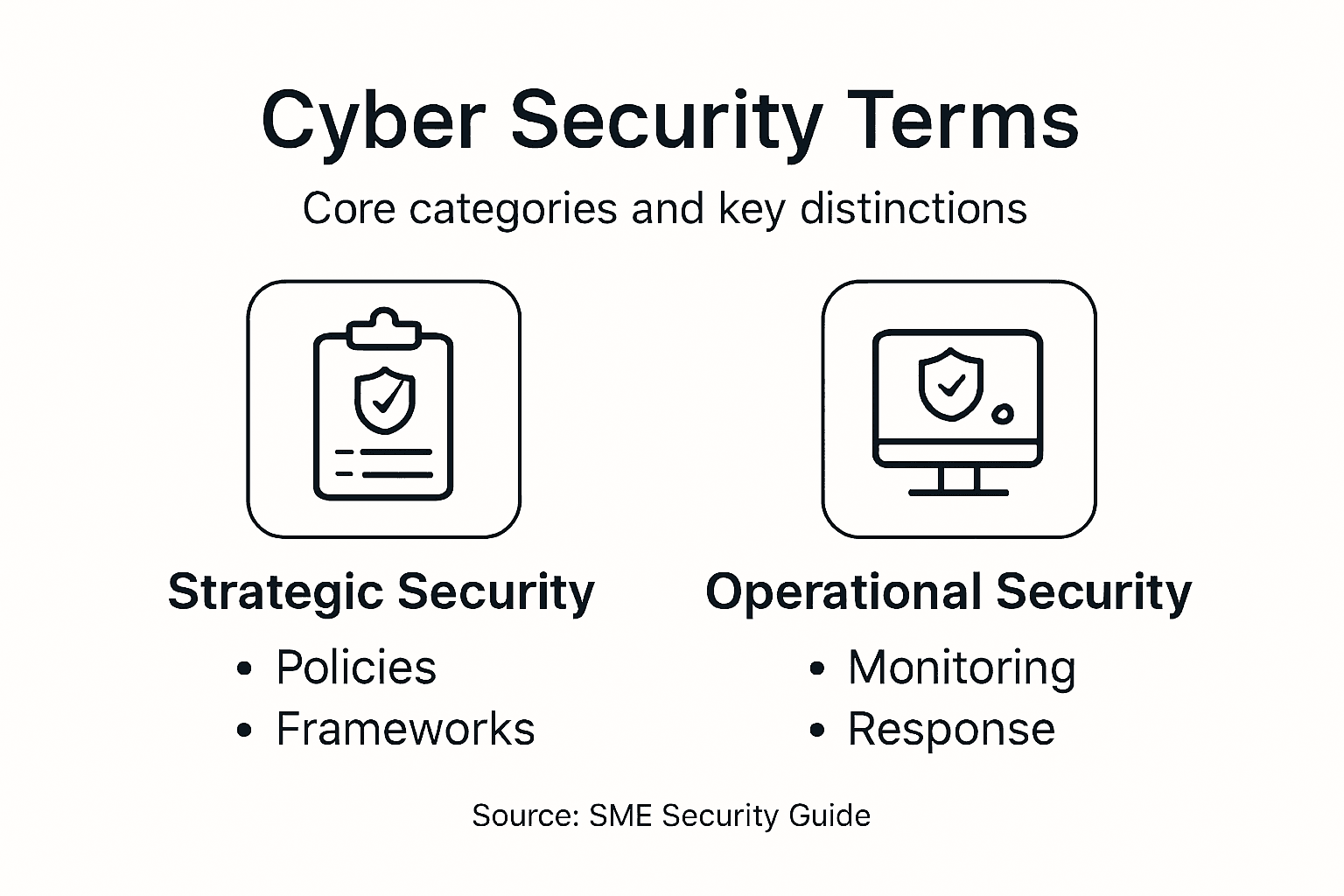
Strategic vs Operational Security
Strategic security involves developing policies, frameworks, and long-term roadmaps. It answers: Where are we heading? What risks matter most? How do we align security with business goals?
Operational security handles day-to-day execution - monitoring systems, responding to alerts, patching vulnerabilities, and managing user access. It answers: Is the system running safely right now? Who accessed what data today?
For SME leaders, strategic security is your responsibility. You set the direction. Operational teams execute it. Without clear strategy, operational work becomes reactive firefighting instead of planned defence.
Here is a comparison of strategic and operational cyber security roles to clarify their differences and impacts:
Aspect | Strategic Security | Operational Security |
Main Focus | Long-term policies and direction | Daily monitoring and execution |
Typical Activities | Setting frameworks, risk strategy | Managing alerts, patching systems |
Who is Responsible | Board and senior leadership | IT security team |
Business Impact | Aligns security to business goals | Ensures systems run safely |
Strategy without operations is fantasy. Operations without strategy is chaos.
Technical, Legal, and Cultural Dimensions
The Cybersecurity Capacity Maturity Model identifies five critical dimensions that all mature security programmes must address:
Technical standards: Firewalls, encryption, intrusion detection, vulnerability management.
Legal and regulatory frameworks: GDPR compliance, contract clauses, liability protections.
Policy and strategy: Board-level decisions on risk appetite and security priorities.
Knowledge and capability: Staff training, technical skills, security awareness.
Responsible culture: Embedding security thinking across every department.
Many SMEs focus heavily on technical fixes whilst neglecting policy, training, and culture. That’s backwards. A well-trained team with clear policies stops more attacks than any tool alone.
Specialist Cyber Security Roles
The UK Cyber Security Council outlines 15 specialisms within cyber security, including:
Governance and risk management: Compliance, audit, policy development.
Incident response: Detecting and containing active attacks.
Cyber threat intelligence: Understanding attacker tactics and emerging threats.
Cryptography: Designing encryption systems and key management.
Digital forensics: Investigating breaches and gathering evidence.
You don’t need all 15 specialisms in-house. Finance and healthcare SMEs typically need strong incident response, governance, and threat intelligence capabilities. Everything else can be outsourced or covered by a vCISO partner.
Preventative vs Detective Controls
Preventative controls stop attacks before they happen - firewalls, MFA, access restrictions, security awareness training.
Detective controls catch attacks that slip through - monitoring, alerting systems, incident response procedures, penetration testing.
Most SMEs invest heavily in prevention and neglect detection. That’s a mistake. Attackers will eventually bypass your defences. Detective controls let you spot and contain the breach before major damage occurs.
Pro tip: Map your current controls into these categories. If you have zero detective controls, your incident response plan is incomplete - 24/7 managed detection and response fills that gap immediately.
Compliance and Regulatory Terminology
Regulatory language feels dense because it has to be precise. But for finance and healthcare SMEs, understanding these terms isn’t optional - they directly affect your legal obligations, audit outcomes, and contract eligibility.
GDPR, NIS, and Legal Obligations
GDPR (General Data Protection Regulation) governs how you collect, store, and process personal data. Breaches trigger mandatory reporting to the Information Commissioner’s Office within 72 hours and can result in fines up to 4% of annual turnover.
The Network and Information Systems Regulations (NIS) require essential service operators in finance and healthcare to maintain adequate security measures. The UK Government’s Cyber Security and Resilience Bill is strengthening these requirements further, introducing tougher incident reporting obligations and clearer accountability for board members.
These aren’t abstract legal requirements. They’re binding obligations with real financial and reputational consequences.
Regulatory compliance isn’t about passing audits - it’s about protecting your firm’s legal standing and market position.
SPOC, CSIRT, and Incident Reporting
When a breach occurs, regulators expect you to have nominated personnel and teams ready to respond. Here’s what that means:
Single Point of Contact (SPOC) is the one person regulators contact about your cyber security. Usually your IT Manager or vCISO. They coordinate incident response and regulatory communication.
Computer Security Incident Response Team (CSIRT) is your internal team that detects, contains, and investigates breaches. They work with your SPOC to meet regulatory reporting obligations within mandatory timeframes.
Without these structures in place, your response to a breach becomes chaotic. Regulators assume poor incident management and may impose additional penalties.
Frameworks and Certification Standards
ISO 27001 is the international standard for information security management. It requires a documented Information Security Management System (ISMS) covering policies, controls, and risk assessment.
Cyber Essentials Plus is the UK Government-backed certification proving you meet basic security standards. For finance and healthcare, it’s often a minimum requirement for larger contracts.
NIST Cybersecurity Framework provides a structured approach to managing cyber risk across five functions: identify, protect, detect, respond, recover.
These aren’t just buzzwords. Enterprise clients won’t award contracts without them. They’re entry tickets to larger opportunities.
Audit, Assessment, and Compliance Verification
Gap Analysis compares your current security state against a framework standard. It identifies what’s missing and what needs improvement.
Compliance Assessment formally verifies you meet required standards. External auditors test your controls, review documentation, and issue a compliance report.
Remediation is the process of fixing gaps and implementing missing controls. This takes time and planning - it’s not something done overnight before an audit.
Pro tip: Nominate your SPOC and draft your incident response plan immediately, even if you haven’t started formal framework implementation. Regulators expect these to exist before a breach occurs, not after.
Risks of Misunderstandings in Contracts
Vague cyber security language in contracts creates liability traps. When terms aren’t defined clearly, both parties assume different things - and when a breach happens, those assumptions collide in expensive ways.
Ambiguous Liability and Responsibility Gaps
Contracts often use phrases like “adequate security” or “industry-standard protections” without defining what those mean. Your vendor thinks it means basic firewalls. You think it includes 24/7 monitoring and penetration testing. When a breach occurs, the dispute begins.
The National Audit Office guidance on cyber risk management emphasises that unclear contract terms lead to gaps in responsibility. One party assumes the other is handling detection. The other assumes responsibility ends at the firewall. Neither takes ownership. The breach spreads.
These gaps don’t just create arguments - they create actual security vulnerabilities.
Ambiguous contracts create ambiguous security. Attackers exploit that confusion.
Delayed Incident Response and Legal Complications
When a breach occurs, you need immediate action. But if your contract doesn’t clearly define who does what, your response becomes paralysed by questions.
Does your cloud provider investigate? Does your internal team? Both? Neither knows. Whilst you’re debating interpretations, the attacker deepens their access. Critical hours are lost.
Legal complications worsen this. If the contract language is unclear, your vendor claims they met their obligations. You claim they failed to deliver what you paid for. Litigation replaces incident response. Regulators don’t care about your contract dispute - they care that you failed to respond properly to the breach.
Data Processor vs Data Controller Confusion
Under GDPR, data controllers decide why and how personal data is processed. Data processors handle data on the controller’s behalf. These roles carry different legal responsibilities.
Many SME contracts don’t clarify these roles. Your cloud provider might legally be a processor, but your contract treats them as a controller. When a breach happens, the processor claims they’re not liable for security decisions. You assumed they were fully responsible.
Your GDPR liability falls entirely on you. The regulator holds you accountable, not your vendor.
Missing or Misaligned Security Standards
Contracts should specify which security standards apply:
ISO 27001 compliance requirements
Cyber Essentials Plus certification
Specific encryption standards
Incident reporting timeframes
Third-party audit rights
Without these, disputes arise about what security level was actually required. Your vendor implemented basic controls. You expected enterprise-grade protection. Both claim they met “reasonable standards.”
Pro tip: Before signing any contract with a vendor handling sensitive data, require them to complete a detailed security questionnaire covering encryption, access controls, incident response, and audit rights. Document their answers in writing as contract appendices - this prevents “we never said that” arguments after a breach.
This table highlights common contract pitfalls and their business consequences, helping firms avoid costly misunderstandings:
Contract Pitfall | Resulting Issue | Business Consequence |
Undefined security standards | Varying interpretations | Disputes and vulnerability gaps |
Role ambiguity (controller/processor) | Unclear liability | End client bears regulator action |
No incident response clarity | Delayed breach handling | Greater damage, legal exposure |
Missing audit rights | Inadequate vendor oversight | Undetected weaknesses |
How Clear Terminology Enables Growth
When your firm speaks the same security language as enterprise clients, auditors, and regulators, everything becomes easier. Contracts get signed faster. Audits pass cleaner. Larger contracts become winnable. This isn’t accidental - it’s a direct business outcome of clarity.
Building Trust with Enterprise Clients
Enterprise procurement teams use standardised security language in their tender documents. They expect you to understand ISO 27001, NIST frameworks, data processor obligations, and incident response procedures. If your proposals use vague language or misuse terminology, they assume your security programme is equally unclear.
When you speak their language, you signal competence. You’re not a small firm scrambling to understand compliance - you’re a trusted partner who understands their requirements precisely. That confidence opens contract doors.
Clear terminology also reduces back-and-forth negotiations. When your security documentation and contract clauses use precise definitions, enterprise clients skip the lengthy validation process.
Winning Larger Contracts Through Certified Compliance
Finance and healthcare enterprises won’t award significant contracts without proof of security maturity. They demand certifications - Cyber Essentials Plus, ISO 27001, SOC 2 reports. These certifications only have value if you can articulate exactly what you’ve achieved and how you maintain it.
Prospects ask: “Are you ISO 27001 certified?” A vague answer loses the deal. A precise answer with documented evidence wins it. The UK Cyber Security Council emphasises how standardised terminology supports organisational growth by enabling clearer communication of security capabilities to stakeholders.
Your compliance becomes currency. Clarity is what makes that currency spendable.
Clear terminology transforms compliance from a cost centre into a competitive advantage.
Passing Audits With Fewer Corrections
When auditors assess your security programme, they’re checking whether your documented controls match your actual practices. If your documentation uses imprecise language, auditors struggle to verify what you’ve actually implemented.
They’ll request clarifications, corrections, remediation evidence. Each round of revision delays certification and increases consulting costs. Clear terminology from the start - precise control descriptions, explicit responsibility assignments, defined timeframes - means auditors can verify compliance quickly and move to sign-off.
Reducing Internal Confusion and Security Gaps
When your team shares clear security terminology, they understand each other’s responsibilities without guessing. Your IT Manager and vCISO speak the same language. Your incident response team knows exactly what “containment” means and who owns it.
This clarity prevents the gaps that attackers exploit:
Role confusion: Everyone assumes someone else is monitoring.
Definition gaps: Teams disagree on what “encrypted” means in practice.
Responsibility ambiguity: Nobody owns incident response because the policy language is too vague.
Clear terminology eliminates these hazards. Your security programme runs as planned, not as individual team members interpret it.
Strategic Decision-Making and Investment Priority
The Global Cyber Security Capacity Centre highlights how clarity in frameworks enables strategic decision-making and sustainable growth. When you understand precise definitions of security maturity, you can assess your actual gaps and prioritise investment intelligently.
You stop throwing money at generic “cyber security tools” and start targeting the specific capabilities you lack. That focused investment delivers measurable business outcomes - faster contract wins, higher client retention, reduced breach risk.
Pro tip: Create a simple one-page security glossary for your team defining the 15 terms most critical to your firm - ISO 27001 key concepts, your incident response process, data handling definitions. Distribute it to all staff and update it annually. This single document prevents more misunderstandings than lengthy compliance training.
Unlock Clear Cyber Security Language to Secure Your SME’s Growth
Struggling to turn complex cyber security terms into practical compliance that wins contracts and builds trust? This article highlights the confusion caused by unclear terminology and the costly risks it brings - from audit delays to breach mishandling. If you want to move beyond jargon and build real digital resilience, Freshcyber’s expertise is designed just for you. We help firms like yours master frameworks such as ISO 27001 and Cyber Essentials Plus with clarity and confidence.

Discover how our vCISO-led Compliance Currency Engine puts strategic leadership and continuous defence at your fingertips. Don’t wait until a breach or audit delays your growth - start turning compliance into a competitive advantage today. Find out more about managing risks and achieving certified compliance in our Cyber Security Compliance for UK SMEs: Guides & Best Practices. Learn how to protect your business against vulnerabilities in UK SMEs Cyber Security: Insights & Vulnerabilities and get expert help with certification from our Cyber Essentials Certification Guide for UK SMEs. Visit Freshcyber now to take control of your cyber security future.
Frequently Asked Questions
What is information security?
Information security involves protecting data from unauthorised access, damage, or theft. It applies to both digital and physical records and is crucial for ensuring confidentiality, integrity, and availability of sensitive information.
What is the significance of encryption in cyber security?
Encryption is essential for securing data by converting it into a scrambled format that can only be read by authorised users. This helps protect sensitive information during transfer and when it is stored, making it a key element in maintaining information security.
What should be included in an incident response plan?
An effective incident response plan should include elements such as detection, containment, investigation, notification, and recovery processes. It helps organisations quickly respond to data breaches, minimising damage and ensuring compliance with regulatory requirements.
How do I improve my company’s access control measures?
Enhancing access control measures can be achieved by implementing multi-factor authentication (MFA), regularly reviewing user permissions, and establishing clear policies on who can access specific data and systems. This reduces the risk of unauthorised access and strengthens overall security.
Recommended
I was recently looking at space improvement options in the UK and noticed https://www.tintfit.com/. I liked that the company offers solutions that help make windows a more functional part of the interior. Window films can add a modern look, create a cozy feeling, and help better customize a space. I find it interesting that a single element can change the perception of an entire room. It's a good option for those who value practicality and neat design.