Cyber Risk Assessment Guide for SME Resilience Success
- Gary Sinnott

- Jan 19
- 7 min read

Every small or medium business in the United Kingdom faces mounting pressure to keep ahead of evolving cyber threats while meeting increasingly complex regulatory demands. Relying on traditional internal resources often exposes unseen gaps, making expert guidance essential for robust cyber risk management. With vCISO-led risk assessments, IT Directors and Compliance Officers can define clear objectives, prioritise critical assets, and strengthen compliance, building a stronger defence against operational and reputational risks in a fast-changing digital world.
Table of Contents
Quick Summary
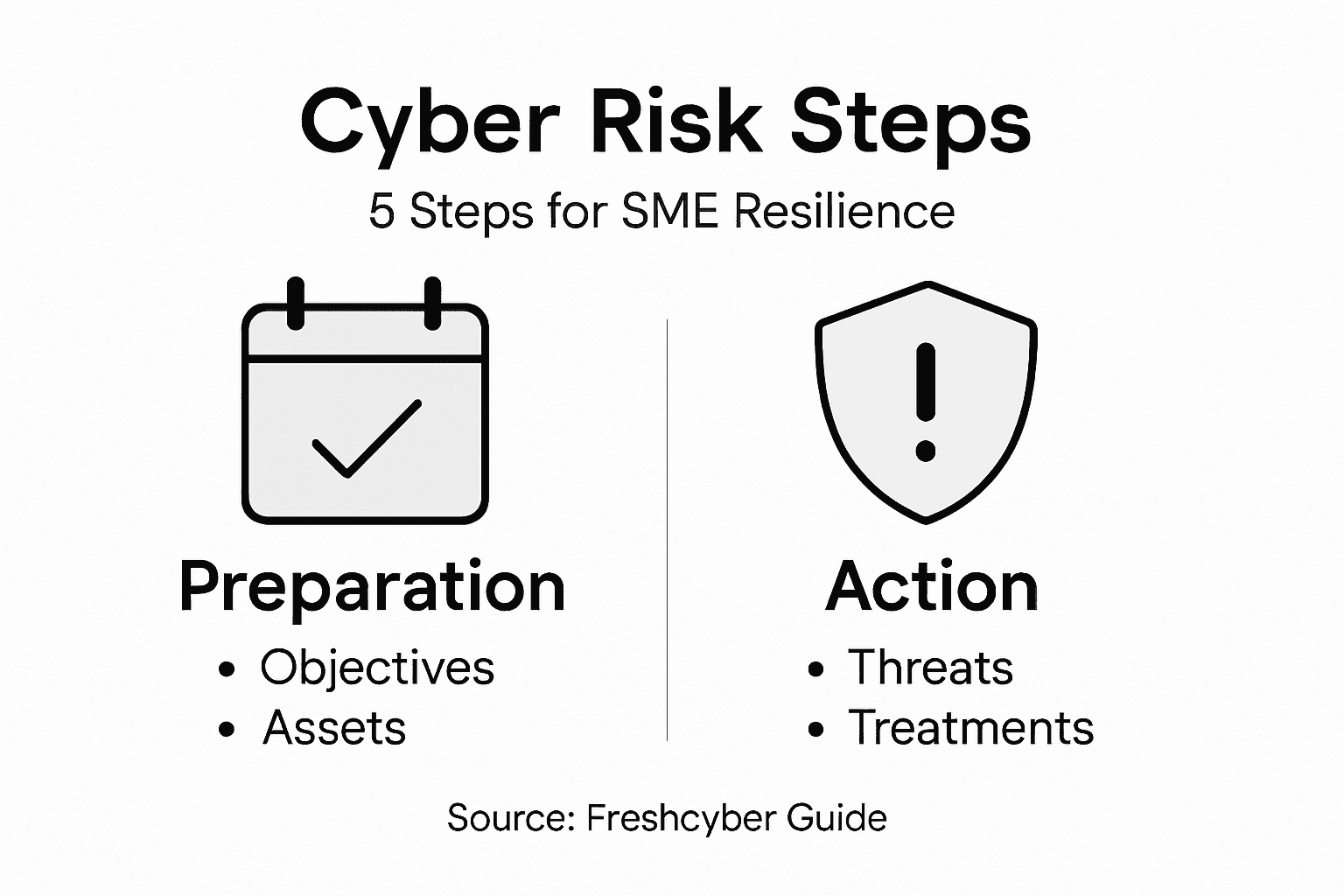
Main Insight | Explanation |
1. Define Cyber Risk Objectives | Collaborate with a vCISO to pinpoint measurable cyber risk goals tailored to your organisation’s needs. |
2. Identify Critical Assets | Conduct a thorough inventory of essential technological resources to support business continuity and regulatory compliance. |
3. Assess Internal and External Threats | Use structured evaluations to prioritise both internal and external threats, scoring them by likelihood and potential impact. |
4. Develop Risk Treatment Plans | Create actionable, detailed plans to address identified risks with specific strategies and measurable outcomes. |
5. Verify Effectiveness through Testing | Regularly conduct assessments like penetration testing to ensure that your cybersecurity measures provide the necessary protection. |
Step 1: Define cyber risk objectives with vCISO expertise
Defining robust cyber risk objectives requires strategic leadership and expert guidance tailored to your organisation’s unique landscape. A Virtual Chief Information Security Officer (vCISO) provides precisely this specialised approach for small and medium enterprises seeking comprehensive security strategies.
The process begins with a comprehensive organisational assessment that maps your current technological infrastructure against potential vulnerabilities. Your vCISO will conduct an in depth analysis to identify strategic cyber risks by examining your network architecture, data storage practices, access controls, and existing security protocols. This diagnostic phase helps establish clear measurement criteria for your cyber risk objectives across three critical dimensions: technical vulnerabilities, regulatory compliance requirements, and potential business impact.
The objective setting involves creating specific, measurable goals that translate complex technical challenges into actionable strategic priorities. Your vCISO will help you develop quantifiable targets such as reducing unpatched system vulnerabilities by 75%, implementing multi factor authentication across all critical systems, and establishing comprehensive incident response protocols that minimise potential downtime and financial loss.
Expert Recommendation: Always view cyber risk objectives as living documents that require continuous refinement and adaptation to emerging technological landscapes and threat environments.
Step 2: Identify critical assets and regulatory requirements
Identifying critical assets and understanding regulatory requirements are fundamental steps in building a robust cybersecurity strategy for your small or medium enterprise. This process involves a strategic approach to pinpointing the most essential technological resources and compliance frameworks that protect your business operations.

The initial phase requires a comprehensive inventory of your organisational assets, focusing on those with the highest potential operational impact. Your vCISO will help you identify strategic business assets by systematically evaluating each technological resource based on its criticality to business continuity, financial performance, and potential vulnerability. This assessment includes examining hardware infrastructure, software systems, data repositories, communication networks, and intellectual property that are crucial to your daily operations.
Simultaneously, you must map these critical assets against the evolving landscape of regulatory requirements. This involves understanding sector specific compliance standards such as data protection regulations, industry security frameworks, and reporting obligations. Your strategic approach will prioritise assets that not only support business functions but also align with legal and regulatory expectations, ensuring your organisation remains resilient and compliant in an increasingly complex digital environment.
Expert Recommendation: Conduct a quarterly review of your critical assets and regulatory landscape to ensure continuous alignment with emerging technological and legal challenges.
Step 3: Assess and score internal and external threats
Threat assessment represents a critical phase in your cybersecurity strategy, requiring a methodical approach to understanding and quantifying potential risks facing your organisation. Your virtual Chief Information Security Officer (vCISO) will guide you through a comprehensive process of identifying, analysing, and prioritising both internal and external cyber threats.
The assessment begins by understanding threat intelligence frameworks that enable systematic evaluation of potential cyber risks. This involves mapping out potential threat vectors including malicious actors, technological vulnerabilities, human error risks, and systemic weaknesses within your technological infrastructure. Your vCISO will help you develop a nuanced scoring mechanism that considers multiple dimensions such as likelihood of occurrence, potential financial impact, operational disruption potential, and reputational damage.
Each identified threat undergoes a rigorous scoring process using established risk matrices that assign numerical values based on severity and probability. This quantitative approach allows your organisation to prioritise mitigation strategies, allocating resources most effectively to address the most critical vulnerabilities. The scoring typically involves evaluating threats across categories including technical complexity, potential breach impact, attacker sophistication, and your current defensive capabilities.
Expert Recommendation: Develop a living threat assessment document that receives quarterly updates to reflect the rapidly evolving cybersecurity landscape.
Step 4: Develop and action risk treatment plans
Developing and actioning risk treatment plans transforms your cyber risk assessment from theoretical analysis into practical, executable strategies that protect your organisation. This critical phase requires a systematic approach that translates identified vulnerabilities into targeted, prioritised mitigation actions.
Your vCISO will guide you through developing comprehensive risk treatment strategies that address each identified threat with a structured response. The process involves selecting appropriate treatment approaches such as risk mitigation (implementing additional controls), risk transfer (through cybersecurity insurance), risk avoidance (eliminating specific high-risk technologies), or risk acceptance (for low-impact threats). Each strategy must align with your organisation’s specific risk tolerance, operational constraints, and financial capabilities.
The treatment plan development requires creating detailed action protocols that specify precise steps, responsible team members, resource requirements, implementation timelines, and expected outcomes. Your vCISO will help you establish clear metrics for measuring the effectiveness of each treatment strategy, ensuring continuous improvement and adaptability in your cybersecurity approach. This involves regular reassessment, tracking key performance indicators, and maintaining flexibility to adjust strategies as new threats emerge or organisational contexts change.
Here is a concise comparison of core risk treatment approaches and when each is most appropriate for small or medium enterprises:
Approach | Best Used When | Example Action |
Risk Mitigation | Threat can be reduced with controls | Introduce multi-factor authentication |
Risk Transfer | Impact can be insured or outsourced | Purchase cyber insurance policy |
Risk Avoidance | Risk outweighs strategic benefit | Decommission legacy technology |
Risk Acceptance | Low-impact, low-likelihood scenario | Document low-risk asset for review |
Expert Recommendation: Implement a quarterly review mechanism to validate and refresh your risk treatment plans, ensuring they remain relevant and effective against evolving cyber threats.
Step 5: Verify effectiveness through testing and review
Verifying the effectiveness of your cyber risk management strategy represents the critical final stage that transforms theoretical planning into practical resilience. This process ensures your implemented controls genuinely protect your organisation against evolving cyber threats.
Your vCISO will guide you through comprehensive cybersecurity effectiveness assessments involving multiple evaluation techniques. These assessments include penetration testing, vulnerability scanning, incident response simulations, and independent security reviews that systematically probe your technological defences. The goal is not merely to identify weaknesses but to validate that your risk treatment plans function precisely as designed under realistic scenarios.
The testing and review process requires a structured approach that examines your cyber resilience from multiple perspectives. This involves technical assessments of system configurations, human factor evaluations through social engineering tests, and comprehensive documentation reviews to ensure all regulatory compliance requirements are met. Your vCISO will help you develop a continuous improvement framework that translates testing insights into actionable enhancements, creating a dynamic and adaptive cybersecurity strategy that evolves with emerging technological challenges.
Expert Recommendation: Schedule independent security assessments twice annually to maintain a proactive and responsive cyber risk management approach.
Below is a summary table outlining the main stages of building a cyber risk management strategy and the unique role a vCISO plays at each step:
Stage | vCISO Contribution | Business Benefit |
Define Objectives | Provides tailored expert guidance | Clear, actionable risk priorities |
Identify Critical Assets & Requirements | Aligns assets with sector regulations | Improved compliance, resilience |
Assess & Score Threats | Establishes risk scoring methodology | Prioritised defence investments |
Develop Treatment Plans | Recommends mitigation and monitoring actions | Rapid, effective risk response |
Test & Review | Oversees independent security assessments | Continuous improvement cycle |
Strengthen Your SME’s Cyber Resilience with Expert Risk Management
Building on the vital steps of cyber risk assessment covered in this guide, Freshcyber offers tailored solutions that turn complex challenges into clear, actionable defence strategies for your business. If defining cyber risk objectives and prioritising threat treatment plans have you overwhelmed, our Virtual CISO service delivers expert leadership that organises your vulnerabilities into a prioritised, live risk register. We help you move beyond theoretical assessments to practical protection with ongoing support in compliance, vulnerability management, and incident response.

Take control of your organisation’s cyber risk today by partnering with a dedicated security leader. Explore our specialised services in Compliance to ensure regulatory alignment, and safeguard your systems with continuous Vulnerability Management. Don’t wait until a threat exposes a weakness — visit Freshcyber now to strengthen your cybersecurity posture and secure your digital future.
Frequently Asked Questions
How can I define my cyber risk objectives effectively?
Defining cyber risk objectives involves creating specific, measurable goals based on your unique organisational landscape. Begin by consulting a Virtual Chief Information Security Officer (vCISO) to conduct an assessment of your current security posture and identify key vulnerabilities.
What critical assets should I focus on during a cyber risk assessment?
Focus on technological resources that have the highest impact on your business operations. Conduct a thorough inventory, including hardware, software, and data repositories that are essential for continuity and compliance with regulatory requirements.
How do I assess and score internal and external cyber threats?
Assessing threats involves identifying potential risks and quantifying them using a systematic scoring mechanism. Work with your vCISO to develop a framework that evaluates likelihood, impact, and other dimensions, which will help prioritise your mitigation strategies.
What should be included in a risk treatment plan?
A risk treatment plan should detail specific actions to mitigate identified threats, including timelines, responsible team members, and resource requirements. Collaborate with your vCISO to determine appropriate strategies, such as risk mitigation or transfer, aligned with your organisational risk tolerance.
How can I verify the effectiveness of my cyber risk management strategy?
To verify effectiveness, conduct regular cybersecurity assessments using methods like penetration testing and vulnerability scanning. Schedule independent evaluations at least twice a year to ensure your strategies remain robust and responsive to evolving threats.
Recommended
Comments