Cyber Essentials vs Plus: Impact on UK SME Compliance


Securing government contracts often hinges on how confidently your business can prove its cyber defences. For IT Managers at British SMEs, understanding the real differences between Cyber Essentials and Cyber Essentials Plus is not just a compliance checkbox, but a strategic move toward greater digital resilience. This article provides clarity on how these certifications offer different assurance levels, helping you focus your compliance efforts and stand out in both public and private sector tenders.
Table of Contents
Key Takeaways
Point | Details |
Cyber Essentials Focus | The Cyber Essentials scheme prioritises five key areas to prevent common cyber-attacks, providing a foundational level of security for organisations. |
Benefits of Cyber Essentials Plus | Cyber Essentials Plus includes an independent technical audit that verifies the effectiveness of security controls, identifying potential vulnerabilities missed in self-assessments. |
Certification Costs and Timelines | Basic Cyber Essentials is more cost-effective and quicker to obtain, while Plus certification typically involves a higher investment and longer timeline due to in-depth audits. |
Strategic Decision for Certification | Choosing between Basic and Plus should align with your contract opportunities, risk tolerance, and sector-specific requirements to optimise business prospects. |
Defining Cyber Essentials and Plus Certification
Cyber Essentials is a UK Government-backed certification scheme designed to protect organisations against common cyber-attacks. Rather than addressing every possible threat, it focuses on five core areas that stop the majority of opportunistic attacks before they start.
Think of it as building a solid foundation. You’re not constructing a fortress; you’re installing the locks, alarms, and basic security measures that deter most break-ins.
What Cyber Essentials Covers
The scheme addresses these five critical technical controls:
Firewalls – securing your internet connection and network perimeter.
Secure Configuration – hardening devices by removing unnecessary software and changing default passwords.
User Access Control – limiting user privileges and enforcing multi-factor authentication (MFA).
Malware Protection – deploying robust antivirus and anti-malware execution policies.
Security Update Management – patching software and operating system vulnerabilities within 14 days.
Your organisation completes a self-assessment questionnaire covering these areas. An accredited assessor then independently reviews and marks your responses to verify you meet the standard.
What Cyber Essentials Plus Adds
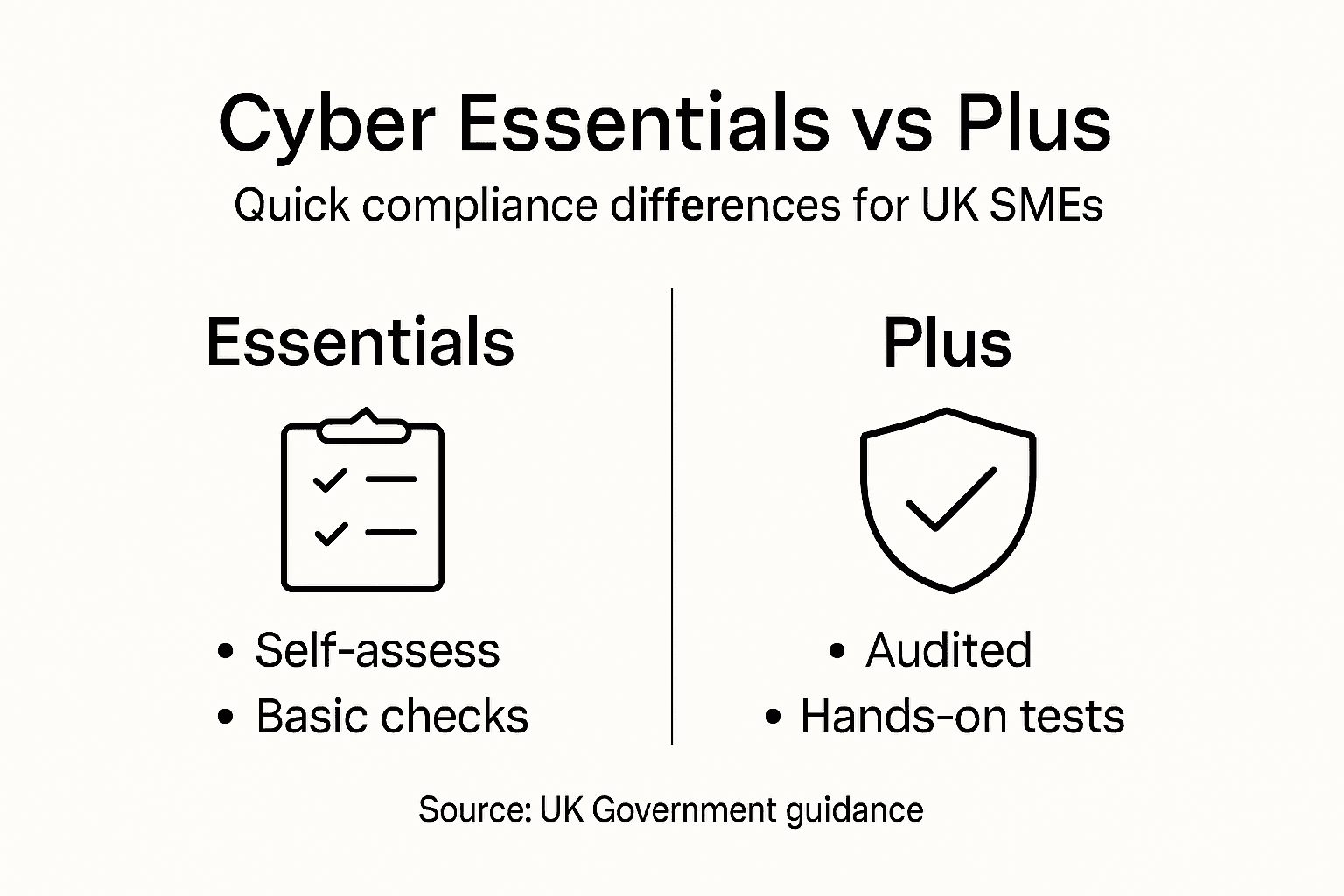
Cyber Essentials Plus takes the same foundation and adds rigorous technical verification. An independent auditor doesn’t just review your claims - they conduct hands-on testing.
They’ll examine your user devices, network gateways, and accessible servers to confirm controls actually work in practice. This audit uncovers gaps that self-assessment might miss.
The critical difference: Basic Cyber Essentials trusts your assessment; Plus verifies your reality through technical testing.
Why does this matter? Many SMEs believe they’ve implemented controls correctly, only to discover during a Plus audit that configuration gaps exist. One IT manager discovered their “secure” firewall was using default passwords - something self-assessment wouldn’t catch.

Assurance Levels and Real-World Impact
Basic Cyber Essentials offers reasonable assurance for most contracts. Government departments, however, often require Plus before awarding larger tenders. Enterprise clients increasingly demand it when selecting suppliers.
Plus certification costs more due to the auditor’s technical expertise and time on-site. Expect to invest between £2,000–£5,000 depending on your organisation’s size and complexity.
But here’s what matters to your business: Cyber Essentials certification is now standard across both public and private sectors for collaboration agreements. Without it, you’re excluded from entire contract categories.
To clarify the differences between Cyber Essentials and Plus, here is a concise comparison of their assurance and assessment methods:
Certification Type | Assurance Level | Assessment Approach | Typical Requirement |
Cyber Essentials | Reasonable assurance | Self-assessment questionnaire | General contracts |
Cyber Essentials Plus | Verified assurance | Independent technical audit | Government/enterprise tenders |
Which One Do You Actually Need?
If government contracts or enterprise partnerships are on your growth roadmap, Plus is the strategic choice. The technical audit identifies weaknesses before your clients’ security teams do.
For smaller contracts with less demanding requirements, Basic often suffices. But as your business scales, you’ll likely find yourself upgrading to Plus anyway—so planning ahead saves time.
Pro tip: Don’t treat certification as a one-time checkbox. The controls you implement for Cyber Essentials Plus become your operational baseline, catching real threats whilst you sleep.
Core Requirements and Assessment Differences
Both Cyber Essentials and Plus start with the same foundation: a self-assessment questionnaire covering the five core controls. Your organisation answers detailed questions about how you’ve implemented each control across your IT infrastructure.
The questionnaire isn’t a tick-box exercise. It asks specific technical questions designed to reveal whether you truly understand your security posture or you’re simply guessing.
The Self-Assessment Stage
Here’s what you’re evaluated on during self-assessment:
Firewall and internet gateway configuration – how you protect your network perimeter
User access controls – who can do what on your systems
Anti-malware deployment – coverage across all devices
Patch management processes – how you stay on top of updates
Device hardening – removing unnecessary software and closing security gaps
You complete this questionnaire honestly. An assessor reviews your answers to check for obvious gaps or contradictions. If your answers seem credible, you receive Cyber Essentials certification.
But self-assessment has a weakness: it relies entirely on what you claim to have done.
Where Cyber Essentials Plus Differs
The technical audit component is what separates Plus from the basic scheme. An accredited assessor doesn’t just read your answers—they verify them hands-on.
They’ll log into your systems, check your configurations, and test whether controls actually function as described. This is where assumptions crumble.
Self-assessment asks “Do you think your devices are secure?" A Plus audit answers "Let’s prove it.”
They examine your environment using highly prescriptive NCSC testing methods:
End-User Devices – laptops, desktops, and mobiles are tested to verify antivirus is working, patches are current, and local admin rights are restricted.
Malware Execution Tests – the auditor will actively attempt to download malicious test files via web browsers and email attachments to prove your defences catch them.
Vulnerability Scans – they will run internal scans on your devices and external scans against your public-facing IP addresses to uncover hidden configuration flaws.
The auditor produces a detailed report showing exactly what works and what doesn’t.
Assessment Timeline and Effort
While preparing your IT environment for Basic Cyber Essentials might take 4–6 weeks, the actual assessment is fast. Once you submit your questionnaire, the assessor typically marks it within 1 to 3 working days.
Plus audits demand much more coordination. Crucially, IASME rules dictate that you must complete your Cyber Essentials Plus audit within 3 months of passing your Basic certification. If you miss this window, you must start the entire process again.
Your internal effort matters too. Basic requires someone to gather data and complete the questionnaire accurately; Plus demands your IT team’s active participation during the on-site or remote audit to facilitate vulnerability scans and endpoint testing.
The investment in Plus pays dividends the moment you win a contract that specifically requires it.
Many SMEs find that Plus certification reveals security gaps they didn’t know existed. One financial services firm discovered their backup systems weren’t being tested—a critical failure that Basic assessment would never have caught.
Real Impact on Your Compliance Position
When government departments or enterprise clients review your security standing, they see certification level. Basic shows competence; Plus demonstrates proven, verified security controls.
If you’re bidding for contracts above £5 million, expect Plus to be mandatory. Clients simply won’t accept unverified claims.
Pro tip: Start with the self-assessment questionnaire before deciding on Plus. This gives you a clear view of your current gaps and whether a technical audit will reveal serious issues worth remedying beforehand.
Hands-on Testing and Assurance Levels Explained
When you pursue Cyber Essentials Plus, you’re paying for something basic certification cannot deliver: proof. An independent auditor doesn’t just trust your word - they verify your controls are genuinely operational and effective.
This distinction matters far more than you might expect. Self-assessment can sound convincing on paper whilst your actual systems remain vulnerable.
What Hands-on Testing Actually Involves
Cyber Essentials Plus requires technical verification where assessors conduct practical checks on your systems, configurations, and security controls. They’re not observing from a distance; they’re actively testing your defences.
Here’s what a typical audit covers:
Antivirus and malware protection – checking each device actually has active, current protection running
Firewall rules – confirming your gateway is enforcing the policies you claimed existed
Patch levels – verifying systems are current with security updates, not months behind
Access controls – testing whether user permissions actually match documented policies
Encryption – confirming sensitive data is genuinely protected
The auditor logs in, runs scans, and attempts basic attacks to see if your controls stop them. It’s adversarial - not hostile, but genuinely probing for weaknesses.
The Assurance Difference This Creates
Basic Cyber Essentials gives clients a baseline assurance that you’ve thought about security. Plus gives them confidence your defences actually work.
When your firm bids for government contracts, that difference becomes contractual currency. A government department sees Plus certification and knows an independent expert has already verified your systems meet standards.
Plus certification removes client doubt. They’re not gambling on your word; they have third-party verification.
This translates directly to competitive advantage. One SME we worked with won a £300,000 contract largely because Plus certification proved their security wasn’t theoretical - it was proven and operational.
Why Stakeholders Trust Plus More
Enterprise clients have been burned before. They’ve encountered organisations with impressive security policies that evaporated under real pressure. Plus certification proves you’re different.
The audit report becomes your insurance policy. When clients ask “Are your controls actually working?” you hand them independent verification from an accredited assessor. No interpretation needed, no guesswork involved.
It also protects your firm in incident response. If a breach occurs post-certification, your documented audit evidence shows you met reasonable security standards at the time of testing.
Real-World Impact on Your Compliance Posture
Many SMEs discover critical gaps during Plus audits that self-assessment completely missed. Configuration drift, forgotten devices, or outdated patches become visible.
This isn’t a failure - it’s the whole point. You find problems before clients do, before attackers do.
Pro tip: Prepare for your Plus audit by running your own mock testing beforehand. Use the same vulnerability scanners auditors will use, and fix obvious issues before the formal assessment. This reduces surprises and shortens the audit timeline.
Costs, Timelines, and Tender Implications
Certification costs matter when you’re budgeting for compliance. Cyber Essentials and Plus have vastly different price tags, and understanding the financial implications helps you make a strategic decision aligned with your contract ambitions.
Basic Cyber Essentials is the low-cost entry point. Plus demands specialist expertise, which costs significantly more.
Pricing Breakdown
Cyber Essentials typically costs between £500–£1,500 depending on your assessor and organisation size. The assessor reviews your self-assessment questionnaire, checks for obvious gaps, and issues certification if credible.
Cyber Essentials Plus involves experienced technical auditors, so costs are substantially higher. Expect to invest £2,500–£6,000 for a typical SME audit. Large organisations with complex infrastructure may exceed £10,000.
The cost difference reflects reality: Plus auditors spend days on-site testing systems, not hours reviewing paperwork. You’re paying for genuine verification, not a quick tick-box exercise.
For business leaders planning tender strategies, consider this summary of certification costs and expected timelines:
Certification | Estimated Cost Range | Time to Certify | Best Use Case |
Cyber Essentials | £500–£1,500 | 4–6 weeks | Fast contract eligibility |
CE Plus | £2,500–£6,000 (SMEs) | 8–12 weeks | High-value tenders, regulated sectors |
Timeline Expectations
Basic certification moves quickly. From initial contact to certificate in hand typically takes 4–6 weeks, often faster. This makes Basic ideal when you need quick contract eligibility.
Plus audits demand more time. Budget 8–12 weeks from booking to final report. Your IT team needs to prepare systems, schedule audit days, and remediate findings if necessary.
The investment in Plus timing pays off when contract deadlines matter. Plan your audit 3–4 months before you need certification.
Many SMEs underestimate internal preparation time. You’ll need to:
Gather documentation on current configurations
Ensure systems are accessible for testing
Brief staff that auditors will be present
Plan remediation time if critical gaps emerge
Contract and Tender Implications
Certification level directly affects which contracts you can pursue. Government departments and enterprise clients use it as a gating factor - not just a preference, but a requirement.
Basic Cyber Essentials qualifies you for most standard contracts, particularly those under £1 million. It proves you’re competent and serious about security basics.
Cyber Essentials Plus opens access to high-value government contracts, large enterprise partnerships, and sectors like financial services or healthcare where clients demand verified assurance. One SME reported that Plus certification increased their tender success rate by 40% within 12 months.
The return on investment becomes obvious quickly. A single £500,000 contract more than pays for Plus certification and audit costs. Many firms recoup their investment on their first major tender win.
Strategic Timing Decision
Don’t pursue Plus if you have no near-term contracts requiring it. That’s money spent before you need it. Conversely, if your growth roadmap includes government bidding within 12 months, start the Plus process now.
Basic Cyber Essentials buys you market access today. Plus certification buys you access to higher-value opportunities. Choose based on your actual contract pipeline, not on what competitors have.
Pro tip: Budget for Plus certification 3–4 months before your first targeted tender deadline. This gives time for remediation if auditors find critical gaps, and ensures your certificate is current when clients verify your standing.
Deciding How Far to Take Your Certification
The choice between Cyber Essentials and Plus isn’t an “either/or” scenario - Basic certification is a mandatory prerequisite for Plus. The real decision is whether you should stop at the Basic level or continue your journey to Plus. The wrong choice costs you either money wasted on unnecessary auditing or contracts lost to competitors with stronger assurance.
Assess Your Contract Pipeline
Start by looking at the contracts you’re actually pursuing right now. Are government departments on your target list? Are enterprise clients demanding specific certifications in tender requirements?
Pull your last 10 lost tenders and read the security requirements section. If Plus certification appears repeatedly, you already have your answer.
Organisations should select the certification that fits their security goals and compliance needs. Basic Cyber Essentials qualifies you for general contracts; Plus opens access to high-value opportunities where clients demand independent verification.
If your pipeline is dominated by tenders under £500,000 with no certification mandates, Basic likely suffices. If government contracts or enterprise partnerships represent 30% or more of your opportunity pipeline, Plus becomes a strategic investment.
Evaluate Your Risk Tolerance
Basic Cyber Essentials works if you’re comfortable with self-assessment risk. You claim your controls are implemented; an assessor reviews your questionnaire.
This creates exposure. If you’ve misconfigured systems or missed updates, Basic certification doesn’t catch it. When clients later discover gaps, your credibility suffers.
Cyber Essentials Plus transfers that risk to an independent auditor. They verify what you claim, reducing your exposure to client disappointment or security incidents post-certification.
Risk-averse businesses favour Plus. Financial services firms, healthcare providers, and those handling sensitive data almost universally choose Plus because the cost of security failures far exceeds certification costs.
Sector-Specific Expectations
Your industry shapes what clients expect:
Government contracting – Plus often mandatory above certain contract values
Financial services – Plus standard for any supplier relationship
Healthcare – Plus increasingly expected alongside NHS compliance
Technology consulting – Basic acceptable for smaller engagements, Plus for enterprise clients
General services – Basic often sufficient
If you’re unsure what your sector demands, contact your top 5 prospects and ask directly. Their answers become your decision framework.
The Readiness Question
Before choosing Plus, ask honestly: are your systems ready for a technical audit? If an external auditor will find critical gaps - default passwords, unpatched systems, missing antivirus - Basic buys you time to remediate first.
Many SMEs use Basic as a stepping stone. They achieve Basic certification, use the audit feedback to strengthen controls, then upgrade to Plus within 12 months when systems are genuinely secure.
The best certification is the one that matches your actual security posture, not your aspirational one.
Making Your Decision
Create a simple decision matrix:
Contract value – Are your targets typically above £500,000?
Tender requirements – Do client specifications mention Plus?
Sector norm – What do established competitors hold?
System readiness – Will an audit find your systems secure?
If three or more factors point toward Plus, that’s your answer. If two or fewer, Basic is your starting point.
Pro tip: Contact 3–5 accredited assessors and request a brief readiness consultation before committing. Most provide free initial discussions where they’ll assess your current posture and recommend the appropriate certification path based on your actual systems, not your assumptions.
Elevate Your SME Compliance Beyond Basics with Freshcyber
The article highlights the challenge UK SMEs face in choosing between Cyber Essentials and Cyber Essentials Plus certification. The key pain points include understanding the real assurance difference, preparing for technical audits, and navigating costly compliance without risking contract opportunities or reputation. Your goal is to move beyond mere self-assessment to verified security that wins government and enterprise contracts confidently while managing risk effectively.
Freshcyber specialises in transforming compliance from a ticking-box exercise into a strategic business asset. Through our Cyber Essentials expertise, combined with robust Vulnerability Management and tailored SME Security solutions, we help you prepare thoroughly for Plus-level audits. Our proven approach ensures you identify hidden gaps and maintain strong security controls in day-to-day operations.

Ready to turn compliance into currency that powers your growth? Visit Freshcyber today and discover how our vCISO-led Compliance Currency Engine can guide your SME through UK certification complexities with expert leadership and ongoing active defence. Take the first step towards certifiable resilience and contract-winning assurance now.
Frequently Asked Questions
What is the difference between Cyber Essentials and Cyber Essentials Plus?
Cyber Essentials involves a self-assessment that provides reasonable assurance of security controls, while Cyber Essentials Plus also includes an independent technical audit that verifies those controls are functioning as claimed.
Why is Cyber Essentials Plus more expensive than Cyber Essentials?
Cyber Essentials Plus is more expensive due to the involvement of experienced technical auditors who perform hands-on testing of your systems, ensuring that security measures are actually in place and effective.
How long does it take to achieve Cyber Essentials or Cyber Essentials Plus certification?
Basic Cyber Essentials certification typically takes 4–6 weeks, while Cyber Essentials Plus requires about 8–12 weeks due to the added complexity of the technical audit process.
Who typically needs Cyber Essentials Plus certification?
Cyber Essentials Plus is often required for government contracts and enterprise partnerships, particularly in sectors where high security standards are expected. It is advisable for SMEs aiming for larger tenders or client contracts that demand verified security assurance.
Recommended
Comments