Cyber Essentials vs Plus: Choosing the Right UK Standard
- Gary Sinnott

- Dec 10, 2025
- 8 min read
Updated: Feb 8

Over eighty percent of cyber attacks in the United Kingdom target weaknesses that could have been prevented with basic precautions. For any British business, staying ahead of digital threats is no longer optional. Understanding the difference between Cyber Essentials and Cyber Essentials Plus gives organisations the clarity they need to choose the right level of protection and earn client trust in an increasingly competitive market.
Table of Contents
Key Takeaways
Point | Details |
Certification Levels | Cyber Essentials and Cyber Essentials Plus offer different depths of assessment, with Plus providing a more comprehensive external verification. |
Self-Assessment vs External Testing | The basic certification relies on self-assessment, while Plus requires hands-on technical scrutiny by independent assessors. |
Ongoing Obligations | Both certifications must be renewed annually to ensure current security practices and compliance with evolving cyber threats. |
Common Misconceptions | Many organisations mistakenly view Cyber Essentials as a one-time certification rather than an ongoing commitment to improving cybersecurity protocols. |
Defining Cyber Essentials and Plus Certification
Cyber Essentials is a UK Government-backed certification scheme designed to help organisations protect themselves against common cybersecurity threats. Developed by the National Cyber Security Centre (NCSC), this standard provides a structured framework for businesses to demonstrate their commitment to digital security.
At its core, Cyber Essentials helps organisations establish fundamental security controls across five critical domains: internet connection security, device and software protection, access control, malware prevention, and system update management. The certification process involves a comprehensive self-assessment questionnaire that evaluates an organisation’s existing cybersecurity practices and identifies potential vulnerabilities.
There are two primary levels of Cyber Essentials certification: Cyber Essentials and Cyber Essentials Plus. The basic Cyber Essentials certification requires organisations to complete a self-assessment, demonstrating they meet minimum security standards. Cyber Essentials Plus takes this assessment further through an additional layer of technical verification, which involves an independent assessor conducting hands-on vulnerability scanning and penetration testing of an organisation’s IT infrastructure.
Key differences between the two certification levels include the depth of assessment, verification method, and the level of assurance provided to potential clients and partners. While Cyber Essentials offers a baseline security standard through self-assessment, Cyber Essentials Plus provides a more rigorous, externally validated approach to cybersecurity compliance. This makes the Plus certification particularly attractive for businesses seeking to demonstrate a more comprehensive commitment to protecting their digital assets and earning stakeholder trust.
Key Differences Between Cyber Essentials and Plus
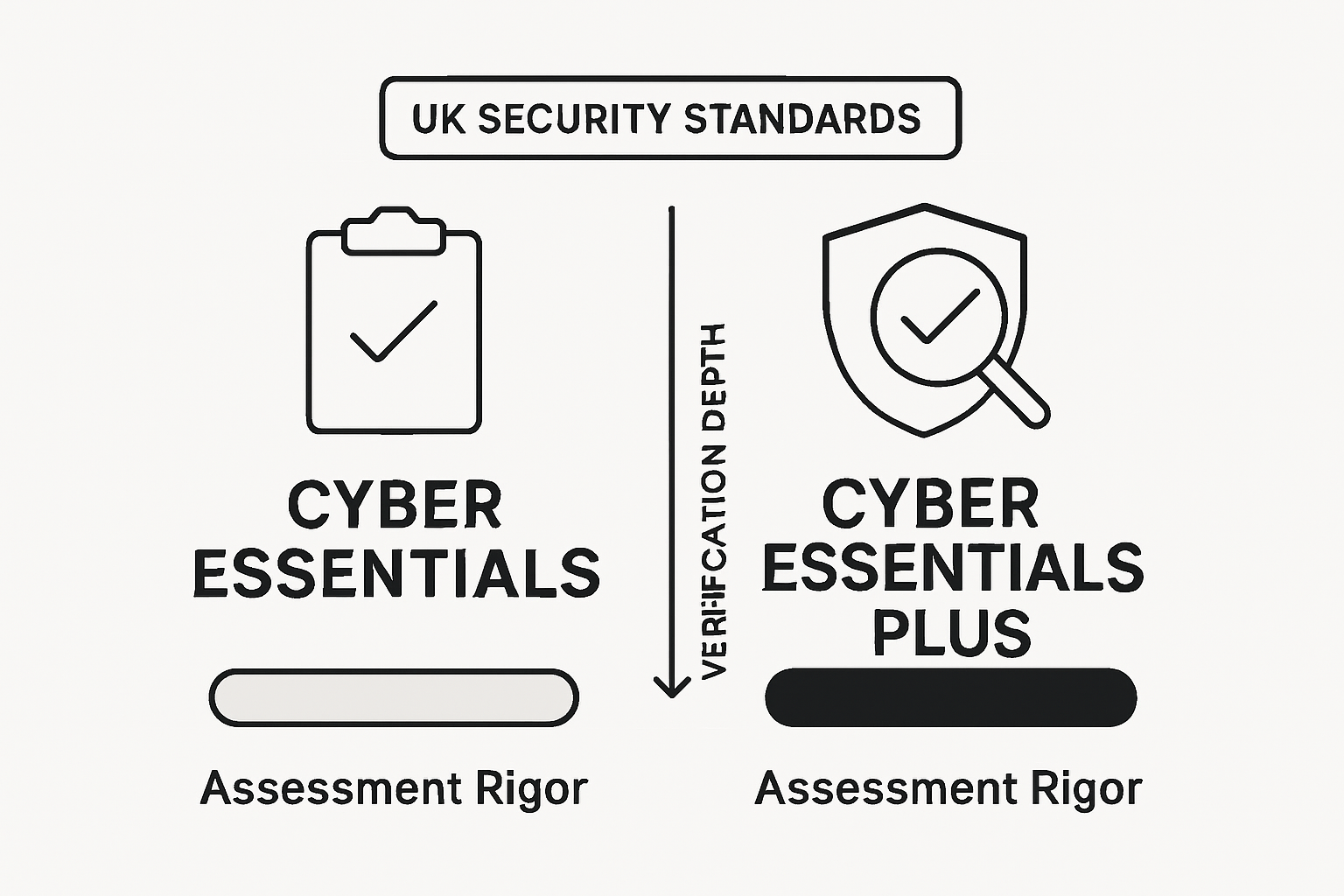
While both Cyber Essentials certifications aim to improve an organisation’s cybersecurity posture, the key distinction lies in their assessment methodology and depth of verification. Cyber Essentials Plus represents a more comprehensive approach to security validation, moving beyond the basic self-assessment model of the standard certification.
The primary differences between Cyber Essentials and Cyber Essentials Plus can be understood through their verification processes. The standard Cyber Essentials certification relies on a self-assessment questionnaire where organisations evaluate their own security practices. In contrast, Cyber Essentials Plus involves an external, independent assessment that includes both remote and on-site technical verification. This advanced level of scrutiny means that an external assessor actively tests the organisation’s security controls, conducting hands-on vulnerability scanning and penetration testing to validate the effectiveness of implemented security measures.
Verification Depth is the most significant differentiator between the two certification levels. Standard Cyber Essentials requires organisations to demonstrate they meet basic security requirements through a self-reported questionnaire. Cyber Essentials Plus provides a higher level of assurance through rigorous external testing, which includes checking whether the claimed security controls actually defend against basic hacking and phishing attempts. This more intensive assessment gives stakeholders greater confidence in an organisation’s cybersecurity preparedness.

For businesses seeking to distinguish themselves in competitive markets, Cyber Essentials Plus offers a more robust credential. The certification signals not just an intention to secure systems, but tangible proof of effective security implementation. While the standard Cyber Essentials provides a solid baseline, the Plus certification demonstrates a proactive and thorough approach to cybersecurity, potentially offering a competitive advantage when bidding for contracts or reassuring clients about digital risk management.
Certification Process and Assessment Requirements
The journey to achieving Cyber Essentials certification involves a structured approach designed to evaluate and improve an organisation’s cybersecurity defences. The certification process begins with a comprehensive self-assessment questionnaire that organisations must complete meticulously, covering critical security domains such as secure configuration, boundary firewalls, access controls, patch management, and malware protection.
For the standard Cyber Essentials certification, organisations conduct a detailed self-evaluation, answering a series of technical and procedural questions that assess their current security practices. This initial stage requires businesses to demonstrate they have implemented basic cybersecurity controls and understand potential vulnerabilities in their IT infrastructure. An independent certification body then reviews the submitted questionnaire, verifying the organisation’s claims and providing guidance on any areas requiring improvement.
Cyber Essentials Plus elevates the assessment process significantly. This advanced certification involves rigorous remote and on-site vulnerability testing conducted by a certified assessor. Unlike the standard certification, Cyber Essentials Plus includes hands-on technical verification where assessors actively probe the organisation’s systems, simulating real-world cyber attack scenarios. This means organisations must not only claim they have implemented security measures but also prove their effectiveness through practical testing.
The assessment requirements differ markedly between the two certification levels. While standard Cyber Essentials relies on self-reported information and documentary evidence, Cyber Essentials Plus demands tangible proof of security effectiveness. Organisations must be prepared for in-depth technical scrutiny, including vulnerability scans, penetration testing of internet-facing services, and comprehensive reviews of device configurations. This more intensive approach ensures that businesses can demonstrate genuine resilience against common cyber threats, providing stakeholders with a higher degree of confidence in their cybersecurity capabilities.
Costs, Timelines, and Ongoing Obligations
The financial investment and commitment required for Cyber Essentials certification varies significantly between the standard and Plus levels, with organisations needing to carefully consider their budgetary constraints and security requirements. The basic Cyber Essentials certification represents a more economical initial investment, typically ranging between £300 and £500 plus VAT, making it an accessible option for smaller businesses seeking to demonstrate their cybersecurity commitment.
The Cyber Essentials certification process involves an annual renewal cycle, requiring organisations to maintain and potentially update their security practices each year. This annual reassessment ensures that businesses continue to meet the baseline security standards and adapt to evolving cyber threats. The relatively straightforward self-assessment questionnaire allows companies to quickly complete the certification process, with most organisations able to achieve certification within a few weeks of initial preparation.
Cyber Essentials Plus represents a more substantial financial and time investment. The certification costs typically start around £1,200 and increase based on the complexity of an organisation’s network infrastructure, reflecting the comprehensive on-site verification and technical testing involved. This advanced certification demands more extensive preparation, with organisations needing to conduct internal audits, address potential vulnerabilities, and undergo rigorous external assessment by certified security professionals.
Ongoing obligations are crucial for maintaining certification validity. Both Cyber Essentials and Cyber Essentials Plus certifications are valid for 12 months, after which organisations must complete a recertification process. This annual requirement ensures that businesses maintain their security standards, continuously adapt to new cyber threats, and demonstrate a proactive approach to cybersecurity. Companies should budget not just for the initial certification cost but also for potential remediation efforts, ongoing security improvements, and the annual renewal process to maintain their certification status and demonstrate continuous commitment to robust cybersecurity practices.
Common Misconceptions and Mistakes To Avoid
Many organisations misunderstand the fundamental purpose and scope of Cyber Essentials certification, often treating it as a one-time checkbox exercise rather than an ongoing cybersecurity improvement process. This misconception can lead businesses to approach the certification with a superficial mindset, completing the minimum requirements without genuinely enhancing their security posture.
One of the most critical mistakes is underestimating the preparation time and depth required for a successful certification. Organisations frequently assume they can complete the self-assessment questionnaire quickly without thorough internal review. In reality, the process demands a comprehensive examination of existing security practices, requiring detailed documentation, system configuration reviews, and a systematic approach to addressing potential vulnerabilities. Businesses should allocate sufficient time for internal audits, collaborative discussions with IT teams, and potential remediation efforts before submitting their assessment.
Another prevalent misconception is the belief that achieving Cyber Essentials certification guarantees absolute protection against all cyber threats. While the certification provides a robust framework for fundamental security controls, it is not an impenetrable shield. Cyber threats continuously evolve, and organisations must maintain a proactive and dynamic approach to cybersecurity. This means ongoing monitoring, regular updates to security protocols, employee training, and a commitment to staying informed about emerging digital risks.
Perhaps the most dangerous mistake is viewing Cyber Essentials as a static achievement rather than a continuous journey of security improvement. Successful organisations treat certification as a starting point for enhancing their cybersecurity capabilities, not an endpoint. This involves regular internal assessments, staying updated with the latest security guidelines, conducting periodic vulnerability scans, and fostering a culture of security awareness across all levels of the organisation. By understanding that cybersecurity is an ongoing process, businesses can transform Cyber Essentials from a compliance requirement into a strategic advantage that builds trust with clients and partners.
Navigate Cyber Essentials with Confidence and Expert Support
Choosing between Cyber Essentials and Cyber Essentials Plus can feel overwhelming, especially when you need to balance thorough compliance with limited time and resources. The article highlights common challenges such as understanding the depth of verification and managing ongoing obligations while avoiding costly mistakes or superficial certification efforts. Freshcyber specialises in guiding busy UK businesses through these exact hurdles, offering clear and practical assistance tailored to your needs.
Our expert team ensures your organisation not only achieves certification but maintains it effortlessly with continuous Vulnerability Management that keeps you secure year-round. If you are a small or medium business looking for reliable, stress-free support, our Cyber Essentials services will help you build strong defences that protect your digital assets and build essential client trust.
Ready to take the complexity out of certification and secure your business today?

Explore how Freshcyber’s expertise in Cyber Essentials and commitment to SME Security can simplify your journey. Visit freshcyber.co.uk now for peace of mind and proven compliance that lasts beyond audit day.
Frequently Asked Questions
What is the difference between Cyber Essentials and Cyber Essentials Plus?
Cyber Essentials requires organisations to complete a self-assessment to demonstrate basic security controls. In contrast, Cyber Essentials Plus includes an independent assessor who conducts technical verification through vulnerability scanning and penetration testing.
How does the certification process for Cyber Essentials work?
The Cyber Essentials certification process starts with a self-assessment questionnaire focused on fundamental security domains. Once complete, an independent certification body reviews the submission to verify compliance with security standards.
How often do businesses need to renew their Cyber Essentials certification?
Both Cyber Essentials and Cyber Essentials Plus certifications are valid for 12 months. Organisations must complete a recertification process annually to maintain their certification status and ensure ongoing adherence to security practices.
Is Cyber Essentials certification sufficient for protecting against all cyber threats?
While Cyber Essentials provides a strong framework for basic cybersecurity controls, it does not guarantee absolute protection. Organisations should treat it as a foundation for ongoing security improvements rather than a one-off solution.
Recommended
Comments