Cyber Essentials Plus: Securing UK SME Contracts


Securing a government contract is a business milestone, but achieving the right cybersecurity certification can feel daunting for many British SMEs. Meeting the stringent requirements of Cyber Essentials Plus is now a critical gateway to public sector work, offering not just compliance but a higher assurance of digital protection. This article provides clear insights into what sets Cyber Essentials Plus apart, outlining the technical audit process and key benefits for organisations aiming to improve cyber resilience and build lasting trust.
Table of Contents
Key Takeaways
Point | Details |
Cyber Essentials Plus Certification Validates Cybersecurity Readiness | Achieving this certification involves an independent technical audit that confirms the effectiveness of an organisation’s security measures. |
Demonstrates Commitment to Cybersecurity | Certification enhances an organisation’s credibility with clients and stakeholders, reducing cyber risk and showcasing a proactive stance on digital protection. |
Distinction from Basic Cyber Essentials | Cyber Essentials Plus involves extensive testing and verification, providing a deeper assurance of an organisation’s security infrastructure than the basic level. |
Anticipate Regulatory Changes | Preparing for upcoming regulatory updates will require organisations to adopt comprehensive cybersecurity strategies, integrating advanced technologies for enhanced protection. |
Defining Cyber Essentials Plus Certification
Cyber Essentials Plus represents a rigorous cybersecurity certification designed specifically for UK organisations seeking to demonstrate robust digital defence capabilities. Unlike its baseline counterpart, this certification goes beyond self-assessment, providing comprehensive verification of an organisation’s security infrastructure.
The certification process involves a detailed technical audit conducted by trained security professionals who systematically evaluate an organisation’s digital environment. Cyber security standards verification requires a comprehensive examination of multiple system components, including:
External vulnerability scanning
Internal network assessments
Device configuration reviews
Email and web browser protection testing
Simulated malware challenge scenarios
What distinguishes Cyber Essentials Plus from standard certifications is its hands-on approach. Unlike basic self-assessment models, trained assessors actively probe and test an organisation’s security controls, ensuring that declared protective measures are genuinely implemented and effective. Technical security audit processes reveal potential vulnerabilities before they can be exploited by malicious actors.
The certification provides organisations with a 12-month validation of their cybersecurity readiness, demonstrating to clients, partners, and stakeholders a commitment to maintaining robust digital defences. By meeting these stringent government-backed standards, businesses can enhance their credibility, reduce cyber risk, and position themselves as trustworthy digital partners.
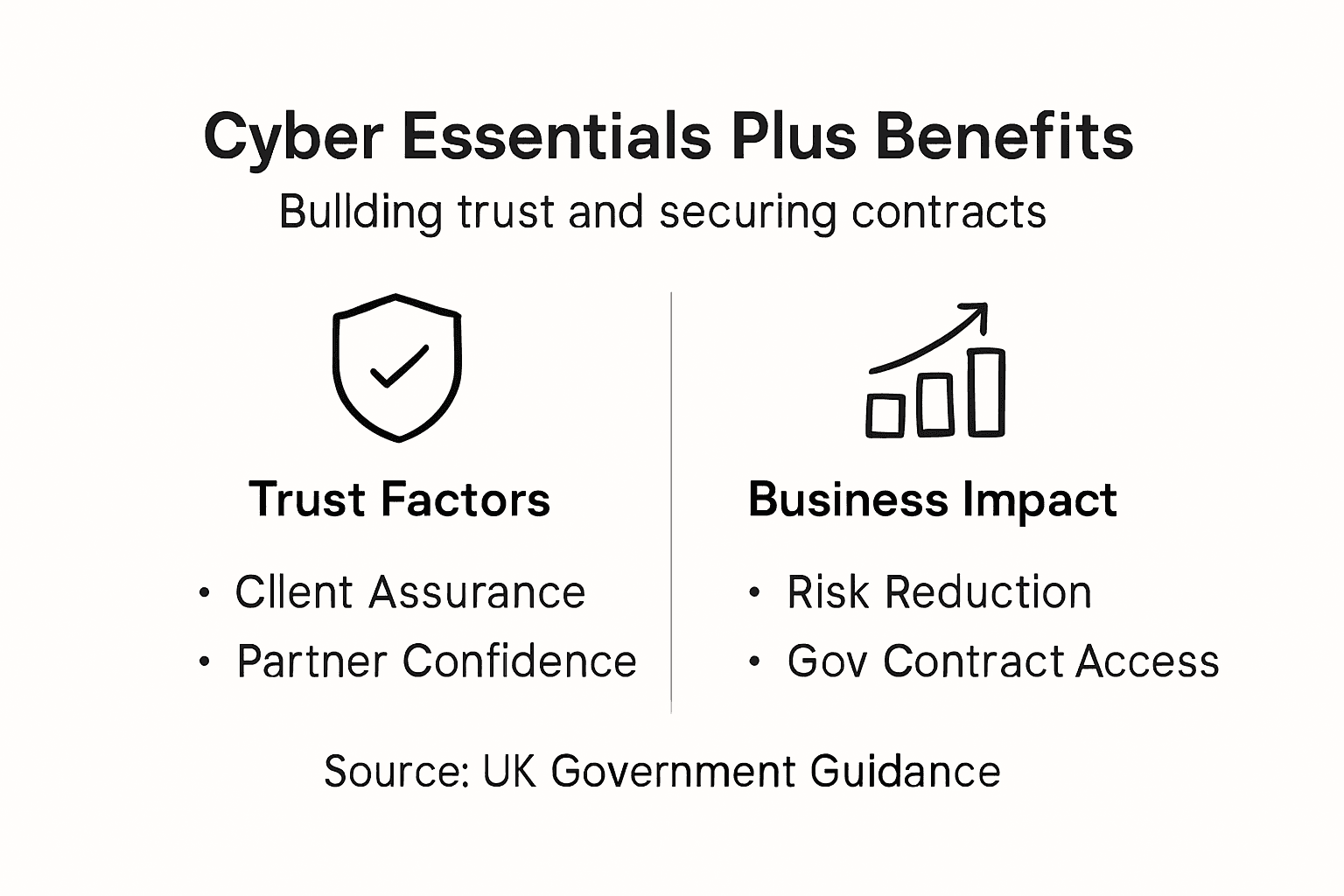
The following table summarises the business benefits of achieving Cyber Essentials Plus certification:
Business Benefit | How It Is Achieved | Impact on Organisation |
Enhanced trust | Independent technical verification | Improves client and partner confidence |
Reduced cyber risk | Hands-on system assessments | Decreases likelihood of data breaches |
Eligibility for contracts | Meets public sector requirements | Enables bidding for government work |
Increased resilience | Continuous security improvements | Strengthens long-term digital defences |
Pro tip: Schedule your technical assessment well in advance, as qualified assessors often have limited availability and the audit process can take several weeks to complete.
Distinct Features of Cyber Essentials Versus Plus
While both Cyber Essentials and Cyber Essentials Plus are critical cybersecurity certifications for UK organisations, they differ substantially in their approach and depth of security validation. Cyber security verification levels represent two distinct stages of organisational digital protection.
The primary differences between the two certification levels can be categorised into several key areas:
Cyber Essentials (Basic Level)
Self-assessment questionnaire
Focuses on five fundamental security controls
Verified by external assessor review
Lower cost and faster certification process
Cyber Essentials Plus (Advanced Level)
Comprehensive technical audit
Hands-on vulnerability testing
Independent assessor conducts infrastructure tests
Higher level of security assurance
Technical compliance verification reveals that Cyber Essentials Plus provides a more rigorous examination of an organisation’s cybersecurity infrastructure. While the basic certification relies on organisational self-reporting, the Plus version involves direct technical testing of IT systems, including vulnerability scanning, device configuration reviews, and simulated cyber attack scenarios.
Here’s a side-by-side comparison of the scope of basic and advanced certification levels:
Aspect | Cyber Essentials | Cyber Essentials Plus |
Assessment Type | Self-reported questionnaire | In-depth technical audit |
Testing Approach | Paper-based verification | Active vulnerability testing |
Assessor Involvement | External review only | Direct engagement onsite |
Evidence Strength | Moderate (declarations) | Strong (proof of application) |
For businesses seeking government contracts or working in sensitive sectors, Cyber Essentials Plus offers a more robust demonstration of cybersecurity readiness. The additional technical audit provides stakeholders with concrete evidence of an organisation’s commitment to maintaining strong digital defences, going well beyond a simple checklist approach.
Pro tip: Consider the Cyber Essentials Plus certification as an investment in your organisation’s digital reputation, not just a compliance requirement.
2026 Regulatory Updates and Scope Expansion
The cybersecurity landscape for UK Small and Medium Enterprises (SMEs) is experiencing significant transformation, with emerging regulatory frameworks demanding more comprehensive and proactive digital protection strategies. UK Cyber Security Regulations are set to introduce more stringent requirements that will fundamentally reshape how organisations approach their digital resilience.
Key anticipated regulatory developments for 2026 include:
Expanded scope of mandatory security assessments
More rigorous third-party vendor risk management
Enhanced reporting requirements for cyber incidents
Increased penalties for non-compliance
Mandatory implementation of advanced threat detection systems
The evolving regulatory environment signals a critical shift towards preventative cybersecurity rather than reactive measures. SMEs will need to demonstrate not just basic compliance, but a holistic approach to digital risk management that encompasses technical controls, organisational processes, and continuous monitoring.
Government and industry bodies are increasingly recognising that cybersecurity is no longer an optional investment but a fundamental business requirement. This means businesses will need to develop more sophisticated approaches to digital defence, integrating advanced technologies like artificial intelligence and machine learning into their security infrastructure to meet emerging regulatory standards.
Pro tip: Proactively engage with cybersecurity consultants who specialise in regulatory compliance to stay ahead of 2026 requirements.
Technical Testing and Compliance Requirement Process
Cyber Essentials Plus certification demands a comprehensive and methodical approach to technical verification, ensuring organisations meet rigorous cybersecurity standards. Compliance verification process involves multiple layers of systematic assessment designed to validate an organisation’s digital security infrastructure.
The technical testing and compliance process typically encompasses several critical stages:
Preparatory Documentation
Complete detailed self-assessment questionnaire
Obtain senior board member signature
Define precise organisational IT infrastructure scope
Technical Verification
Comprehensive firewall configuration review
Patch management system evaluation
Malware protection infrastructure testing
User access control verification
Secure device configuration audit
The assessment goes beyond standard paperwork, involving hands-on technical evaluations that simulate real-world cyber threat scenarios. Qualified assessors conduct in-depth examinations, probing for potential vulnerabilities and verifying that declared security measures are genuinely implemented and effective.

Organisations must understand that compliance is not a one-time event but a continuous process of monitoring, updating, and improving cybersecurity practices. The technical testing requires organisations to demonstrate not just theoretical knowledge, but practical implementation of robust security controls across their entire digital ecosystem.
Pro tip: Maintain comprehensive, up-to-date documentation of your security configurations to streamline the compliance verification process.
Legal Obligations for Government Contracts
Government contract procurement has become increasingly sophisticated in its cybersecurity requirements, with Cyber Essentials Plus emerging as a critical standard for organisations seeking public sector opportunities. Legal cybersecurity procurement standards now mandate robust digital protection as a fundamental prerequisite for contract eligibility.
Key legal obligations for government contracts typically include:
Mandatory Cyber Essentials Plus certification
Comprehensive data protection compliance
Regular security vulnerability assessments
Transparent reporting of potential cyber risks
Maintenance of ongoing cybersecurity standards
Public sector cybersecurity requirements represent more than mere bureaucratic checkboxes. They constitute a critical framework designed to protect sensitive government infrastructure, taxpayer data, and national digital interests. SMEs must recognise these requirements as strategic opportunities to demonstrate their organisational maturity and commitment to robust cybersecurity practices.
The legal landscape surrounding government contracts is evolving rapidly, with increasing emphasis on proactive risk management. Organisations that view certification as a continuous journey rather than a static achievement will be best positioned to secure and maintain lucrative public sector contracts. This means consistently updating security protocols, conducting regular internal audits, and maintaining a dynamic approach to digital defence.
Pro tip: Develop a comprehensive compliance roadmap that anticipates future regulatory changes and positions your organisation as a trusted, forward-thinking contractor.
Common Pitfalls and How to Avoid Failure
Cyber Essentials Plus certification demands meticulous preparation and a comprehensive understanding of potential vulnerabilities. Certification failure prevention requires organisations to anticipate and systematically address common technical and procedural challenges.
The most frequent pitfalls organisations encounter include:
Incomplete or inaccurate questionnaire responses
Lack of senior management engagement
Outdated software and unpatched systems
Poorly configured access controls
Insufficient documentation of security practices
Inadequate staff cybersecurity training
Neglecting continuous monitoring and updates
Successful certification hinges on developing a proactive cybersecurity strategy that goes beyond simple compliance. This means creating a robust framework that integrates technical controls, organisational processes, and continuous improvement mechanisms. Organisations must treat the certification process as a holistic approach to digital risk management, not merely a bureaucratic exercise.
Technical preparedness requires a comprehensive audit of existing infrastructure, ensuring all systems meet the stringent requirements of Cyber Essentials Plus. This involves detailed vulnerability assessments, rigorous configuration reviews, and a commitment to maintaining up-to-date security protocols across all digital assets.
Pro tip: Conduct a comprehensive internal pre-assessment at least three months before your official certification audit to identify and rectify potential vulnerabilities.
Strengthen Your SME’s Cyber Essentials Plus Readiness with Freshcyber
Navigating the complexities of Cyber Essentials Plus certification is a critical step for UK SMEs aiming to secure government contracts and build lasting trust. The article highlights key challenges such as rigorous technical audits, continuous vulnerability management, and staying ahead of evolving regulations. Freshcyber understands these hurdles and offers a strategic approach that goes beyond mere compliance to create true digital resilience. By integrating frameworks like ISO 27001 and providing hands-on support with vulnerability and risk management, we empower your organisation to demonstrate robust cybersecurity capabilities with confidence.

Don’t leave your Cyber Essentials Plus certification to chance. Explore how our Cyber Essentials expertise, combined with comprehensive Vulnerability Management and practical SME Security solutions, can transform compliance into a competitive advantage. Visit https://freshcyber.co.uk today and take the first step in turning regulatory obligations into your strongest asset for winning contracts and securing your future.
Frequently Asked Questions
What is Cyber Essentials Plus certification?
Cyber Essentials Plus is a rigorous cybersecurity certification aimed at UK organisations that wish to demonstrate robust digital defence capabilities. It involves a detailed technical audit by trained assessors to verify an organisation’s security infrastructure.
How does Cyber Essentials Plus differ from Cyber Essentials?
Cyber Essentials Plus involves a comprehensive technical audit and hands-on vulnerability testing, while Cyber Essentials relies on a self-assessment questionnaire and paper-based verification. The Plus version offers a higher level of security assurance.
What are the main benefits of obtaining Cyber Essentials Plus certification?
Key benefits include enhanced trust from clients and partners, reduced cyber risk through thorough assessments, eligibility for public sector contracts, and increased resilience through ongoing security improvements.
What are common pitfalls organisations face during Cyber Essentials Plus certification?
Common pitfalls include incomplete questionnaire responses, lack of senior management engagement, outdated software, poorly configured access controls, insufficient security documentation, inadequate staff training, and neglecting continuous updates.
Recommended
Comments