Cyber Essentials 2026 Update: MFA and Cloud Rules

Updated: Mar 4

Trusting the basics of your cyber security can be surprisingly challenging as regulations evolve and threats change daily. For IT and Compliance Managers at British SMEs, the upcoming Cyber Essentials v3.3 update is about more than just ticking boxes. With the government now mandating multi-factor authentication on all available cloud services and expanding scoping requirements, adapting your approach is no longer optional. This article will clear up common misconceptions and outline practical steps for staying compliant and secure as the April 2026 deadline approaches.
Table of Contents
Key Takeaways
Point | Details |
Cyber Essentials Framework | The Cyber Essentials scheme provides a structured approach to cybersecurity for organisations, enhancing their resilience against online threats. |
Mandatory MFA by 2026 | All organisations are required to implement multi-factor authentication across cloud services, with no exceptions permitted. |
Comprehensive Cloud Security | From April 2026, organisations must include all cloud services in security assessments, requiring thorough documentation and justification for any exclusions. |
Shift to Passwordless Authentication | The adoption of passwordless technologies is being endorsed, alongside robust backup strategies for data protection and disaster recovery. |
Cyber Essentials scheme fundamentals and misconceptions
The Cyber Essentials scheme represents a critical UK government-backed cybersecurity framework designed to protect organisations against prevalent online threats. At its core, this certification provides a standardised approach to managing digital security risks, particularly for small and medium enterprises seeking robust protection strategies.
The scheme centres around five fundamental technical controls that address the majority of common cybersecurity vulnerabilities:
Firewalls: Configuring network perimeter defences
Secure Configuration: Establishing secure settings for systems and devices
User Access Control: Managing user privileges and authentication processes
Malware Protection: Implementing robust anti-malware strategies
Security Update Management: Ensuring timely software and system updates
Common misconceptions about Cyber Essentials often stem from misunderstandings about its complexity and scope. Many organisations incorrectly assume the certification requires extensive technical expertise or significant financial investment. However, the National Cyber Security Centre guidance emphasises that the framework is deliberately designed to be achievable for businesses of all sizes and technical capabilities.
Here is a summary of key business advantages provided by each Cyber Essentials control:
Control Area | Main Benefit | Business Impact |
Boundary Firewalls | Filters internet traffic | Reduces exposure to attacks |
Secure Configuration | Blocks default vulnerabilities | Minimises risk of breaches |
User Access Control | Limits unauthorised access | Prevents insider threats |
Malware Protection | Detects and stops malware | Protects business continuity |
Patch Management | Closes software loopholes | Ensures compliance and safety |
The certification process involves either a self-assessment option or verification through a certified body, allowing organisations flexibility in their approach. Importantly, Cyber Essentials is not just a theoretical exercise but a practical mechanism for demonstrating commitment to cybersecurity, increasingly becoming a prerequisite for winning contracts and building client trust.
Pro tip: Start your Cyber Essentials preparation by conducting a thorough internal audit of your current technical controls, identifying potential gaps before initiating the certification process.
Mandatory MFA: what SMEs must do in 2026
The UK cyber security regulations are dramatically reshaping multi-factor authentication (MFA) requirements for small and medium enterprises, with significant changes set to take effect in 2026. From April 2026, organisations will face strict new mandates that fundamentally alter how they approach user authentication and cloud service security.
Specifically, Cyber Essentials version 3.3 introduces several critical MFA requirements for SMEs:
Mandatory MFA Activation: Enable multi-factor authentication on all cloud platforms and user accounts
Comprehensive Coverage: Apply MFA to every service supporting the technology
Evidence Requirements: Maintain documented proof of MFA implementation
Zero Exceptions: Failure to implement available MFA results in automatic certification failure
Cloud Service Scope: Include all cloud-connected services within authentication strategy
The procurement landscape is also evolving, with public sector contracts now demanding robust authentication processes. From February 2025, suppliers to government contracts deemed at higher cybersecurity risk must demonstrate advanced authentication controls, effectively making MFA a prerequisite for contract eligibility.
Implementation strategies should focus on a systematic approach: first, conduct a comprehensive inventory of all cloud services and user accounts, then methodically enable MFA across each platform. Prioritise services handling sensitive data and ensure consistent implementation across your entire digital infrastructure.

Pro tip: Create a centralised MFA tracking spreadsheet documenting each service’s authentication status, implementation date, and responsible team member to ensure comprehensive coverage.
Cloud services in scope: new definitions and impact
The UK cyber security regulations are introducing unprecedented clarity around cloud service definitions, fundamentally transforming how organisations approach digital infrastructure security. From April 2026, the Cyber Essentials scheme will mandate comprehensive inclusion of all cloud-based services within organisational security assessments.
Key changes in cloud service scoping include:
Explicit Service Definition: Comprehensive coverage of SaaS, PaaS, and IaaS platforms
Internet-Connected Services: All services accessible via internet now mandatory
Data Processing Environments: Including identity management and cloud-hosted systems
Zero Exclusion Policy: Cloud services that store or process organisational data cannot be excluded from your assessment scope.
Network Segregation Justification: If you wish to exclude a specific subset of devices or a network segment, you must provide robust technical evidence that they are fully separated from your main network.
The new regulatory framework demands a holistic approach to cloud security, effectively eliminating previous ambiguities around service boundaries. Organisations must now conduct thorough audits of their entire digital ecosystem, mapping out every cloud-connected service and implementing robust security controls across all platforms.
Implementation will require a systematic approach, starting with a comprehensive inventory of all cloud services, followed by rigorous authentication and security control assessments. This means IT managers must develop a granular understanding of their cloud infrastructure, documenting each service’s purpose, data handling processes, and specific security mechanisms.
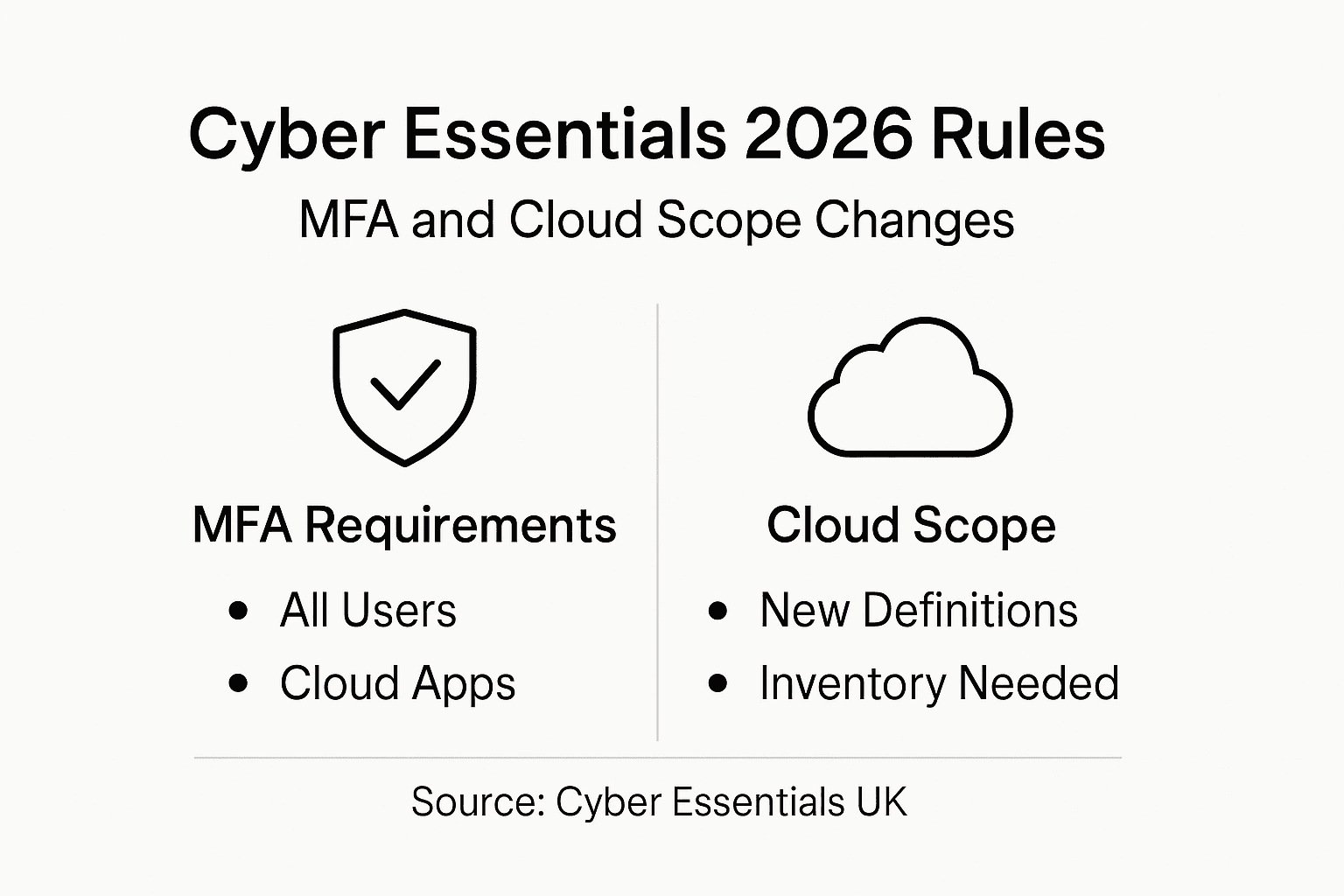
Pro tip: Create a detailed cloud service register that tracks every platform’s connectivity, data processing capabilities, and current security configurations to simplify compliance documentation.
Updated scoping and exclusion justification requirements
The Cyber Essentials certification process introduces stringent new requirements for organisations seeking to define their cybersecurity assessment scope, demanding unprecedented levels of transparency and evidential support for any network segmentation or service exclusions.
Critical aspects of the updated scoping requirements include:
Comprehensive Infrastructure Mapping: Document entire IT infrastructure used for business activities
Explicit Network Segmentation: Clearly define and justify any isolated network segments
Detailed Exclusion Rationales: Provide robust evidence for any proposed service exclusions
Firewall and VLAN Demarcation: Demonstrate precise boundaries between in-scope and out-of-scope systems
Risk-Based Justification: Substantiate exclusions with quantifiable security risk assessments
Organisations must now adopt a forensically precise approach to defining their cybersecurity scope. This means developing a comprehensive inventory that goes beyond simple asset listing, requiring deep technical understanding of network architectures, interconnections, and potential security vulnerabilities across all digital environments.
Implementation demands a methodical approach, with IT managers required to create detailed documentation that not only lists network components but provides compelling, evidence-based justifications for any proposed exclusions. This shift emphasises transparency, compelling organisations to demonstrate a proactive and comprehensive approach to cybersecurity risk management.
Pro tip: Develop a standardised template for scoping documentation that includes network topology diagrams, detailed justification narratives, and risk assessment matrices to streamline your Cyber Essentials compliance process.
Passwordless authentication and backup recommendations
The Cyber Essentials Requirements for IT Infrastructure are transforming authentication strategies by formally endorsing passwordless technologies and establishing comprehensive backup guidelines for UK organisations.
Key passwordless authentication technologies include:
Biometric Authentication: Fingerprint, facial recognition, and retinal scanning
Hardware Security Keys: FIDO2-compatible physical authenticators
Mobile Device Verification: Smartphone-based authentication mechanisms
Cryptographic Token Systems: Advanced security token technologies
Behavioural Authentication: Analysing user interaction patterns
Backup recommendations now emphasise a holistic approach to data protection, requiring organisations to develop robust, multi-layered backup strategies. This involves not just creating copies, but ensuring those copies are secure, regularly tested, and capable of supporting rapid disaster recovery processes.
While backup strategies have been moved to the forefront of the v3.3 guidance document to emphasise their critical role in ransomware recovery, it is worth noting that backups remain a strong recommendation rather than a formally assessed technical control for basic certification.
Implementation demands a systematic approach, integrating passwordless authentication across all organisational systems while maintaining comprehensive backup protocols. IT managers must conduct thorough assessments of existing authentication methods, gradually transitioning to more secure, passwordless alternatives that reduce human error and enhance overall cybersecurity posture.
The following table highlights differences between traditional password authentication and modern passwordless approaches:
Authentication Method | Security Level | User Experience | Implementation Effort |
Password-Based | Moderate | Prone to error/fatigue | Widely implemented |
Passwordless | High | Fast and seamless | May require upgrades |
Pro tip: Conduct quarterly backup restoration drills and implement a rotating hardware authentication key system to ensure both data resilience and robust access control.
Preparing your SME for April 2026 compliance
The UK government cyber security guidance provides a comprehensive roadmap for small and medium enterprises preparing for the 2026 Cyber Essentials updates. Understanding and acting on these recommendations will be crucial for maintaining certification, reducing cyber incident risks, and protecting organisational digital infrastructure.
Key preparation steps for SMEs include:
Infrastructure Audit: Conduct comprehensive review of current IT systems
Multi-Factor Authentication: Enable MFA across all user accounts and cloud services
Staff Training: Implement mandatory cybersecurity awareness programmes
Documentation Preparation: Create detailed scoping and exclusion justification records
Cloud Service Inventory: Map and secure all internet-connected platforms
Successful compliance requires a systematic, proactive approach. IT managers must view these updates not as bureaucratic requirements, but as strategic opportunities to enhance organisational resilience. This means moving beyond simple checkbox compliance to developing a robust, adaptive cybersecurity culture that anticipates and mitigates potential risks.
Implementation should be gradual and methodical, prioritising critical systems and high-risk access points. Organisations should allocate sufficient time and resources for thorough testing, staff training, and incremental technology upgrades to ensure smooth transition and minimal operational disruption.
Pro tip: Create a dedicated compliance project team with representatives from IT, operations, and management to oversee and coordinate your April 2026 Cyber Essentials preparation.
Strengthen Your SME Security with Expert Cyber Essentials Support
The Cyber Essentials 2026 Update brings essential changes in MFA implementation and cloud service coverage that SMEs cannot afford to ignore. With mandatory multi-factor authentication on all cloud-connected services and stringent scoping requirements, the challenges of maintaining compliance and proving robust cybersecurity controls are more complex than ever. Businesses must address these evolving pain points to avoid certification failure and win critical contracts.
At Freshcyber, we understand the pressure of turning these regulatory demands into true business advantages. Our Cyber Essentials specialists help you navigate comprehensive MFA rollouts and detailed cloud service inventories with confidence. Plus, our SME Security solutions ensure your organisation stays resilient against cyber threats while meeting compliance expectations. Discover how strategic leadership and active defence can transform compliance from a burden into your strongest asset.

Don’t wait until April 2026 to start your preparation. Visit Freshcyber today to explore how our expert team can guide your business through the latest Cyber Essentials updates and secure your future growth.
Frequently Asked Questions
What are the main changes to MFA requirements under Cyber Essentials in 2026?
From April 2026, all cloud platforms and user accounts must have multi-factor authentication (MFA) enabled, with comprehensive coverage across all services that support this technology. Failure to implement MFA will result in automatic certification failure.
How should SMEs prepare for the new cloud service scoping requirements?
SMEs need to conduct a thorough inventory of all cloud services, mapping out every internet-connected platform. Implementing robust security controls and maintaining documentation for each service will be crucial for compliance.
What types of passwordless authentication are endorsed by the updated Cyber Essentials guidelines?
The updated guidelines endorse several passwordless technologies, including biometric authentication (fingerprint and facial recognition), hardware security keys, mobile device verification, cryptographic token systems, and behavioural authentication.
What steps should SMEs take to ensure compliance for the Cyber Essentials requirements by 2026?
SMEs should perform an infrastructure audit, enable MFA across all user accounts, conduct staff training on cybersecurity, prepare detailed scoping documentation, and map all internet-connected cloud services to ensure compliance by April 2026.
Recommended
Comments