Certification in Nonprofit Security - Why It Matters
- Gary Sinnott

- Jan 19
- 7 min read

Keeping sensitive client data secure is a daily challenge for compliance officers in United Kingdom healthcare and legal SMEs. Contractual demands and regulatory scrutiny mean that even a single weak point can have far-reaching consequences for operational reputation. By focusing on ISO 27001 certification, your organisation gains a structured framework to address risks, implement rigorous controls, and demonstrate your ongoing commitment to security resilience to both partners and regulators.
Table of Contents
Key Takeaways
Point | Details |
Certification Enhances Security | Nonprofit security certification validates an organisation’s ability to manage risks through structured protocols and frameworks. |
Key Certifications to Consider | UK nonprofits can benefit from Cyber Essentials for basic controls or ISO 27001 for comprehensive information security management. |
Importance of Regular Assessments | Conducting thorough security assessments and audits is essential to identify vulnerabilities and ensure compliance with certification standards. |
Building Trust and Resilience | Cybersecurity certification demonstrates commitment to protecting sensitive information, thereby enhancing stakeholder confidence and organisational resilience. |
Defining Certification in Nonprofit Security
Certification in nonprofit security represents a structured, comprehensive approach to protecting organisational assets, data, and operational integrity through systematic risk management and security protocols. The Cyber Assessment Framework provides critical guidance for organisations seeking to establish robust cybersecurity foundations, particularly within the nonprofit sector.
At its core, nonprofit security certification involves a formal recognition process that validates an organisation’s capability to identify, assess, and mitigate potential security risks. This goes beyond traditional compliance checklists, encompassing a holistic strategy that addresses technological vulnerabilities, human factors, and organisational resilience. Nonprofits face unique challenges, including limited resources, diverse stakeholder networks, and often sensitive mission-critical information that requires sophisticated protection mechanisms.
The certification process typically involves comprehensive evaluations across multiple domains. These include technological infrastructure assessment, policy development, staff training protocols, incident response readiness, and ongoing risk management strategies. A graduate-level security and risk management approach emphasises the importance of creating adaptable, context-specific security frameworks that can evolve with emerging technological threats.
Pro tip: Conduct an initial security gap analysis to understand your nonprofit’s specific vulnerabilities before pursuing certification, ensuring a targeted and efficient preparation strategy.
Key Certification Types for UK Nonprofits
UK nonprofits have access to several critical cybersecurity certification pathways designed to enhance organisational resilience and protect sensitive information. The Professional Certificates in Cyber Security offer targeted training that equips nonprofit leaders with essential skills to manage complex digital risks effectively.
Three primary certification types dominate the nonprofit cybersecurity landscape: Cyber Essentials, ISO 27001, and specialised graduate-level risk management certifications. Cyber Essentials provides a foundational framework for basic cybersecurity controls, focusing on protecting an organisation against common online threats. ISO 27001 represents a more comprehensive approach, establishing a robust information security management system that demonstrates sophisticated risk mitigation strategies.
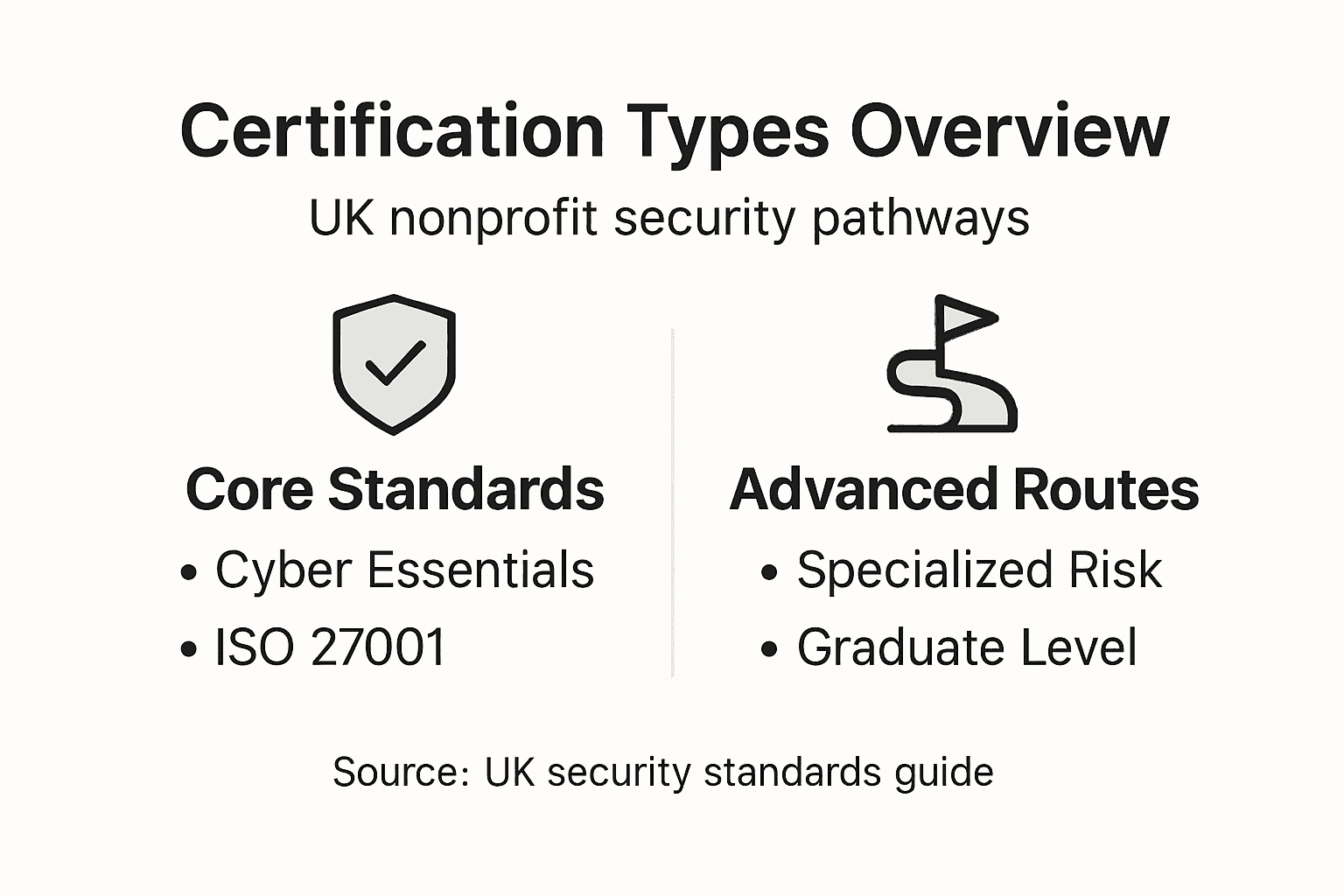
Graduate-level certifications offer an advanced pathway for nonprofit professionals seeking deeper cybersecurity expertise. These Cyber Risk Mitigation programmes go beyond technical training, integrating governance, compliance, and strategic risk management. They emphasise developing holistic security frameworks that address technological, human, and organisational vulnerabilities, enabling nonprofits to create adaptive and resilient security strategies.
Pro tip: Begin your certification journey by conducting a comprehensive internal security assessment to identify your specific organisational vulnerabilities and select the most appropriate certification pathway.
ISO 27001 and Cyber Essentials Standards
Two pivotal cybersecurity standards play crucial roles in protecting nonprofit organisations across the United Kingdom: ISO 27001 Information Security Management and Cyber Essentials. These frameworks provide structured approaches to managing digital risks, each offering unique benefits tailored to different organisational needs and maturity levels.
ISO 27001 represents a comprehensive international standard for information security management. It provides a systematic approach to managing sensitive information, ensuring that nonprofits can identify, assess, and mitigate potential security risks across their entire operational ecosystem. The standard requires organisations to develop a robust Information Security Management System (ISMS) that encompasses technical controls, governance processes, and continuous improvement mechanisms. Unlike more basic certifications, ISO 27001 demands a holistic approach to security that integrates people, processes, and technology.

Cyber Essentials, by contrast, offers a more entry-level certification focused on foundational cybersecurity controls. This UK-specific standard helps organisations demonstrate their commitment to cybersecurity by implementing basic protective measures against common online threats. It covers critical areas such as boundary firewalls, secure configuration, user access control, malware protection, and patch management. For smaller nonprofits with limited resources, Cyber Essentials provides an accessible starting point for building a structured approach to digital security.
Pro tip: Consider pursuing Cyber Essentials as an initial step, then progressively work towards the more comprehensive ISO 27001 certification to build a mature, adaptable security framework.
The following table contrasts the main features of Cyber Essentials and ISO 27001 for UK nonprofits:
Standard | Focus Area | Implementation Complexity | Ideal For |
Cyber Essentials | Basic cyber controls | Low, straightforward checklist | Small charities, beginners |
ISO 27001 | Full security management system | High, ongoing process | Medium–large nonprofits, advanced needs |
Certification Requirements and Implementation Steps
Implementing cybersecurity certification for nonprofits involves a structured, methodical approach that begins with comprehensive security risk assessment processes. Organisations must systematically evaluate their current security posture, identifying potential vulnerabilities and developing targeted mitigation strategies that align with recognised certification frameworks.
The certification journey typically involves several critical stages. First, nonprofits must conduct a thorough internal audit of existing security practices, documenting current policies, technological infrastructure, and potential risk areas. This diagnostic phase helps organisations understand their specific security gaps and develop a roadmap for improvement. Key documentation requirements include creating detailed risk registers, developing comprehensive security policies, and establishing clear protocols for incident response and data protection.
Important implementation steps include staff training, technology upgrades, and continuous monitoring. Nonprofits must invest in building a security-aware culture, ensuring that team members understand their roles in maintaining organisational cybersecurity. This involves developing structured training programmes, implementing secure configuration guidelines, and creating robust access management protocols. Technical implementation requires updating network infrastructure, implementing advanced threat detection systems, and ensuring regular security patches and updates are applied across all organisational digital assets.
Pro tip: Create a dedicated internal working group responsible for driving the certification process, ensuring cross-departmental engagement and maintaining momentum throughout the implementation journey.
Risks of Non-Compliance and Common Mistakes
Nonprofit organisations face significant consequences when they fail to implement robust cybersecurity measures. Government cyber security policies highlight the critical importance of comprehensive risk management, revealing that non-compliance can expose organisations to devastating operational, financial, and reputational damages.
Some of the most prevalent mistakes include inadequate risk assessment processes and poor security governance. Nonprofits often underestimate the complexity of insider threats, leaving critical vulnerabilities unaddressed. These organisations frequently neglect continuous risk monitoring, fail to update security policies regularly, and provide insufficient staff training. Such oversights create systemic weaknesses that cybercriminals can exploit, potentially leading to data breaches that could compromise sensitive donor information, disrupt critical services, and erode stakeholder trust.
The potential consequences of non-compliance extend far beyond immediate financial losses. Legal ramifications can include significant regulatory fines, potential loss of funding, and mandatory reporting of security incidents. Reputational damage can be particularly devastating for nonprofits, potentially undermining years of community trust and relationship-building. Moreover, many grant-making bodies and institutional donors now require demonstrable cybersecurity competence as a prerequisite for funding, meaning non-compliant organisations risk losing critical financial support.
Summary of key risks from non-compliance and their potential impacts for nonprofits:
Risk Type | Example Consequence | Long-Term Impact |
Data breach | Loss of donor information | Erosion of community trust |
Legal penalty | Regulatory fines | Reduced funding eligibility |
Service disruption | Interrupted operations | Damaged reputation with beneficiaries |
Pro tip: Conduct quarterly comprehensive security audits and maintain a living risk register that captures evolving threats and organisational vulnerabilities in real-time.
Certification’s Impact on Trust and Resilience
Cybersecurity certification fundamentally transforms how nonprofits build and maintain stakeholder confidence. Certified Training enhances organisational credibility by demonstrating a structured, professional approach to protecting sensitive information and managing digital risks effectively.
Trust is the cornerstone of nonprofit operations, and certification provides tangible evidence of an organisation’s commitment to responsible data management. By implementing rigorous cybersecurity standards, nonprofits signal to donors, beneficiaries, and partners that they take their responsibility to protect confidential information seriously. This goes beyond mere compliance; it represents a proactive stance in safeguarding the interests of those who rely on the organisation’s critical services.
Certification dramatically improves organisational resilience by establishing robust frameworks for identifying, managing, and responding to cyber threats. These structured approaches ensure that nonprofits can maintain operational continuity even when confronted with potential security incidents. The comprehensive nature of certification means that organisations develop not just technical capabilities, but also the strategic understanding needed to adapt to evolving digital risks. This holistic approach transforms cybersecurity from a technical challenge into a strategic organisational capability.
Pro tip: Treat cybersecurity certification as an ongoing journey of improvement, not a one-time compliance exercise, by regularly reviewing and updating your security practices.
Strengthen Your Nonprofit’s Security with Expert Guidance
Nonprofit organisations face unique challenges in navigating complex cybersecurity standards like ISO 27001 and Cyber Essentials. Limited resources and evolving threats make it difficult to achieve meaningful certification that truly protects your mission and stakeholder trust. If you are aiming to build a resilient security framework, address compliance effectively, and close critical vulnerabilities, Freshcyber’s hands-on approach can guide your journey.
Our Virtual CISO (vCISO) service provides tailored strategic leadership and practical implementation support for nonprofits moving beyond checklists to real digital resilience. From conducting detailed gap analysis and managing risk registers to leading ISO 27001 implementation and providing expert penetration testing, we ensure you develop a security strategy that works in the real world, not just on paper.
Take the next step to secure your organisation’s future with trusted, expert support at Freshcyber. Explore our comprehensive resources on Cyber Essentials and Compliance to start strengthening your nonprofit’s security posture today.

Don’t wait for a security incident to force action. Contact us now to build a robust, adaptive defence tailored for your organisation’s needs and ensure full compliance with evolving cybersecurity standards.
Frequently Asked Questions
What is certification in nonprofit security?
Certification in nonprofit security involves a formal recognition process that validates an organisation’s ability to identify, assess, and mitigate potential security risks, ensuring the protection of assets and sensitive information.
Why is cybersecurity certification important for nonprofits?
Cybersecurity certification enhances organisational credibility, demonstrates a commitment to data protection, and builds trust among stakeholders, while also establishing robust frameworks for managing and responding to cyber threats.
What are the main types of cybersecurity certifications available for nonprofits?
The primary types of cybersecurity certifications include Cyber Essentials, ISO 27001, and specialised graduate-level risk management certifications, each serving different organisational needs and maturity levels.
How can nonprofits prepare for the certification process?
Nonprofits can prepare for certification by conducting a thorough internal audit, developing comprehensive security policies, investing in staff training, and creating mitigation strategies for identified vulnerabilities.
Recommended
Comments