Certification for Client Trust: Strategic Benefits in UK SMEs
- Gary Sinnott

- Feb 9
- 8 min read

Finding the balance between regulatory demands and client expectations is an everyday challenge for Compliance Officers in United Kingdom finance SMEs. Certification stands out as a reliable signal of professionalism and security, reassuring clients of your organisation’s commitment to protecting sensitive data and managing risk. By embracing recognised frameworks like Cyber Essentials and ISO 27001, you can turn compliance into a visible strength, building trust foundations that support audit readiness and inspire long-term client confidence.
Table of Contents
Key Takeaways
Point | Details |
Certification as a Business Asset | UK SMEs should pursue certification to establish client trust and translate compliance into a strategic advantage. |
Continuous Improvement | Organisations must view compliance not as a one-time task, but as an ongoing journey requiring regular reviews and updates. |
Holistic Security Culture | Developing a culture of security across all operations is essential for sustaining client confidence and managing risks effectively. |
Strategic Alignment of Certifications | Selecting the right certifications should align with business goals and evolving industry demands to maximise relevance and effectiveness. |
Certification Defined: Building Trust Foundations
In the competitive landscape of UK small and medium enterprises (SMEs), certification represents far more than a bureaucratic checkbox - it’s a strategic foundation for building deep client trust. Achieving recognised certification transforms technical compliance into a powerful business asset that communicates reliability, professionalism, and commitment to robust security practices.
At its core, certification provides a structured framework for demonstrating an organisation’s capability to protect sensitive information and manage risks effectively. Trusted research principles underscore the critical importance of establishing transparent, secure operational environments that inspire confidence among clients and partners.
Key elements of certification that build client trust include:
Formal documentation of security policies and procedures
Independent verification of organisational standards
Transparent risk management processes
Systematic approach to protecting intellectual property
Demonstrable commitment to continuous improvement
By pursuing certifications like Cyber Essentials or ISO 27001, SMEs signal their dedication to maintaining high standards of digital security and operational integrity. Trusted research guidance highlights how these frameworks help businesses establish credible, trustworthy collaborations that protect sensitive data and intellectual property.
Certification is not merely about meeting minimum requirements - it’s about creating a culture of security that permeates every aspect of organisational operations. This holistic approach transforms compliance from a static document into a dynamic strategy for building long-term client relationships.
The following table highlights major advantages UK SMEs gain from pursuing professional certification:
Benefit Area | Business Impact | Example |
Competitive edge | Differentiates from uncertified rivals | Preferential supplier selection |
Risk reduction | Enhances protection of client data | Fewer security breaches |
Regulatory alignment | Simplifies compliance audits | Faster GDPR verification |
Reputation enhancement | Builds verified trust signals | Marketable website badges |
Partner confidence | Attracts larger collaborations | Secures partnership opportunities |
Pro tip: Start your certification journey by conducting a comprehensive internal audit to identify potential security gaps and demonstrate proactive risk management to potential clients.
Types of Certifications in UK Finance
In the complex world of UK financial services, professional certifications serve as critical markers of expertise, credibility, and commitment to industry standards. Professional finance qualifications represent far more than academic credentials - they are strategic assets that demonstrate an organisation’s professional competence and dedication to ethical practice.
The landscape of UK finance certifications is rich and diverse, encompassing a range of specialised credentials that validate professional capabilities across different domains. Recognised finance certifications include several key professional qualifications that SMEs can leverage to build client trust:
Key Certifications for UK Financial Professionals:
Chartered Financial Analyst (CFA): Investment analysis and portfolio management
Certified Financial Planner (CFP): Personal financial planning and wealth management
Association of Chartered Certified Accountants (ACCA): Financial reporting and audit
Chartered Institute of Management Accountants (CIMA): Strategic financial management
Chartered Banker Institute: Banking sector specialisation
These certifications provide more than individual validation - they represent a comprehensive framework for professional development, risk management, and compliance. Each qualification equips professionals with specialised skills in financial reporting, investment strategies, risk analysis, and ethical decision-making.
Moreover, these certifications are not static achievements but dynamic pathways of continuous learning. Financial professionals must engage in ongoing professional development, ensuring their knowledge remains current with evolving regulatory landscapes and technological advancements.
Pro tip: Select certifications strategically by aligning them with your specific sector and long-term career objectives, considering both current market demands and future industry trends.
How Certification Boosts Client Confidence
In the competitive landscape of UK financial services, client confidence represents the most critical currency for small and medium enterprises (SMEs). Cyber Essentials: Building Lasting Trust demonstrates how professional certifications transform potential client scepticism into robust, measurable trust.
Certification acts as a powerful signal of organisational reliability, communicating several key attributes that clients deeply value:
Demonstrated commitment to rigorous security standards
Proactive risk management approach
Transparent operational practices
Independent verification of professional capabilities
Continuous improvement mindset
These certification-driven signals go beyond mere compliance - they represent a strategic narrative of professionalism that resonates with discerning clients. By investing in recognised certification frameworks, SMEs effectively communicate their dedication to maintaining high operational standards, thereby reducing perceived risk and increasing potential client comfort.
Moreover, certification provides tangible evidence of an organisation’s ability to protect sensitive information, manage complex challenges, and respond effectively to emerging threats. This transparency becomes a competitive differentiator, particularly in sectors where trust is paramount, such as financial services, legal consultancy, and technology.

Pro tip: Document and visibly communicate your certification achievements through multiple channels, including your website, proposals, and client communications, to maximise the trust-building potential of your credentials.
Legal and Regulatory Frameworks
The landscape of legal and regulatory compliance for UK SMEs has become increasingly complex and critical in recent years. UK Cyber Security Regulations underscore the growing importance of proactive digital governance and risk management for businesses across all sectors.
Key Legal Frameworks Impacting SMEs include:
UK GDPR: Data protection and privacy regulations
Data Protection Act: Comprehensive data handling requirements
Cyber Essentials: Baseline cybersecurity standards
ISO 27001: Information security management system certification
Consumer Protection Regime: Transparency and fair business practices
These regulatory frameworks are not mere bureaucratic checkboxes but strategic tools that enable SMEs to demonstrate their commitment to professional standards, client protection, and operational integrity. By adhering to these regulations, organisations can build robust trust mechanisms that differentiate them in competitive markets.
Moreover, compliance represents more than legal obligation—it is a proactive approach to risk management. The potential consequences of non-compliance extend beyond financial penalties, potentially damaging an organisation’s reputation and client relationships. Businesses that view these frameworks as opportunities for improvement rather than administrative burdens can transform regulatory requirements into competitive advantages.
Pro tip: Conduct a comprehensive annual review of your compliance frameworks, treating regulatory alignment as a dynamic, continuous improvement process rather than a static annual requirement.
Certification vs Alternatives for Audit Readiness
In the evolving landscape of UK SME compliance, audit readiness demands strategic approaches that balance rigour with practicality. How to Prepare for Cyber Audit reveals that organisations have multiple pathways to demonstrate operational excellence and transparency.
Critical Approaches to Audit Preparedness:
Formal Certification: Structured, externally validated framework
Internal Audit Processes: Self-managed compliance mechanisms
Documentation-Based Readiness: Comprehensive record-keeping strategy
Risk Management Systems: Proactive vulnerability identification
Continuous Improvement Protocols: Dynamic compliance adaptation
While certification provides a standardised, independent validation of organisational capabilities, alternative approaches offer flexibility for SMEs with varying resource constraints. Each method carries distinct advantages, with certification typically offering the most comprehensive and credible assurance for potential clients and stakeholders.
The key distinction lies in the depth and breadth of validation. Certified frameworks like Cyber Essentials or ISO 27001 provide a rigorous, third-party assessment of an organisation’s security posture, whereas internal alternatives rely more heavily on self-assessment and may lack the same level of external credibility. SMEs must carefully evaluate their specific requirements, budget constraints, and strategic objectives when selecting their audit readiness approach.
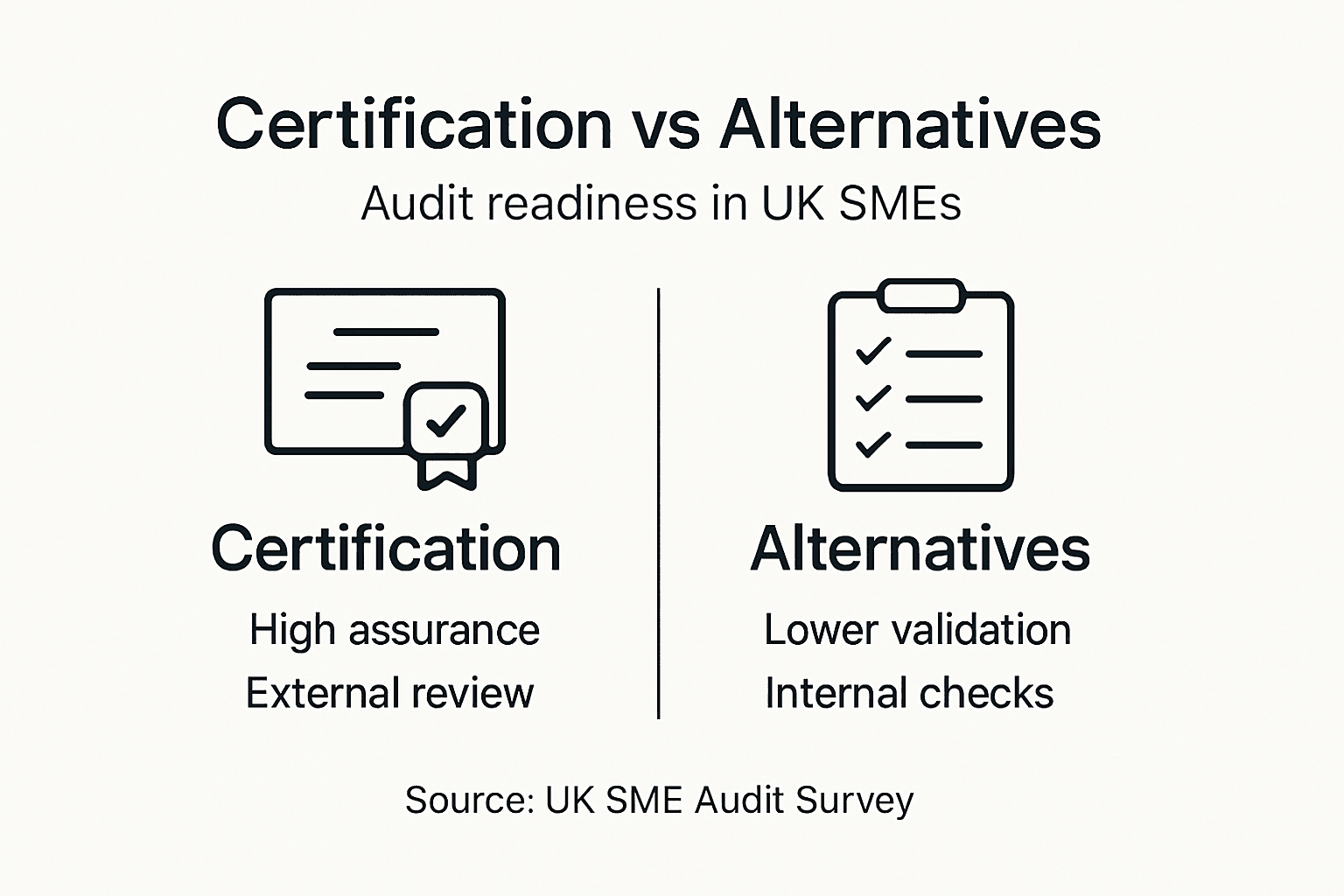
To support decision-making, here is a comparison of formal certification versus alternative audit-readiness strategies:
Approach | Level of Assurance | External Recognition | Resource Intensity |
Certification (e.g. ISO 27001) | Highest verification, third-party validated | Widely recognised by clients | Requires investment in time and cost |
Internal audit | Moderate, self-assessed | Limited, less client persuasive | Lower initial resource outlay |
Documentation-based | Basic, evidence-focused | Minimal, mainly for internal use | Ongoing maintenance required |
Pro tip: Combine multiple audit readiness strategies, using formal certification as a foundational framework and supplementing it with robust internal processes to create a comprehensive compliance ecosystem.
Common Mistakes and Strategic Solutions
In the complex realm of certification and compliance, UK SMEs frequently encounter critical pitfalls that can undermine their audit readiness and client trust. IT Security Checklist for Certification illuminates the nuanced challenges organisations face in maintaining robust security standards.
Common Certification and Compliance Mistakes:
Superficial Implementation: Treating certification as a box-ticking exercise
Inconsistent Documentation: Poorly maintained or outdated compliance records
Neglecting Ongoing Training: Failing to continuously update staff knowledge
Siloed Security Approaches: Disconnected security strategies across departments
Inadequate Risk Assessment: Incomplete or infrequent vulnerability evaluations
These mistakes often stem from a fundamental misunderstanding of certification’s strategic value. Many SMEs view compliance as a burdensome administrative task rather than a comprehensive framework for building organisational resilience and client confidence. The most successful organisations transform compliance from a regulatory requirement into a strategic competitive advantage.
Strategic solutions require a holistic approach that integrates robust documentation, continuous staff education, and dynamic risk management. This means developing a living compliance ecosystem that evolves with technological changes, regulatory shifts, and emerging security threats. Organisations must move beyond static compliance models to create adaptive, proactive security frameworks that demonstrate genuine commitment to protecting client interests.
Pro tip: Implement a quarterly compliance review process that treats certification as a continuous improvement journey, not a one-time achievement.
Transform Compliance Into Your Greatest Business Asset Today
For UK SMEs striving to build unshakable client trust through certification, tackling complex regulatory demands and maintaining continuous improvement can feel overwhelming. The article highlights key challenges like demonstrating rigorous security standards, managing risk effectively and avoiding superficial compliance that damages reputations. If your goal is to elevate certification from a mere box-ticking exercise to a strategic advantage that differentiates your organisation in competitive markets, then Freshcyber has the solution.
With our pioneering Compliance Currency Engine led by expert vCISOs, we guide you through tailored frameworks such as ISO 27001, Cyber Essentials, and GDPR with a hands-on approach. This ensures your compliance is more than paperwork: it becomes a living, breathing driver of client confidence and business growth. Our proactive risk management, continuous audit readiness and supply chain vetting take the burden off your shoulders so you can focus on scaling your SME securely.
Don’t let compliance complexity hold you back. Visit Freshcyber now to discover how we convert technical certification into measurable trust. If Cyber Essentials is your priority, our specialist services at Cyber Essentials ensure swift, managed certification that makes security your strongest sales asset. Act now to transform certification into currency for your business success.
Frequently Asked Questions
What is the importance of certification for UK SMEs?
Certification builds client trust by demonstrating an organisation’s reliability, security practices, and commitment to high operational standards, effectively differentiating them from competitors.
How do certifications like Cyber Essentials and ISO 27001 benefit small businesses?
These certifications enhance protection of client data, streamline compliance processes, and signal professionalism, ultimately leading to improved client relationships and competitive advantage.
What are common mistakes SMEs make in the certification process?
Common mistakes include treating certification as a box-ticking exercise, maintaining inconsistent documentation, neglecting ongoing training, and conducting inadequate risk assessments.
How can SMEs ensure they maintain compliance after certification?
SMEs should implement a quarterly compliance review process, focus on continuous improvement, and integrate robust staff training and dynamic risk management practices to adapt to regulatory changes and emerging security threats.
Recommended
Comments