Why Annual Security Audits Matter for UK SMEs
- Gary Sinnott

- Jan 23
- 18 min read

Each year, directors across British healthcare and financial SMEs face mounting pressure to prove their digital defences are strong enough to protect vital data and meet strict regulations. The challenge is knowing whether hidden gaps leave you exposed before a costly breach or investigation occurs. Annual security audits offer a systematic way to uncover vulnerabilities, demonstrate compliance, and build digital resilience, with the Cyber Security Breaches Survey confirming SMEs that conduct structured reviews are far better equipped to identify and address threats.
Table of Contents
Key Takeaways
Point | Details |
Conduct Annual Security Audits | Regular audits are crucial for identifying vulnerabilities, demonstrating compliance, and enhancing digital resilience in healthcare and financial SMEs. |
Understand Audit Types | Be aware of the different types of audits: vulnerability assessments highlight weaknesses, penetration testing confirms exploitability, and compliance audits ensure regulatory adherence. |
Establish a Remediation Framework | Develop a clear process to address audit findings, assign accountability, and ensure ongoing monitoring to improve security posture. |
Document Everything | Maintain thorough documentation of audit results and remediation actions to demonstrate diligence and compliance to regulators and stakeholders. |
Defining Annual Security Audits for SMEs
An annual security audit is a comprehensive, structured review of your organisation’s entire information security posture. For healthcare and financial SMEs, this means systematically examining your systems, processes, people, and policies to identify gaps, vulnerabilities, and opportunities for improvement. Unlike ad-hoc security checks, an annual audit follows a deliberate methodology and produces documented evidence of your security controls. Think of it as taking inventory of your digital defences once every year, rather than discovering problems only when something goes wrong.
The core purpose of an annual security audit is threefold. First, it detects vulnerabilities before attackers can exploit them, whether those vulnerabilities exist in your network infrastructure, cloud applications, or security policies. Second, it demonstrates compliance with regulatory frameworks relevant to your sector. In healthcare, you need to prove your GDPR compliance and alignment with NHS Digital standards. In financial services, you must show adherence to FCA regulations and PCI DSS if you handle card payments. Third, it creates an evidence trail for your board, your customers, and your insurers, proving that you take security seriously. This documentation becomes invaluable when you’re negotiating contracts or responding to client due diligence questionnaires. The Cyber Security Breaches Survey 2025 confirms that SMEs conducting systematic reviews of cyber security practices are significantly better equipped to detect threats and respond effectively. An annual audit typically involves assessing three key dimensions: technical controls (firewalls, encryption, access management), operational controls (incident response procedures, backup routines, change management), and governance controls (security policies, roles and responsibilities, risk management frameworks).
For your specific situation as a director in healthcare or financial services, understand what a real audit actually covers. It’s not simply running a vulnerability scanner and sending you a report. A proper annual security audit includes asset discovery (knowing everything connected to your network), threat identification (understanding what risks apply to your organisation), control testing (verifying that your existing security measures actually work), and risk evaluation (prioritising which issues pose the greatest danger to your business). A healthcare SME might discover that patient records aren’t encrypted at rest, or that your staff access controls don’t properly segregate duties between administrators and operators. A financial services firm might find that your multi-factor authentication isn’t enforced across all systems, or that your third-party vendor assessments are outdated. The audit captures these findings, quantifies the risks, and recommends remediation steps with timelines and priorities. This prevents the overwhelming situation where you don’t know where to start with improvements, because the audit tells you exactly which issues matter most.
Pro tip: Schedule your annual audit for the same period each year (often Q4), allowing time to remediate findings before your next cycle whilst maintaining momentum on improvements identified in previous audits.
Types of Audits and Key Differences
Not all security audits are created equal. As a healthcare or financial SME director, you need to understand the distinct types available because choosing the wrong one wastes money and leaves blind spots in your defences. The three main categories you’ll encounter are vulnerability assessments, penetration testing, and compliance audits. Each serves a different purpose, uses different methodologies, and produces different types of evidence. Vulnerability assessments are the foundation. These involve automated and manual scanning of your systems to identify weaknesses like unpatched software, misconfigurations, weak passwords, or missing security controls. A scanner runs against your network, identifies open ports, outdated applications, and known vulnerabilities in your systems. The output is typically a list of issues ranked by severity, telling you what’s broken but not necessarily whether an attacker could actually exploit those weaknesses to cause real harm. Think of it as a thorough health check of your infrastructure.
Penetration testing takes things further. Where a vulnerability assessment identifies weaknesses, penetration testing simulates what an actual attacker would do with those weaknesses. A penetration tester attempts to exploit vulnerabilities to gain unauthorised access, move laterally through your network, and access sensitive data. They stop before causing actual damage but prove whether those vulnerabilities represent genuine risk. For a healthcare SME, a penetration test might reveal that whilst your firewall has a known vulnerability, an attacker can’t actually reach it from the internet due to network segmentation. For financial services, it might show that your staff could be tricked into revealing credentials through social engineering, even though your technical controls are sound. Penetration testing and vulnerability assessments differ fundamentally in that the former simulates attacks whilst the latter identifies weaknesses without attempting exploitation. Penetration testing produces proof of exploitability, which is invaluable when justifying security investments to your board or demonstrating due diligence to regulators.
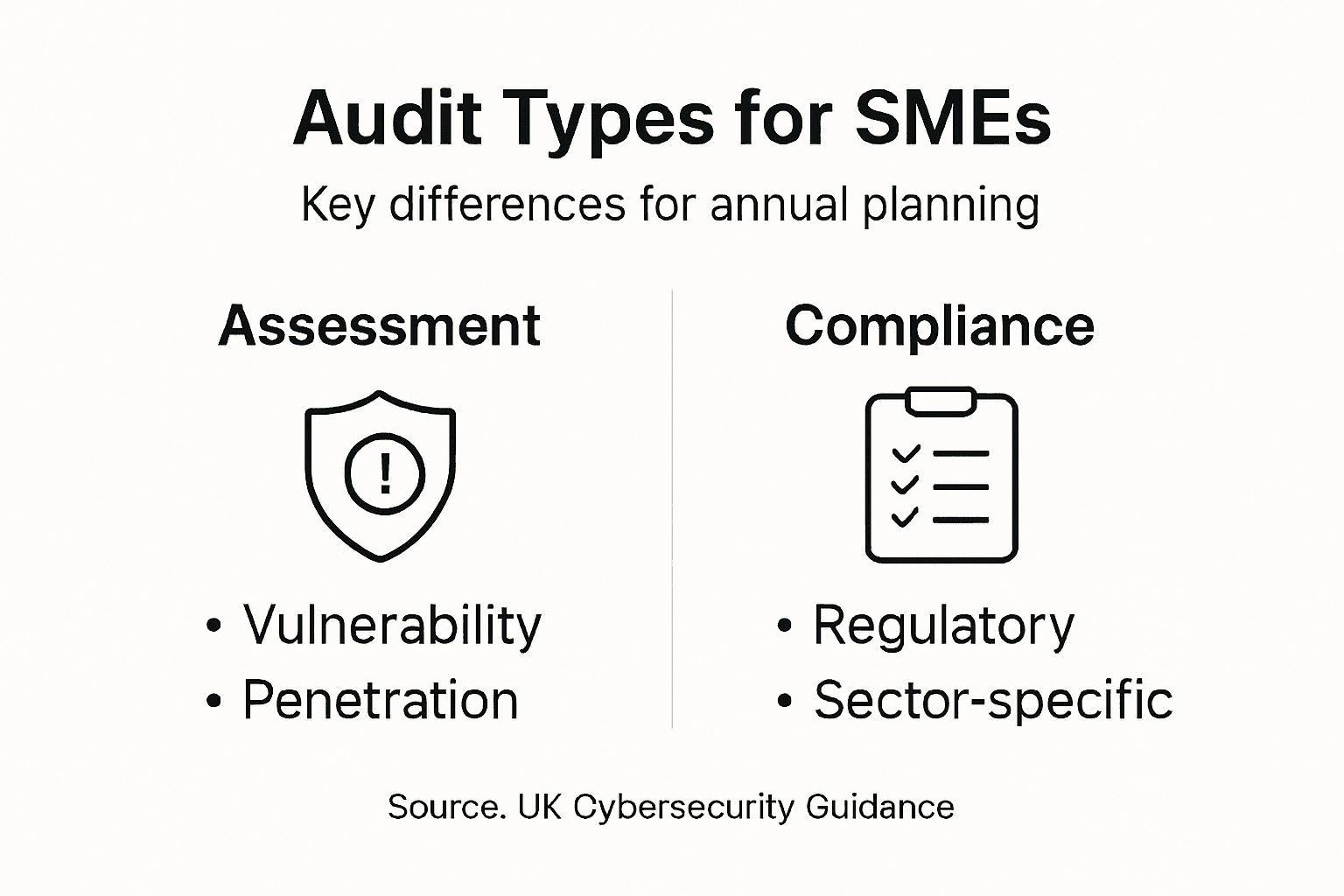
Compliance audits focus specifically on whether you meet regulatory requirements relevant to your sector. In healthcare, this means verifying that you comply with GDPR, NHS Digital standards, and data protection principles. In financial services, it means checking alignment with FCA regulations, PCI DSS (if handling card data), and anti-money laundering requirements. A compliance audit examines your policies, processes, and controls through the lens of specific regulatory frameworks. It produces documentation showing what you’ve done to meet obligations and where gaps exist. Unlike vulnerability assessments that focus on technical weaknesses, compliance audits examine governance, risk management, incident response procedures, and staff training. The key distinction is this: a vulnerability assessment tells you what’s technically broken, penetration testing proves it can be exploited, and compliance audits tell you whether you’re meeting legal obligations. Many SMEs make the mistake of thinking one audit type covers everything. They don’t. A healthcare provider might pass a compliance audit for GDPR but fail a penetration test because they haven’t properly secured their cloud backups. A financial services firm might identify dozens of vulnerabilities but discover through compliance audit that they lack proper vendor risk management processes entirely.
Here’s a practical framework for choosing: conduct a full security audit annually if possible. This combines vulnerability assessment, penetration testing, and compliance validation into one comprehensive review. For organisations with limited budgets, start with vulnerability assessments annually (identifying what’s broken), then rotate between penetration testing and compliance audits on alternate years. If you operate in healthcare or financial services with sensitive customer data, your risk profile demands at least vulnerability assessments annually plus penetration testing at least every two years. SME audits serve distinct purposes depending on whether your focus is financial verification, regulatory conformance, or cybersecurity resilience. Your choice determines what you’ll discover and what evidence you’ll hold when regulators ask what you’ve done to protect customer data and business continuity.
Here is a comparison of the main types of security audits and their outcomes for UK healthcare and financial SMEs:
Audit Type | Primary Focus | Typical Evidence Produced | Business Value |
Vulnerability Assessment | Identifying technical weaknesses | Ranked vulnerability report | Reveals urgent issues for remediation |
Penetration Testing | Proving exploitability | Proof of successful exploits | Justifies security investment |
Compliance Audit | Regulatory conformance | Documentation of policy alignment | Enables contract wins, reduces fines |
Pro tip: Start with a vulnerability assessment if you’ve never done a security audit before, then layer in penetration testing once you’ve remediated the obvious issues, ensuring you’re not paying for simulated attacks against infrastructure that still has basic security gaps.
How Audits Strengthen Digital Resilience
Digital resilience means your organisation can absorb, adapt to, and recover from cyber threats without losing critical functions. It’s not about preventing every attack (that’s impossible) but about reducing the time between when an attack happens and when you regain control. Annual security audits directly strengthen this resilience by creating a feedback loop of continuous improvement. Each audit identifies gaps in your defences, you remediate them, and the following year’s audit validates those improvements whilst uncovering new issues to address. This cyclical process embeds security into your culture and infrastructure rather than treating it as a one-time project. For healthcare SMEs, resilience means patients can still access their records and receive care even during a cyber incident. For financial services firms, it means transactions continue flowing and customer funds remain protected. Without regular audits, you’re essentially running your digital infrastructure blind, hoping nothing goes catastrophically wrong.

Here’s how audits specifically strengthen your resilience. First, they identify single points of failure you didn’t know existed. A healthcare provider discovers their entire patient database relies on one unencrypted server with no backup. A financial services firm learns that only one person knows the master password to critical systems. These aren’t theoretical risks—they’re active vulnerabilities that could cripple your business. Audits expose them before an attacker does. Second, audits validate your incident response capability. You probably have a disaster recovery plan, but have you tested it recently? An audit typically includes simulating an actual incident response scenario to see whether your team knows what to do, whether your backups actually work, and whether your communication procedures function under stress. Many organisations discover their backup restore process takes 48 hours when they’ve promised customers four hour recovery times. Third, audits quantify your actual risk profile, allowing you to prioritise spending on security improvements that matter most. A vulnerability assessment might identify 300 issues, but perhaps only 15 pose genuine risk to your business. The audit helps you distinguish between noise and genuine threats, preventing the paralysis of trying to fix everything at once.
The resilience benefit extends beyond technical controls into your entire organisation. Security audits provide expert guidance on risk mitigation and compliance, empowering your team to understand not just what’s broken but why it matters and how to fix it. Your staff learn about the threats you actually face, the data you need to protect, and their role in maintaining security. Over time, this creates a security conscious culture where people automatically think about risks when designing new systems or processes. A healthcare administrator doesn’t just book cloud storage because it’s convenient; they ask whether patient data will be encrypted and who holds the encryption keys. A finance team member reviewing a new payment processor doesn’t just look at cost; they verify the vendor’s security certifications and incident response procedures. This shift from security being an IT function to security being everyone’s responsibility is what genuine digital resilience looks like.
The practical path to building resilience through audits works like this. Year one, you conduct a comprehensive baseline audit identifying your current state. You’ll likely discover dozens of issues. That’s normal and actually positive because now you know what to fix. You remediate the high risk items throughout the year. Year two, the audit reveals which issues you’ve successfully addressed and what new vulnerabilities have emerged (perhaps from new software implementations or staff changes). You continue this cycle, each year getting stronger. By year three or four, your audit reports become shorter, your remediation times faster, and your confidence higher. You’re not eliminating risk entirely - that’s impossible - but you’re systematically reducing it whilst building organisational muscle memory around security practices. This is how SMEs move from basic compliance box-ticking to genuine digital resilience that protects your business, your customers’ data, and your reputation.
Pro tip: Document every audit finding and remediation action in a live risk register, updating it monthly; this creates accountability, prevents issues from being forgotten between audits, and gives your board real-time visibility into your security posture rather than relying on annual reports.
Compliance Requirements Under UK Law
You cannot ignore UK compliance requirements and hope nothing happens. For healthcare and financial services SMEs, the regulatory landscape isn’t optional guidance - it’s legally binding, with real penalties for non-compliance. Annual security audits aren’t just good practice; they’re a documented way to prove you’re meeting your legal obligations. The primary frameworks affecting UK SMEs are the General Data Protection Regulation (GDPR), the Data Protection Act 2018, and increasingly, the Network and Information Systems (NIS2) Directive. Healthcare organisations must also comply with NHS Digital standards and the Health and Social Care (Safety and Quality) Regulations. Financial services firms face obligations under FCA regulations, PCI DSS (if handling card payments), and the Proceeds of Crime Act for anti-money laundering. Each of these frameworks explicitly or implicitly requires you to conduct regular security assessments and maintain evidence of your controls. GDPR, for instance, requires you to implement appropriate technical and organisational measures to protect personal data. What’s “appropriate” is deliberately vague, which is where audits become your legal shield. An annual security audit with documented findings and remediation plans demonstrates to regulators that you took appropriate steps and exercised reasonable care. Without that documentation, if a breach occurs and regulators investigate, you’ll struggle to prove you did anything to prevent it.
The practical compliance landscape works like this. When you sign a contract with a major healthcare provider or financial institution, they’ll request evidence of your security controls. They’ll ask for audit reports, certifications like Cyber Essentials Plus, or evidence of ISO 27001:2022 compliance. Without recent audit evidence, you either can’t bid for these contracts or you lose them to competitors who can demonstrate stronger controls. For public procurement (contracts with NHS trusts, local authorities, central government), audit evidence becomes mandatory in many cases. Annual security audits form a critical part of maintaining compliance with UK laws such as the Data Protection Act and the Procurement Act 2023, ensuring you manage data securely and implement necessary controls to mitigate cyber risks. Beyond contracts, if you suffer a data breach affecting more than a handful of people, UK regulators will investigate. They’ll ask what controls you had in place to prevent it. They’ll ask whether you’d conducted security audits and whether your audit findings were addressed. If you can show a clean audit history with consistent remediation, you’re demonstrating diligence. If you can’t, regulators may escalate the investigation and consider fines or enforcement action. The Information Commissioner’s Office has issued guidance explicitly stating that organisations should conduct regular security audits and maintain records of those audits.
For healthcare specifically, the compliance requirements are particularly stringent. NHS Digital publishes an annual Data Security and Protection Toolkit (DSPT) that healthcare organisations must complete. Part of that toolkit involves certifying that you’ve conducted security assessments and have evidence to back those claims. If you’re a healthcare SME providing services to NHS trusts (data processing, IT support, cloud services), your clients will often require evidence of your DSPT compliance or equivalent third-party assessments. Many include audit requirements in their contracts. For financial services, the FCA explicitly requires firms to have a robust approach to cybersecurity risk management, which includes regular testing and assessment of controls. PCI DSS mandates annual penetration testing and quarterly vulnerability scanning for any organisation handling credit card data. These aren’t suggestions - they’re regulatory requirements with specific timelines and scopes defined. A financial services SME handling customer payments without annual penetration testing is technically non-compliant, regardless of whether they’ve been caught yet.
The compliance burden might feel overwhelming, but annual audits actually reduce your compliance risk substantially. You’re not trying to achieve perfection; you’re trying to demonstrate reasonable effort and continuous improvement. An audit showing 50 vulnerabilities is far better than no audit at all, because you’re proving you looked, you found issues, and you’re addressing them. Regulators understand that every organisation has vulnerabilities. What they don’t accept is organisations pretending they don’t exist. By conducting annual audits and documenting your remediation efforts, you’re building a compliance record that protects you legally, helps you win contracts, and demonstrates to customers and regulators that you take their data seriously. Think of it as insurance - you hope you never need to prove compliance, but when regulators ask or a breach occurs, that audit trail becomes invaluable.
Pro tip: Schedule your annual audit in a way that aligns with your contract renewal dates and regulatory submission deadlines; this ensures you have fresh audit evidence when clients request it and when you need to certify compliance to regulators.
Obligations and Risks for SME Directors
As an SME director, you carry personal accountability for cybersecurity governance that many directors don’t fully appreciate until something goes wrong. This isn’t just about company liability; it’s about your personal exposure. Under UK company law, particularly the Companies House filing requirements and director liability provisions, you have a duty to ensure your company has appropriate systems and controls in place to protect assets, including data and IT infrastructure. If your company suffers a significant data breach and it’s discovered that you didn’t implement reasonable security measures, you could face personal liability, regulatory censure, or reputational damage. Regulators like the Information Commissioner’s Office have explicitly stated they hold directors personally accountable for data protection failures. A healthcare director overseeing patient records without annual security audits isn’t just exposing their company to fines; they’re exposing themselves personally to enforcement action. A financial services director failing to implement penetration testing for systems handling customer funds is breaching their fiduciary duty to shareholders and potentially violating FCA rules that carry personal sanctions. The reality is stark: annual security audits are no longer optional for directors who want to demonstrate they’ve acted with reasonable care.
Your obligations as a director fall into three categories. First, governance responsibility. You must ensure your organisation has appropriate security policies, a clear risk management framework, and documented oversight of cyber risks. This doesn’t mean you personally write code or configure firewalls, but it means you’re accountable for ensuring someone is responsible for these things. Second, investment responsibility. You must allocate adequate resources to cybersecurity based on your organisation’s risk profile. A healthcare SME handling thousands of patient records needs more security investment than a consultancy without sensitive data. You can’t hide behind budget constraints if you’ve deliberately under-invested in security and then suffer a preventable breach. Third, oversight responsibility. You must receive regular updates on your organisation’s security posture, understand your key vulnerabilities, and track whether remediation efforts are progressing. Directors of SMEs are increasingly accountable for protecting company data and ensuring security governance frameworks are in place, with cybersecurity risk assessments and regular audits serving as practical tools to fulfil these obligations. Annual security audits give you documented evidence that you’ve met all three responsibilities. The audit report proves you understood your risks, you took steps to address them, and you tracked progress. That documentation becomes invaluable if regulators investigate or if shareholders challenge your security decisions.
The specific risks you face without annual audits are substantial. If your organisation suffers a data breach affecting customers, regulators will investigate. They’ll ask when you last audited your security. If you can’t produce an audit report from the past year or two, that itself becomes evidence of negligence. Regulators may issue a Monetary Penalty Notice, which can reach tens of thousands of pounds for SMEs. Beyond regulatory fines, you face reputational damage. Customers learn you didn’t bother conducting security audits, and they take their business elsewhere. You face civil liability if customers sue for damages resulting from the breach. You face potential criminal liability if the breach involved deliberate negligence or gross misconduct. Directors have been prosecuted under the Computer Misuse Act for failures to implement basic security controls. Additionally, cyber insurance policies often require evidence of regular security audits. Without documented audits, you may find your insurance claim denied if a breach occurs, leaving you personally exposed to liability. Professional indemnity insurance, if relevant to your sector, similarly requires security audit evidence. The insurance companies understand the risk; directors who don’t conduct audits are statistically more likely to suffer breaches.
The following table summarises the escalating risks for SME directors not conducting annual security audits:
Risk Type | Regulatory Impact | Financial Impact | Personal Exposure |
Data Breach Investigation | Possible enforcement action | Fines up to tens of thousands | Personal censure or sanctions |
Contractual Non-compliance | Loss of key contracts | Missed business or contract value | Director reputation damage |
Insurance Policy Denial | Rejected insurance claims | Out-of-pocket incident costs | Liability for losses |
The practical path forward is straightforward. Establish a governance structure where security is a board agenda item at least quarterly. Ensure someone on your leadership team (either internally or through a Virtual CISO arrangement) is explicitly responsible for security. Commission annual security audits and require that audit findings are presented to you with clear remediation timelines. Track remediation progress between audits. Document all of this. When auditors ask for evidence of your security governance, you’ll have audit reports, board minutes showing security discussions, and remediation records. This documentation doesn’t prevent breaches, but it proves you acted with reasonable care and exercised proper oversight. It shifts the liability narrative from negligence to a reasonable organisation experiencing an unfortunate incident. That distinction matters enormously when regulators investigate or when customers consider legal action. Your obligation as a director isn’t to eliminate all cyber risk (that’s impossible); it’s to demonstrate you understood your risks and took reasonable steps to manage them. Annual security audits are how you provide that evidence.
Pro tip: Request that your annual security audit report includes an executive summary specifically addressing governance and risk, then present this directly to your board with a remediation action plan; this demonstrates proactive director oversight and creates a clear record of your governance accountability.
Common Pitfalls and Effective Audit Planning
Most SMEs don’t fail because they conduct audits; they fail because they conduct audits badly or don’t act on the findings. The difference between an audit that drives real improvement and one that wastes time and money comes down to planning and follow-through. The most common pitfall is conducting an audit with no clear objective. You hire an external auditor, they spend a week scanning your network and testing systems, they produce a 200-page report with hundreds of findings, and then the report sits in a drawer. Nobody knows which issues actually matter to your business, nobody understands the remediation priorities, and nothing changes. This happens because the audit scope was never properly defined. Before you commission any audit, you need to articulate what you’re trying to achieve. Are you auditing for compliance with a specific framework like GDPR or PCI DSS? Are you identifying vulnerabilities in a particular system? Are you preparing for a contract where the client requires audit evidence? Different objectives require different audit types and scopes. A healthcare provider auditing for NHS Digital compliance needs different questions answered than a financial services firm auditing for FCA requirements. Vague objectives lead to audits that produce information but not actionable intelligence.
Another critical pitfall is treating audit findings as historical artefacts rather than action items. You receive the audit report, skim it, maybe send it to your IT manager, and then move on. Six months later, you haven’t addressed any of the high-risk findings because there’s no formal remediation process, no accountability for who’s fixing what, and no tracking mechanism. The audit becomes a checkbox exercise for compliance rather than a driver of actual security improvement. Effective audit planning prevents this by establishing a remediation framework before the audit even starts. You designate someone accountable for implementing audit findings. You establish monthly tracking meetings where remediation progress is reviewed. You create a live risk register where every finding is logged, scored, and tracked until closed. You communicate results to your board or leadership team so they understand what was found and what’s being done about it. Effective audit planning involves clearly setting objectives, involving relevant stakeholders, and establishing timelines for remediation, ensuring continuous follow-up embeds improvements in security practices. This transforms the audit from a compliance event into a continuous improvement cycle.
Another frequent mistake is failing to select the right audit type for your actual needs. Some organisations commission penetration testing when they haven’t yet remediated obvious vulnerabilities, wasting money testing defences that have easily fixable gaps. Others conduct basic vulnerability assessments annually without ever attempting exploitation testing, meaning they never really understand whether their vulnerabilities represent genuine risk. The solution is to understand your current maturity level and plan a multi-year audit strategy accordingly. Year one, conduct a comprehensive vulnerability assessment to establish your baseline. If you’ve never been audited before, you’ll discover dozens of issues. Prioritise remediation of high-risk findings. Year two, conduct another vulnerability assessment to validate improvements, then add penetration testing to understand exploitation risk. Year three, continue the cycle whilst adding compliance audits if you’re pursuing frameworks like ISO 27001. Effective audit planning necessitates understanding specific business risks and operational context, with risk-based audits tailored to size and complexity, ensuring auditors with relevant experience integrate results into broader risk management frameworks. This prevents the false economy of spending money on advanced testing before you’ve addressed fundamental vulnerabilities.
Practical audit planning requires these concrete steps. First, document your audit objectives in writing. What are you trying to validate? What frameworks are you targeting? What audience will see the results (regulators, customers, your board)? Second, define your audit scope precisely. Which systems, networks, or processes will be included? What’s explicitly out of scope? Third, select your auditor based on experience with your sector and frameworks. A penetration tester experienced with financial services payment systems is more valuable than a generic auditor if you’re a financial SME. Fourth, establish a remediation structure before the audit starts. Who owns remediation? How will progress be tracked? How often will you review findings? When will your next audit occur? Fifth, communicate audit results to relevant stakeholders. Your board needs a high-level executive summary. Your IT team needs detailed technical findings. Your compliance team needs evidence of controls. Different audiences need different presentations of the same data. Without this planning, you’ll commission audits that produce reports nobody acts upon, leaving you exposed to the same vulnerabilities year after year.
Pro tip: Schedule your annual audit for the same quarter every year, then allocate a two-week period immediately following the audit to conduct an initial triage meeting where your team assesses findings, assigns ownership, and creates a prioritised remediation roadmap; this prevents findings from being forgotten and creates momentum for implementation.
Strengthen Your SME’s Security Posture with Expert Guidance
Annual security audits reveal the gaps in your business’s digital defences and help you demonstrate compliance with essential frameworks such as GDPR, NHS Digital standards, and PCI DSS. For UK healthcare and financial SMEs, this means overcoming the challenge of understanding complex vulnerabilities, managing risk effectively, and proving your commitment to security to regulators and customers alike. If you struggle with analysing audit findings or prioritising remediation, Freshcyber offers a tailored approach through our flagship Virtual CISO (vCISO) service to lead your information security strategy and governance.

Take control of your cybersecurity today by partnering with Freshcyber. We provide strategic leadership and hands-on support including risk management, penetration testing, and compliance oversight aligned with frameworks such as ISO 27001 and Cyber Essentials. Don’t let audit reports sit unread or compliance become a source of stress. Visit Freshcyber to learn how our experts can help you transform audit insights into actionable improvements. Explore our resources on Compliance and Vulnerability Management to get started on building true digital resilience.
Frequently Asked Questions
What is an annual security audit?
An annual security audit is a comprehensive review of your organisation’s information security posture, which systematically examines systems, processes, and policies to identify vulnerabilities and areas for improvement.
Why are annual security audits important for SMEs?
Annual security audits help SMEs detect vulnerabilities before they can be exploited, demonstrate compliance with regulatory frameworks, and create a documented evidence trail that shows commitment to security, which is vital for contracts and insurance.
What types of audits should SMEs consider?
SMEs should consider conducting vulnerability assessments, penetration testing, and compliance audits. Each serves a different purpose, such as identifying technical weaknesses, proving exploitability, and ensuring regulatory adherence.
How do audits enhance an organisation’s digital resilience?
Audits enhance digital resilience by identifying single points of failure, validating incident response capabilities, and quantifying risk profiles, allowing businesses to improve their security posture continuously and recover effectively from cyber threats.
Recommended
Comments